Comprehensive Nuclear Test Ban Treaty in Geopolitics: CTBT Framework, Challenges & Impact of Non-Ratification
The Comprehensive Nuclear Test Ban Treaty (CTBT), adopted in 1996, seeks to establish a universal ban on all nuclear test explosions, thereby freezing the qualitative development of nuclear weapons. Although 187 countries have signed the treaty, its entry into force remains stalled due to the non-ratification by eight Annex-II states, including the United States, China, India, Pakistan, Israel, Iran, Egypt, and North Korea. This has created a strategic vacuum at a time when global nuclear inventories, though reduced from 65,000 warheads in the late 1970s to about 12,500 today, are witnessing renewed modernisation, rising geopolitical rivalries, and weakening arms-control architecture. The recent revival of rhetoric around nuclear testing underscores the fragility of the CTBT framework and its implications for global peace, stability, and non-proliferation.
1. CTBT’s Purpose and Its Relevance in Today’s Geopolitical Environment
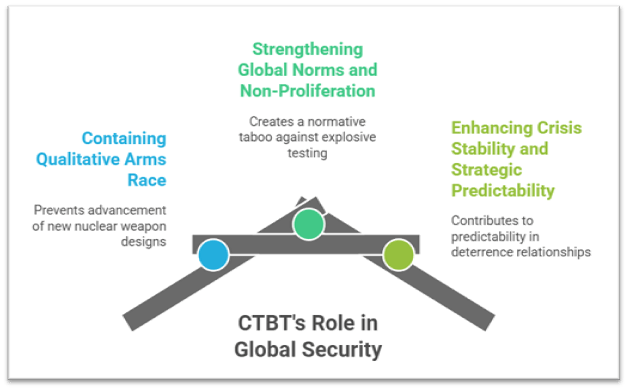
1.1 Containing Qualitative Arms Race
- By prohibiting explosive nuclear testing, CTBT aims to halt the advancement of new nuclear weapon designs. This is critical as major powers today are developing low-yield warheads, hypersonic delivery systems, and dual-use platforms that could lower the threshold for nuclear use.
- Case studies such as the development of nuclear-capable hypersonic glide vehicles demonstrate how the absence of a legally binding test ban accelerates competition among major powers.
- Initiatives like UN Security Council resolutions on non-proliferation and verification systems provide complementary guardrails, but their effectiveness is diminished without CTBT’s full implementation.
1.2 Strengthening Global Norms and Non-Proliferation
- Even without legal enforcement, CTBT has created a robust normative taboo against explosive testing, evidenced by the fact that no major nuclear power has conducted an explosive test since the 1990s.
- The International Monitoring System (IMS), comprising more than 300 stations, allows real-time detection of seismic, radionuclide or hydroacoustic signatures of any test, reinforcing deterrence against violations.
- Examples include the detection of North Korea’s six nuclear tests between 2006 and 2017, highlighting the network’s operational success in strengthening global transparency.
1.3 Enhancing Crisis Stability and Strategic Predictability
- CTBT contributes to predictability in deterrence relationships by preventing sudden leaps in nuclear capability, such as miniaturised thermonuclear weapons or exotic delivery systems.
- Real-life episodes like the Cuban Missile Crisis and the Kargil conflict reveal how nuclear ambiguity amplifies crisis instability; CTBT’s role in limiting technological surprise remains relevant.
- Confidence-building arrangements, including Hotline mechanisms, Strategic Stability Dialogues, and regional nuclear-risk reduction centres, derive greater meaning when embedded within a larger structure like CTBT.
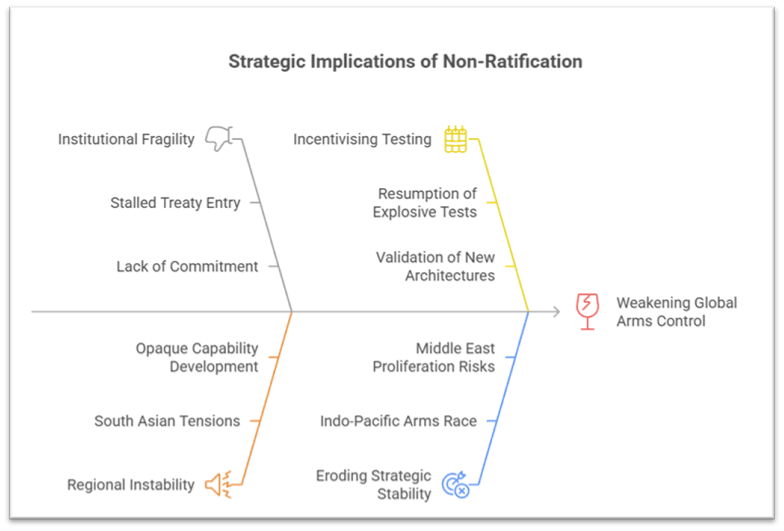
2. Strategic Implications of Non-Ratification
2.1 Weakening the Non-Proliferation Regime
- The absence of U.S., China, and India’s ratification stalls the treaty’s entry into force, signalling institutional fragility within global arms-control systems.
- Their non-ratification encourages regional instability, as seen in South Asia, where India and Pakistan maintain a voluntary moratorium but continue capability development under opaque conditions.
- The weakening CTBT framework undermines the NPT bargain, as non-nuclear states question the commitment of nuclear weapon states to genuine disarmament.
2.2 Incentivising Renewed Nuclear Testing
- Statements by major leaders signalling a possible resumption of testing risk triggering reciprocal explosive tests by Russia, China, India, and Pakistan.
- Case examples such as Russia’s testing of nuclear-powered cruise missiles and unmanned underwater delivery systems, or China’s rapid arsenal expansion, show how testing could validate new architectures.
- A shift from laboratory-based simulations to explosive testing could also embolden aspirant states that have remained restrained due to normative pressure.
2.3 Eroding Strategic Stability in Key Regions
- In the Indo-Pacific, unresolved rivalries make renewed testing particularly destabilising. China’s expanding arsenal, Pakistan’s tactical nuclear weapon programmes, and India’s need to validate thermonuclear and boosted-fission designs could create a cascading arms race.
- In the Middle East, non-ratification by Israel, Egypt, and Iran complicates the creation of a nuclear-weapon-free zone, raising proliferation risks.
- The Korean Peninsula, already volatile due to North Korea’s nuclear posture, could see increased testing and further doctrinal shifts if global norms erode.
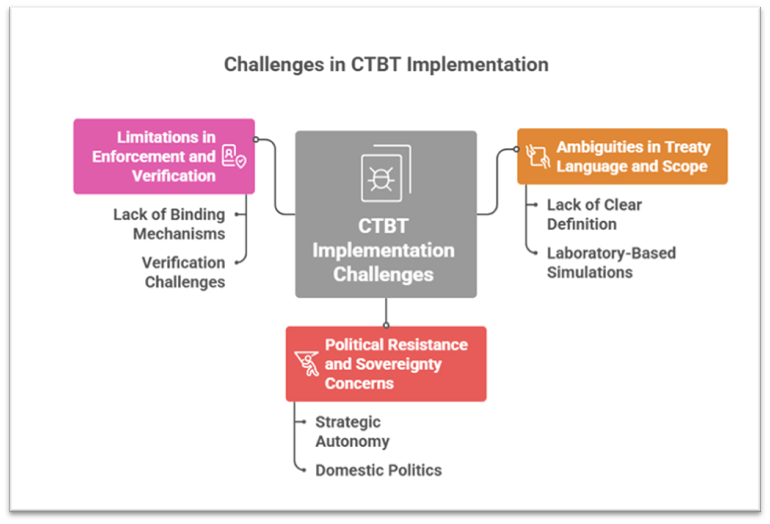
3. Policy, Legal, and Institutional Challenges in CTBT Implementation
3.1 Ambiguities in Treaty Language and Scope
- CTBT’s lack of a clear definition of “nuclear test explosion” allows states to conduct subcritical or zero-yield tests, creating loopholes for capability enhancement.
- Major powers conduct laboratory-based simulations under stockpile stewardship programmes, enabling weapon modernisation without explosive testing.
- This ambiguity erodes trust, as seen in periodic allegations of low-yield testing at certain sites, even if uncorroborated by monitoring networks.
3.2 Political Resistance and Sovereignty Concerns
- Some states perceive CTBT as a constraint on strategic autonomy, especially those with relatively few past tests who require additional validation of their designs.
- Real-life debates within the U.S. Senate on sovereignty, verification, and reliability of nuclear stockpiles illustrate how domestic politics obstruct ratification.
- Similar concerns in China, India, and Pakistan relate to regional threat asymmetries, complicating consensus even when moratoriums exist.
3.3 Limitations in Enforcement and Verification
- Although the IMS is technologically robust, CTBT lacks binding enforcement mechanisms, making compliance largely voluntary.
- Verification challenges persist in detecting very low-yield or evasively conducted tests, particularly in geologically complex regions.
- Without formal entry into force, the CTBT Organization lacks legal authority to mandate on-site inspections, limiting its deterrent value.
Conclusion:
The CTBT framework remains a cornerstone of the global non-proliferation and disarmament architecture, offering one of the most effective tools to prevent a dangerous qualitative nuclear arms race. Yet, its potential is curtailed by the non-ratification by key nuclear-armed states, whose strategic choices today will determine the future stability of the global nuclear order.
With the global nuclear arsenal projected to expand in the coming decade, and geopolitical contestation intensifying, revitalising CTBT’s credibility becomes imperative. A constructive path forward involves multi-power strategic dialogues, recommitment to moratoriums, strengthening verification technologies, and linking CTBT compliance to broader arms-control negotiations.
Upholding the taboo on nuclear testing is essential not only to prevent catastrophic escalation but also to sustain the fragile framework of global nuclear restraint that has held for nearly eight decades.
Recap: