
Climate Finance Challenges in South Asia: Barriers, Solutions & Future Pathways
Climate finance refers to funds mobilised to assist developing countries in mitigating greenhouse-gas emissions (mitigation) and adapting to the adverse effects of climate change (adaptation). In the case of South Asia, the urgency is enormous: the region needs roughly USD 97 billion annually for adaptation by 2021-2030 — equivalent to about 2.4% of GDP for the region. Despite this, only a fraction of the required funding is flowing, leaving a substantial finance gap for climate action.
In the context of the Paris Agreement and the developmental challenges facing South Asia, it becomes critical to understand the challenges South Asian countries face in accessing climate finance, and to suggest measures to overcome these obstacles.
Key Challenges in Accessing Climate Finance
1. Institutional and Capacity‐Related Constraints
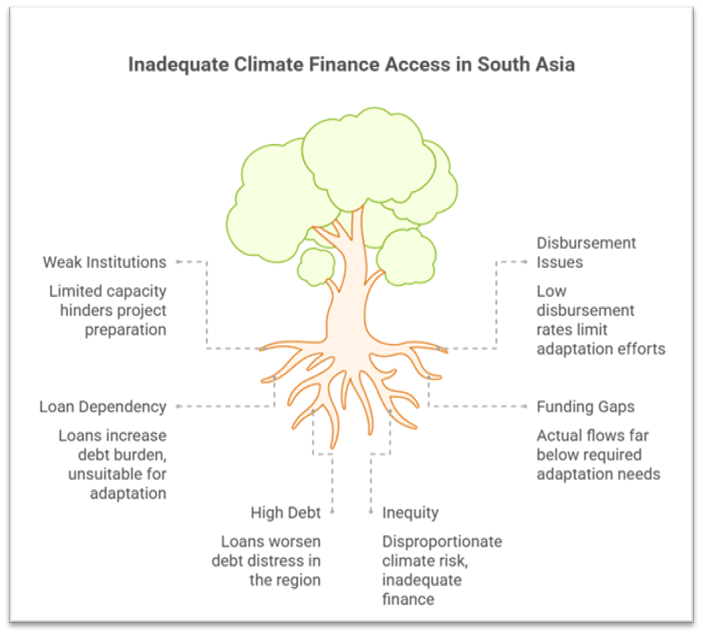
- Many South Asian countries face weak institutional readiness—limited ability to prepare bankable proposals or meet international fiduciary/safeguard standards.
- Fragmented policy frameworks and weak coordination across agencies delay project preparation and fund approval.
- Local-level institutions often lack technical expertise and financial management capacity, inhibiting effective fund absorption. (Example: Nepal’s rural project management systems remain weak)
2. Disbursement, Accessibility and Quality Issues
- In South Asia, only about 51% of allocated adaptation finance was actually disbursed in 2017–21, compared to ~79% in Sub-Saharan Africa.
- Most flows are loans, not grants. In Asia, around 85% of adaptation finance in 2023 were loans—unsuitable for public-good adaptation projects.
- Lack of predictability and flexibility of funds—complex procedures, high transaction costs, and rigid conditions hinder access.
3. Finance Magnitude, Equity and Debt Burden Concerns
- The scale of required adaptation finance (USD 40–205 billion annually) far exceeds actual flows.
- High debt burdens and limited fiscal space make loan-based financing risky for many countries.
- Equity issues persist—the region bears a disproportionate share of climate risks yet receives inadequate global finance flows.
Regional and National Examples
1. Bangladesh – Proactive Institutional Innovation
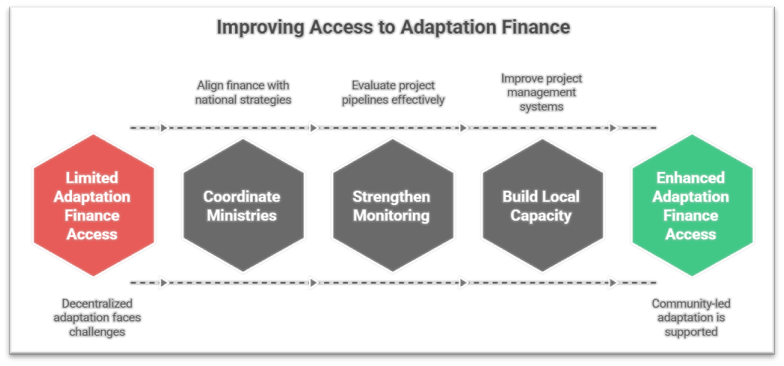
- Bangladesh launched the Bangladesh Climate Development Partnership (BCDP) aligning adaptation finance with national strategies like the National Adaptation Plan (2023–2050) and the Delta Plan 2100.
- Shows the value of building coordination platforms and project pipelines.
- Challenges remain for decentralised, community-led adaptation due to weak local capacities.
2. India – Fiscal Space vs. Preparedness
- While India aligns national priorities with climate finance frameworks, some states (e.g., Bihar, Uttarakhand) struggle to develop proposals and absorb funds.
- Frameworks like the Coalition for Disaster Resilient Infrastructure (CDRI) need deeper sub-national integration.
3. Nepal – Local Adaptation Finance Bottlenecks
- Local project management and devolved finance remain weak, limiting locally-led adaptation investment.
- Access issues span global, national, and community levels.
Measures to Enhance Access to Climate Finance
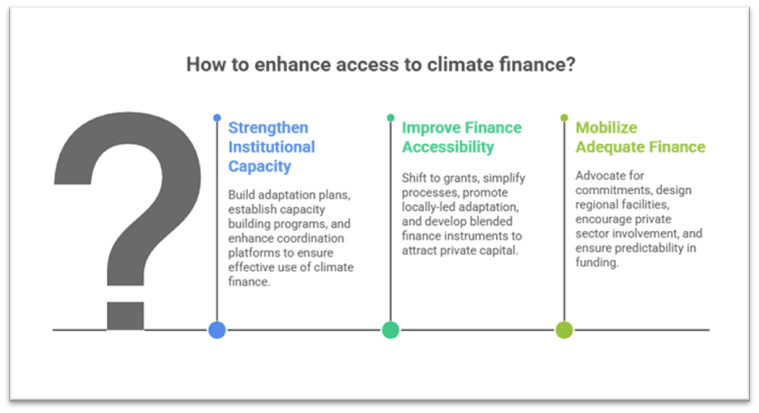
1. Strengthening Institutional and Governance Capacity
- Develop national and sub-national adaptation investment plans translating NDCs/NAPs into bankable projects (e.g., Bangladesh’s BCDP).
- Conduct capacity-building for ministries and local bodies to meet fiduciary standards, monitor, and report outcomes.
- Create inter-ministerial committees to align climate finance with development planning.
2. Improving Accessibility, Quality and Design of Finance
- Shift toward grants and concessional instruments instead of loans for adaptation projects.
- Simplify application processes and make finance accessible to smaller entities—local governments, NGOs, and communities.
- Encourage locally-led adaptation by integrating indigenous knowledge and participatory planning.
- Use blended finance, risk-sharing, and de-risking mechanisms to attract private investment.
3. Mobilising Adequate, Predictable Finance and Regional Cooperation
- Urge developed nations to meet and scale up climate finance commitments (e.g., USD 1.3 trillion annual target by 2035).
- Establish a regional climate-resilience finance facility in South Asia for pooled resources and shared best practices.
- Encourage private sector innovation—climate bonds, insurance for floods and heatwaves, PPPs for adaptation projects.
- Ensure predictability through multi-year funding commitments and transparent disbursement tracking.
Conclusion:
In the South Asian context, climate finance remains a linchpin for safeguarding development gains and protecting vulnerable populations from intensifying climate risks. The gap between need and actual flows is stark—estimated at USD 97 billion annually.
Yet, these challenges—from weak institutional capacity to debt pressures—are surmountable. A holistic approach focusing on governance strengthening, improved finance accessibility, and enhanced regional cooperation can bridge the divide.
As 90% of households in South Asia anticipate climate shocks in the next decade, inaction is not an option. With sustained reforms and commitments, the region can turn climate-finance challenges into opportunities for resilient, inclusive growth.
Recap: