

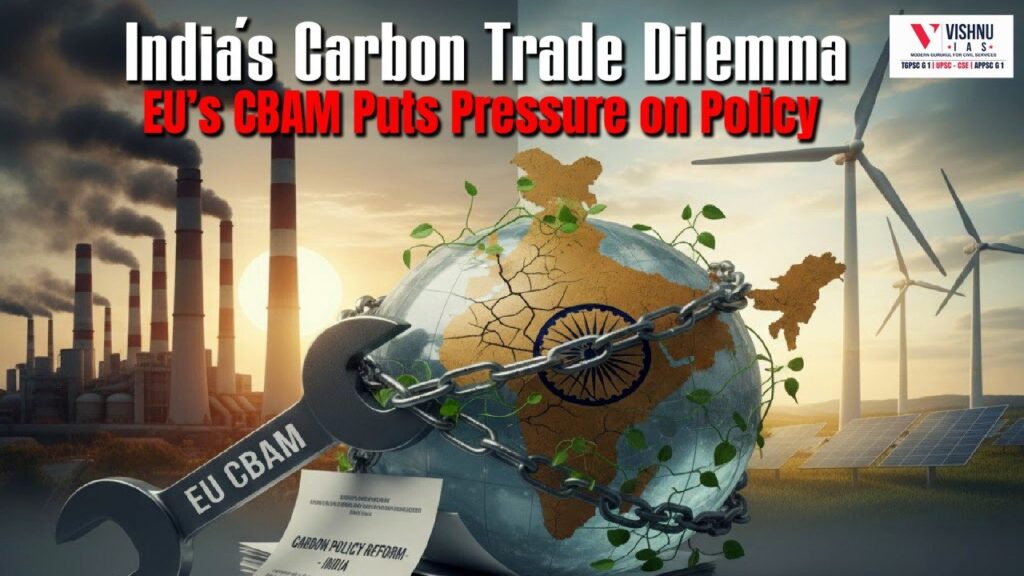
India EU CBAM alignment: Challenges in Aligning India’s Carbon Trading Framework with the EU’s CBAM
This analysis focuses on India EU CBAM alignment and examines the technical, legal, and operational challenges India may face when seeking recognition or linkage with the EU’s CBAM and ETS frameworks.
Introduction:
- The EU–India Joint Communication formalised a strategic agenda that explicitly foresees such a linkage as part of deeper cooperation on the clean transition, technology and trade. At present the EU’s emissions trading and CBAM environment is a mature compliance system with benchmark carbon prices in recent years in the range of roughly €60–€80/tonne (with volatility around those levels), while India’s nascent trading arrangements are still transitioning from intensity/project-based mechanisms to a compliance-cap system (CCTS) with much lower observed carbon credit prices and limited independent market infrastructure.
- CBAM allows deduction of a carbon price paid in the country of origin only where reliable actual emissions data and recognised domestic carbon pricing exist.
Body:
• 1. Technical and market-design challenges
A. Cap and accounting mismatch
- Absolute vs intensity basis: India’s legacy instruments (PAT, project offsets and early crediting) have often rewarded intensity improvements rather than absolute ton-for-ton caps; CBAM requires accurate embedded-carbon accounting (tonne CO₂e per product) for a credible deduction.
- Baseline setting and phase-in timing: India’s phased baseline methodology for the CCTS (using 2023–24 emissions data for first sectors) must produce stable, transparent sectoral baselines to avoid large reconciliation disputes at the border.
- Leakage and scope differences: If the Indian scheme excludes upstream or indirect emissions that the EU counts, exporters will face residual CBAM liability; sectoral misalignment (steel, cement, aluminium) is a high-risk area. (Government initiative: CCTS phased sectoral rollout for nine sectors from FY2025–26.)
B. Institutional and governance gaps
- Independent registry and verifier absence: The EU relies on independent registries and accredited verifiers; India needs a compliance-grade national registry, accredited third-party verifiers and transparent public registries to create trust. (Example/Case study: EU ETS registry model and registry audits.)
- Legal enforceability and penalties: CBAM treats credits from systems without strong compliance enforcement as inferior; India must legislate clear penalties, legal liability and administrative enforcement comparable to ETS rules.
- Conflict resolution & reciprocity mechanisms: Linked systems need bilateral procedures to resolve measurement, reporting and verification (MRV) disputes and to define when deductions are accepted or refused.
C. Price formation, market depth and fungibility
- Large price gap risk: Indian carbon prices (often observed far below EU levels) create a shortfall in the amount deductible under CBAM unless a negotiated floor or sectoral contracts bridge the gap.
- Market liquidity and hedging: Thin trading, limited futures/derivatives and shallow liquidity in India raise price-risk for exporters, compared with a deep EU EUA market where hedging exists.
- Fungibility and additionality: CBAM will scrutinise whether Indian credits represent real, additional and permanent emissions reductions; project-offset credits tied to marginal intensity gains may be discounted.
• 2. Legal, political and trade-policy challenges
A. WTO, sovereignty and precedent concerns
- Political contradiction and legal optics: Accepting CBAM deductions effectively recognises a mechanism that India has previously criticised at multilateral fora as potentially protectionist; this creates diplomatic friction and domestic political optics of legitimising a contested instrument. (Example/Case study: India’s WTO and UNFCCC positions on unilateral trade-related climate measures.)
- Sovereignty over domestic policy: CBAM’s conditional acceptance of domestic carbon pricing gives external actors a de-facto role in judging domestic policy adequacy—a red line for ministers defending policy space.
- Precedent risk: A linkage could set precedent for other trading partners and sectors; India must weigh long-term trade governance implications and possible legal disputes under WTO or investment treaties.
B. Domestic political economy and industry resistance
- Double burden fear: If EU regulators reject full deductions, exporters face both domestic compliance costs and full CBAM levies, creating strong industry pressure to weaken domestic compliance or seek exemptions. (Example/Case study: Indian steel exporters’ vulnerability because two-thirds of steel exports go to Europe.)
- Lobbying and regulatory rollback risk: Powerful sectors might push to water down CCTS compliance parameters; such backtracking would trigger CBAM exposure and trade instability.
- Compensation and social equity: Transition costs for energy-intensive industries require targeted finance, compensation mechanisms and skill programmes to avoid political backlash.
C. Dispute scenarios and escalation pathways
- Verification disagreements: If the EU deems India’s credits “insufficient”, exporters will seek redress—this risks rapid escalation to political or legal channels (WTO complaints, bilateral arbitration).
- Timing mismatches and sudden exposure: A domestic policy reversal or delay in strengthening MRV can immediately expose exporters to full CBAM charges, disrupting trade flows and investment planning.
- Need for joint safeguards: To prevent escalation, both parties need clear, time-bound remediation clauses, an agreed arbitration forum and technical assistance triggers.
• 3. Operational, capacity and financing constraints
o A. Measurement, reporting and verification (MRV) capacity
- Data quality and granularity: CBAM requires embedded carbon accounting at product/plant level; many Indian firms and regulators currently lack the plant-level data systems and standardised lifecycle accounting needed.
- Third-party accreditation and labs: India must scale accredited verifier networks, testing labs and standardised protocols to match EU expectations; this is resource and time intensive.
- Digital registries and transparency: A secure, interoperable digital registry (with audit trails) is essential to prove credits were not double-counted or double-sold.
B. Sectoral coverage, sequencing and transition finance
- Prioritising high-risk sectors: Early focus should be on steel, cement, aluminium and fertilisers — both because of CBAM scope and because these sectors have the largest trade exposure to the EU.
- Capital investment needs: Decarbonising heavy industry requires capital for low-carbon tech (EAF steel, CCS, alternative fuels); without concessional finance or public support, firms face competitiveness stress.
- Blended finance and transition contracts: Innovative instruments (sectoral carbon contracts for difference, concessional loans, blended public-private funds) can bridge the cost differential and incentivise early decarbonisation.
C. International technical support, capacity building and phased linkage design
- Technical assistance packages: The EU can provide technical support on MRV, registry design and verifier accreditation to fast-track India’s compliance capability. (Example/Case study: bilateral ETS linkages and technical assistance arrangements between developed partners.)
- Pilot linkage and recognition corridors: A pragmatic approach is sectoral pilot linkages or phased recognition (start with direct emissions, expand to lifecycle accounting) to build trust.
- Contingent financial safety nets: Mechanisms such as temporary price floors, partial rebates or adjustment assistance should be considered to avoid abrupt competitiveness shocks while the domestic market deepens.
Conclusion:
- Aligning India’s carbon trading framework with the EU’s CBAM is both a major opportunity and a complex governance project — it can protect exporters from double taxation, accelerate industrial decarbonisation and create a model for North–South carbon cooperation if India builds compliance-grade market architecture and the EU offers transparent, predictable recognition rules.
- The EU ETS has demonstrated that a mature compliance market supports carbon prices in the tens of euros per tonne and above, which is the benchmark CBAM uses for deductions; India’s policy package (CCTS) is an explicit attempt to move from intensity/project credits to compliance-grade instruments, but success depends on rapid scaling of MRV, registry and enforcement capacity.
- If India implements its phased CCTS baselines and institutional upgrades while securing EU technical recognition and transition finance, the linkage can shift from a theoretical breakthrough into an operational tool that shields exporters and drives faster domestic decarbonisation.
• 1. Technical and market-design challenges
A. Cap and accounting mismatch
- Absolute vs intensity basis: India’s legacy instruments (PAT, project offsets and early crediting) have often rewarded intensity improvements rather than absolute ton-for-ton caps; CBAM requires accurate embedded-carbon accounting (tonne CO₂e per product) for a credible deduction.
- Baseline setting and phase-in timing: India’s phased baseline methodology for the CCTS (using 2023–24 emissions data for first sectors) must produce stable, transparent sectoral baselines to avoid large reconciliation disputes at the border.
- Leakage and scope differences: If the Indian scheme excludes upstream or indirect emissions that the EU counts, exporters will face residual CBAM liability; sectoral misalignment (steel, cement, aluminium) is a high-risk area. (Government initiative: CCTS phased sectoral rollout for nine sectors from FY2025–26.)
B. Institutional and governance gaps
- Independent registry and verifier absence: The EU relies on independent registries and accredited verifiers; India needs a compliance-grade national registry, accredited third-party verifiers and transparent public registries to create trust. (Example/Case study: EU ETS registry model and registry audits.)
- Legal enforceability and penalties: CBAM treats credits from systems without strong compliance enforcement as inferior; India must legislate clear penalties, legal liability and administrative enforcement comparable to ETS rules.
- Conflict resolution & reciprocity mechanisms: Linked systems need bilateral procedures to resolve measurement, reporting and verification (MRV) disputes and to define when deductions are accepted or refused.
C. Price formation, market depth and fungibility
- Large price gap risk: Indian carbon prices (often observed far below EU levels) create a shortfall in the amount deductible under CBAM unless a negotiated floor or sectoral contracts bridge the gap.
- Market liquidity and hedging: Thin trading, limited futures/derivatives and shallow liquidity in India raise price-risk for exporters, compared with a deep EU EUA market where hedging exists.
- Fungibility and additionality: CBAM will scrutinise whether Indian credits represent real, additional and permanent emissions reductions; project-offset credits tied to marginal intensity gains may be discounted.
• 2. Legal, political and trade-policy challenges
A. WTO, sovereignty and precedent concerns
- Political contradiction and legal optics: Accepting CBAM deductions effectively recognises a mechanism that India has previously criticised at multilateral fora as potentially protectionist; this creates diplomatic friction and domestic political optics of legitimising a contested instrument. (Example/Case study: India’s WTO and UNFCCC positions on unilateral trade-related climate measures.)
- Sovereignty over domestic policy: CBAM’s conditional acceptance of domestic carbon pricing gives external actors a de-facto role in judging domestic policy adequacy—a red line for ministers defending policy space.
- Precedent risk: A linkage could set precedent for other trading partners and sectors; India must weigh long-term trade governance implications and possible legal disputes under WTO or investment treaties.
B. Domestic political economy and industry resistance
- Double burden fear: If EU regulators reject full deductions, exporters face both domestic compliance costs and full CBAM levies, creating strong industry pressure to weaken domestic compliance or seek exemptions. (Example/Case study: Indian steel exporters’ vulnerability because two-thirds of steel exports go to Europe.)
- Lobbying and regulatory rollback risk: Powerful sectors might push to water down CCTS compliance parameters; such backtracking would trigger CBAM exposure and trade instability.
- Compensation and social equity: Transition costs for energy-intensive industries require targeted finance, compensation mechanisms and skill programmes to avoid political backlash.
C. Dispute scenarios and escalation pathways
- Verification disagreements: If the EU deems India’s credits “insufficient”, exporters will seek redress—this risks rapid escalation to political or legal channels (WTO complaints, bilateral arbitration).
- Timing mismatches and sudden exposure: A domestic policy reversal or delay in strengthening MRV can immediately expose exporters to full CBAM charges, disrupting trade flows and investment planning.
- Need for joint safeguards: To prevent escalation, both parties need clear, time-bound remediation clauses, an agreed arbitration forum and technical assistance triggers.
• 3. Operational, capacity and financing constraints
o A. Measurement, reporting and verification (MRV) capacity
- Data quality and granularity: CBAM requires embedded carbon accounting at product/plant level; many Indian firms and regulators currently lack the plant-level data systems and standardised lifecycle accounting needed.
- Third-party accreditation and labs: India must scale accredited verifier networks, testing labs and standardised protocols to match EU expectations; this is resource and time intensive.
- Digital registries and transparency: A secure, interoperable digital registry (with audit trails) is essential to prove credits were not double-counted or double-sold.
B. Sectoral coverage, sequencing and transition finance
- Prioritising high-risk sectors: Early focus should be on steel, cement, aluminium and fertilisers — both because of CBAM scope and because these sectors have the largest trade exposure to the EU.
- Capital investment needs: Decarbonising heavy industry requires capital for low-carbon tech (EAF steel, CCS, alternative fuels); without concessional finance or public support, firms face competitiveness stress.
- Blended finance and transition contracts: Innovative instruments (sectoral carbon contracts for difference, concessional loans, blended public-private funds) can bridge the cost differential and incentivise early decarbonisation.
C. International technical support, capacity building and phased linkage design
- Technical assistance packages: The EU can provide technical support on MRV, registry design and verifier accreditation to fast-track India’s compliance capability. (Example/Case study: bilateral ETS linkages and technical assistance arrangements between developed partners.)
- Pilot linkage and recognition corridors: A pragmatic approach is sectoral pilot linkages or phased recognition (start with direct emissions, expand to lifecycle accounting) to build trust.
- Contingent financial safety nets: Mechanisms such as temporary price floors, partial rebates or adjustment assistance should be considered to avoid abrupt competitiveness shocks while the domestic market deepens.