
Women Judges in Supreme Court | Judicial Representation and Gender Equality
The Supreme Court of India, as the apex constitutional court, plays a pivotal role in safeguarding fundamental rights and constitutional morality. While the Court has often upheld progressive interpretations of gender justice—such as in Vishaka v. State of Rajasthan (1997) and Navtej Johar v. Union of India (2018)—its own institutional record of gender representation remains deeply inadequate.
Only 11 women judges have served in the Supreme Court since 1950, constituting a mere 3.8% of the 287 judges appointed. As of September 2025, Justice B.V. Nagarathna remains the sole woman judge on the Bench of 34, despite India having a female population of nearly 48% (Census projection 2021) and increasing participation of women in the legal profession.
This paradox—progressive rulings versus poor internal representation—raises concerns about judicial diversity, legitimacy, and public trust. The debate requires a nuanced discussion of both arguments: the need for women judges for substantive gender equality, and the counter-view that judicial merit and independence must not be subordinated to representational quotas.
Why Women Judges Matter for Judicial Representation
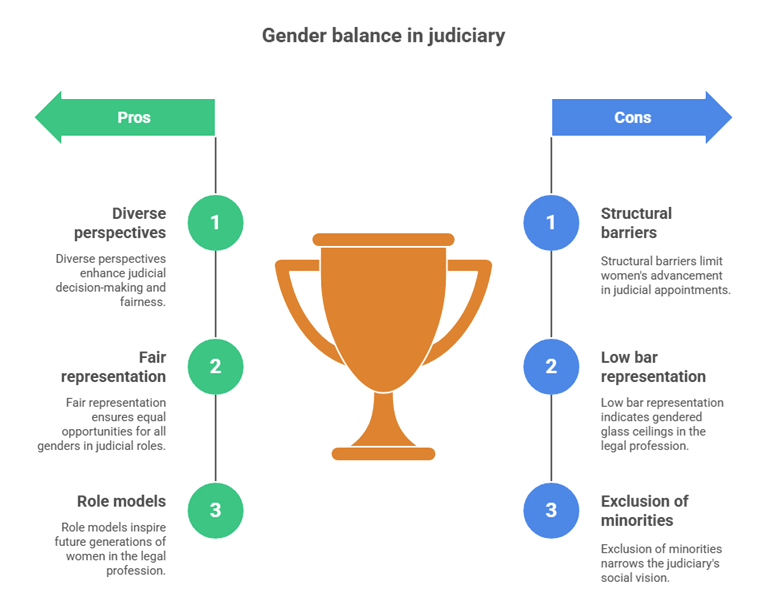
Reflecting Social Diversity
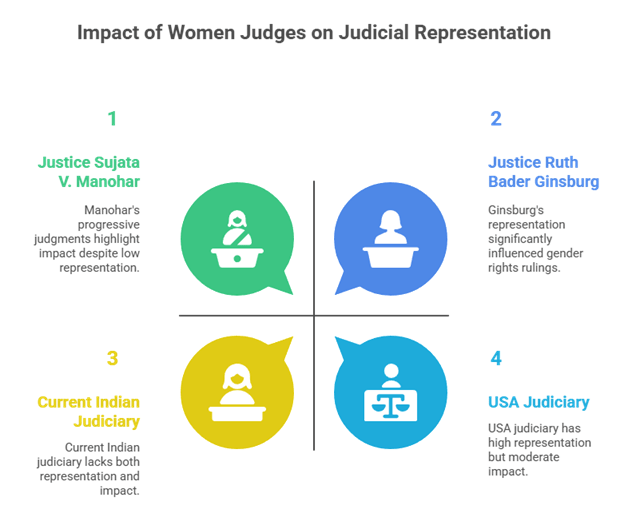
- A judiciary that mirrors society fosters legitimacy. Women’s representation in the Supreme Court (currently below 5%) contrasts with countries like USA (~36%) and UK (~27%).
- Case study: Justice Ruth Bader Ginsburg in the US Supreme Court influenced landmark gender rights rulings, underscoring how representation shapes outcomes.
- India’s own Justice Sujata V. Manohar authored progressive judgments on equality and social justice.
Unique Perspectives in Adjudication
- Women judges bring experiential knowledge of issues such as domestic violence, sexual harassment, and reproductive rights, enriching deliberations.
- Example: Justice Indu Malhotra’s dissent in Indian Young Lawyers Association v. State of Kerala (2018) highlighted religious freedom alongside gender rights.
- UN Women reports (2023) indicate that judicial gender diversity improves quality of justice delivery.
Building Public Trust in Institutions
- Greater representation enhances perceptions of fairness and inclusivity. Surveys by Centre for Social and Economic Progress (2024) indicate higher citizen trust in diverse institutions.
- The presence of women judges ensures the judiciary does not appear as an exclusively male preserve.
Challenges in Achieving Gender Balance
Structural Barriers in Judicial Appointments
- Women are often appointed late, limiting tenure and chances of reaching the Collegium or CJI position.
- Several women High Court judges were overlooked in the 2025 appointments, revealing systemic bias.
Low Representation from the Bar
- Only one woman (Justice Indu Malhotra) has been elevated directly from the Bar, while nine men have been.
- Highlights gendered glass ceilings in the legal profession.
- South Africa actively promotes women advocates to higher judiciary, ensuring a talent pipeline.
Caste, Religion, and Regional Exclusion
- Among 11 women judges, none have belonged to Scheduled Castes or Tribes, and only Justice Fathima Beevi represented a minority faith.
- This lack of intersectional representation deepens exclusion and narrows the judiciary’s social vision.
Debating the Case For and Against Gender-Based Appointments
Arguments in Favor of Institutionalised Gender Criteria
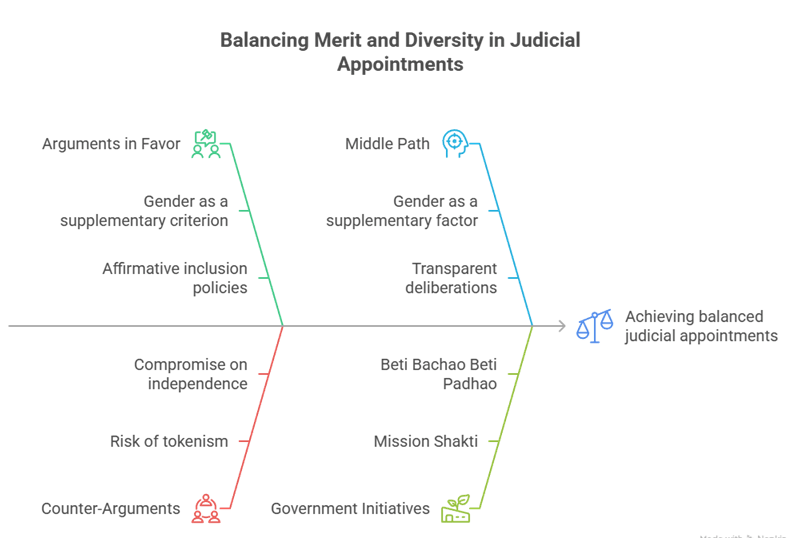
- Gender can be considered alongside seniority, merit, and regional diversity already factored in Collegium decisions.
- Transparent policies could institutionalize affirmative inclusion, similar to corporate boards (Companies Act, 2013).
- Canada’s Judicial Appointments Advisory Committee mandates gender as a criterion, enhancing diversity without compromising merit.
Counter-Arguments: Risks of Tokenism and Compromise on Independence
- Critics argue appointments must be based on legal acumen, integrity, and jurisprudential depth, not gender identity.
- Risk of token representation if gender becomes a formal quota.
- Former CJIs claim “availability of senior women” is limited, though challenged by women’s rights groups.
Middle Path: Balancing Merit with Diversity
- Gender should be supplementary, ensuring well-rounded diversity.
- Transparent publication of Collegium deliberations can balance merit and inclusivity.
- Government initiatives like Mission Shakti (2021) and Beti Bachao Beti Padhao highlight state commitment to gender empowerment.
Conclusion
The Supreme Court of India has often been the torchbearer of gender equality in jurisprudence, but its internal gender imbalance undermines credibility. With women constituting nearly half of India’s population yet only 3.8% of SC judges historically, the dissonance is stark. The way forward lies in institutionalised diversity policies, ensuring gender, caste, and regional representation are embedded into the Memorandum of Procedure.
As per World Bank’s 2023 Gender Equality Report, countries with inclusive institutions exhibit stronger public trust and better governance outcomes. If the Supreme Court aspires to embody the ideals of justice and equality it champions, appointing more women judges is not just desirable but necessary for democratic legitimacy.
Recap: