
Urban Noise Pollution in India: A Silent Public Health Crisis
Introduction
Urban noise pollution in India refers to the excessive or disturbing sound in urban areas that disrupts normal activities, harms health, and reduces quality of life. The World Health Organization (WHO) classifies environmental noise as the second largest environmental cause of health problems in Western Europe, after air pollution, highlighting its global importance.
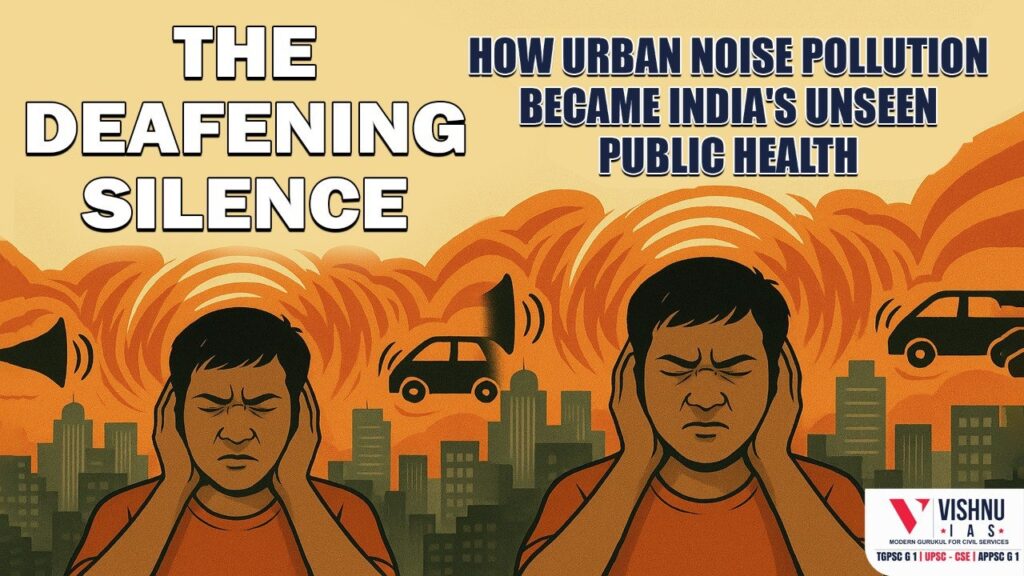
In India, the Central Pollution Control Board (CPCB) acknowledges that most cities routinely breach the prescribed decibel levels of 50 dB (day) and 40 dB (night) in silence zones, particularly around schools and hospitals. The National Ambient Noise Monitoring Network (NANMN), launched in 2011, was meant to provide real-time monitoring, but enforcement remains weak. This situation has been described as a “silent public health crisis,” as civic fatigue and fragmented governance perpetuate inaction despite the constitutional guarantees of dignity under Article 21 and environmental protection under Article 48A.
Health And Social Dimensions
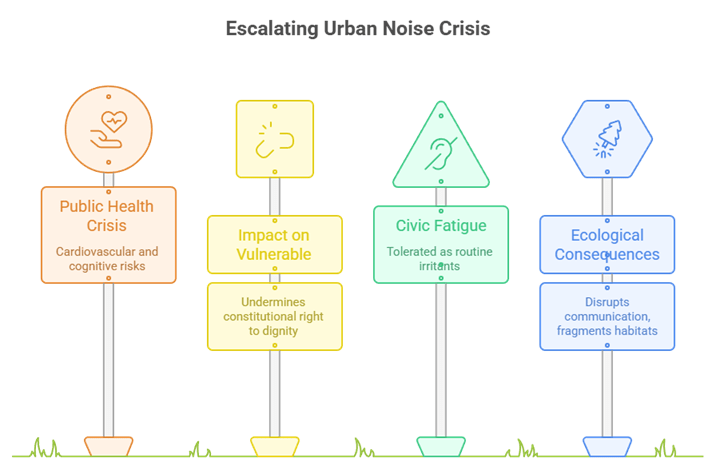
- Public Health Crisis: Chronic exposure to noise above 65–70 dB, as observed in Delhi and Bengaluru near sensitive zones, leads to hypertension, cardiovascular risks, sleep disorders, and impaired cognitive development in children. WHO 2018 guidelines link long-term noise exposure with increased risk of heart disease and depression. Example: A 2025 University of Auckland study found that one night of urban noise altered bird song complexity, indirectly signalling risks to human health.
- Impact on Vulnerable Groups: The elderly, children, and hospital patients are disproportionately affected. Supreme Court in Noise Pollution (V), In Re (2005, reaffirmed 2024) recognised unchecked noise as a violation of Article 21. NFHS-5 data highlights rising non-communicable diseases worsened by stressors like noise exposure.
- Civic Fatigue and Normalisation: Honking, drilling, and loudspeakers are seen as routine rather than violations. Unlike smog or waste, noise leaves no visible residue, reducing public outrage. Example: Mumbai’s “No Honking Day” had symbolic success but lacked continuity.
- Ecological Consequences: Noise disrupts communication patterns in birds, frogs, and pollinators, fragmenting habitats and worsening biodiversity decline. Example: 2025 study on common mynas showed disrupted song patterns due to urban noise.
Governance And Regulatory Dimensions
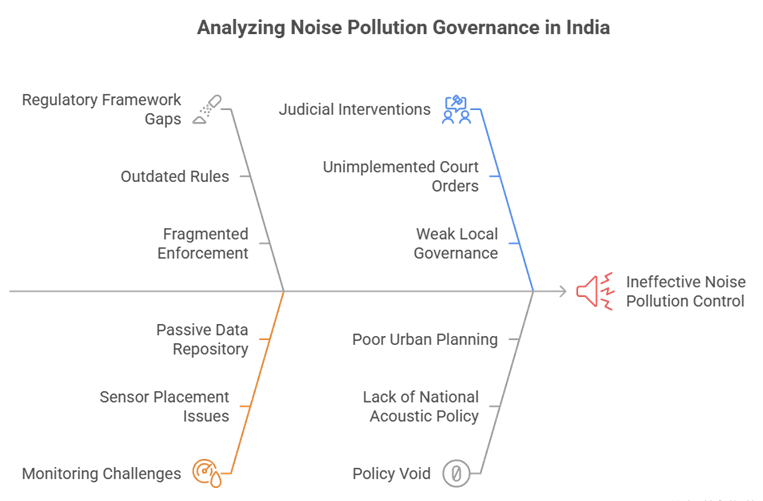
- Regulatory Framework Gaps: The Noise Pollution (Regulation and Control) Rules, 2000 prescribe standards but lack updates and enforcement. Responsibility is fragmented across municipal bodies, traffic police, and SPCBs. RTI data in 2025 showed states like Uttar Pradesh withheld quarterly noise data.
- Monitoring Challenges: Many NANMN sensors are installed at 25–30 feet against CPCB guidelines, producing unrepresentative data. Instead of real-time enforcement, NANMN acts as a passive repository. In contrast, the EU estimated €100 billion annual costs in 2023, spurring reforms.
- Judicial Interventions: The Supreme Court (2024) reaffirmed that unchecked noise violates Article 21. High Courts (e.g., Allahabad HC, 2023) banned loudspeakers beyond permissible levels. Yet, implementation remains weak.
- Policy Void: India lacks a National Acoustic Policy. Urban planning ignores acoustic resilience. Inter-agency synergy is absent, leading to fragmented, symbolic action.
Cultural And Policy Solutions
- Sonic Empathy and Awareness: Awareness must move beyond slogans to immersive education. Example: Seatbelt campaigns in the 1990s transformed behaviour. Driver schools, curriculums, and civic workshops should inculcate noise sensitivity.
- Decentralised Enforcement: Local bodies should use NANMN data for targeted enforcement. Linking monitoring with penalties ensures compliance. Example: Barcelona’s 2022 Noise Action Plan integrates citizen complaints with real-time monitoring.
- Urban Design for Silence: City planning must integrate buffer green zones, acoustic barriers, and noise-friendly materials. Smart Cities Mission (2015) should embed noise management in sustainability indicators.
- Integrated National Framework: India needs a National Acoustic Policy with zoning standards. Audits, grievance redressal, and transparent data-sharing must be mandated. Lessons can be drawn from the EU Environmental Noise Directive (2002/49/EC).
Conclusion:
Urban noise pollution in India is a silent but pressing public health and ecological crisis, undermining both constitutional rights and quality of life. While legal frameworks exist, regulatory fragmentation and civic fatigue hinder progress. According to World Bank (2024), environmental degradation including noise costs India nearly 5.7% of GDP annually. A rights-based, multi-agency, and culturally sensitive approach—decentralising monitoring, embedding noise resilience, and cultivating sonic empathy—is essential.
If India aims to build truly “smart cities”, they must also be quiet cities, where silence is not imposed but enabled through design, governance, and civic responsibility.
Recap: