
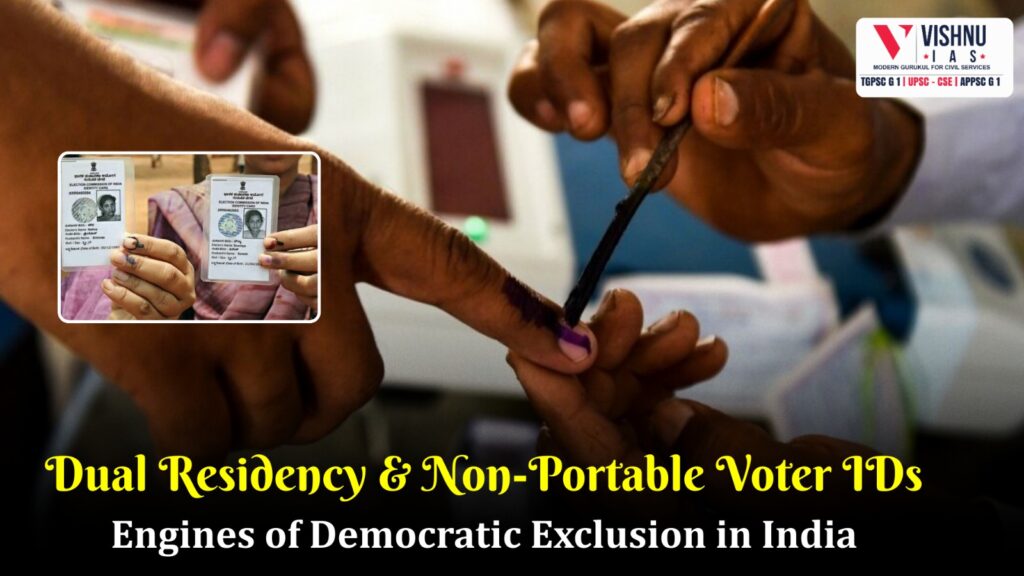
Dual Residency and Lack of Portability in Voter Identity: Democratic Exclusion in India
In a democracy as vast as India, with 1.4 billion citizens and over 96 crore registered voters (ECI, 2024), the principle of universal adult franchise (Article 326 of the Constitution) is foundational. Yet, millions of internal migrants face structural exclusion due to the dual residency and lack of portability in voter identity systems. This dual residency dilemma arises when migrants economically belong to one state (destination) but politically remain tied to another (origin). The absence of a portable voter identity system deepens this exclusion. A 2015 TISS-ECI study on Inclusive Elections in India confirmed that migrant workers face a “triple burden” of administrative barriers, digital illiteracy, and social exclusion. Recent developments such as Bihar’s Special Intensive Revision (2025), leading to the deletion of 3.5 million voters (4.4% of total electorate), highlight how rigid electoral infrastructure excludes migrants.
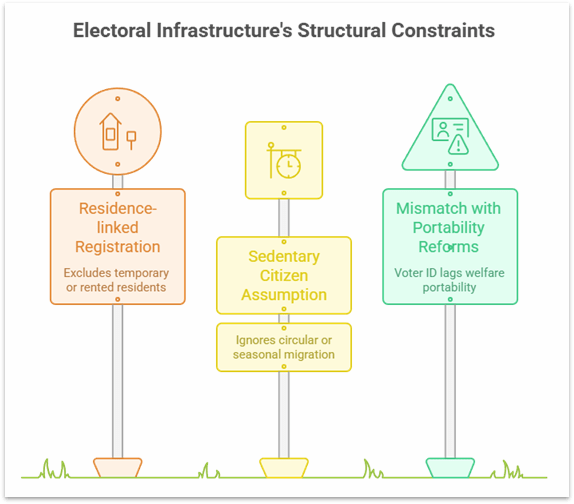
Structural Constraints in Electoral Infrastructure
- Residence-linked Registration – Voter registration in India is tethered to proof of residence and in-person verification, excluding migrants living in temporary shelters, slums, or rented rooms. Example: Migrant workers in NCR or Surat often lack proof of residence at their destination, leading to exclusion. Schemes such as SVEEP have attempted outreach but remain limited in targeting mobile populations.
- Sedentary Citizen Assumption – Electoral laws are designed around the notion of a stationary citizenry. The Representation of People Act, 1950, mandates registration at a “place of ordinary residence,” ambiguous for circular migrants. Example: Migrants from Bihar and UP working in Punjab’s agriculture often miss roll revisions due to seasonal absence.
- Mismatch with Other Portability Reforms – Initiatives like ONORC show portability in welfare delivery, yet voter identity portability lags. Case Study: Kerala’s Migration Survey model demonstrates how mapping mobile populations can prevent such exclusions.
Democratic Deficit and Electoral Participation
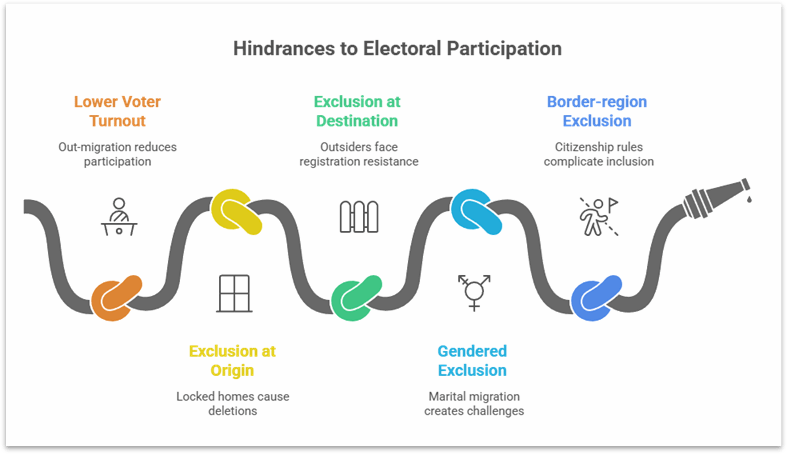
- Lower Voter Turnout in Migrant-heavy States – Bihar averages 53.2% turnout, below Gujarat (66.4%) or Karnataka (70.7%). The TISS-ECI 2015 study confirmed a correlation between migration intensity and turnout.
- Exclusion at Both Origin and Destination – Locked homes during enumeration lead to deletions (e.g., Bihar SIR, 2025). At destinations, migrants are viewed as outsiders and face resistance due to fears of demographic shifts.
- Gendered and Border-region Exclusion – Women migrants face disenfranchisement due to documentation challenges and dependency on marital homes. Case Study: The “Roti-Beti ka Rishta” tradition in Bihar-Nepal borderland complicates electoral inclusion.
Policy Gaps and Institutional Responses
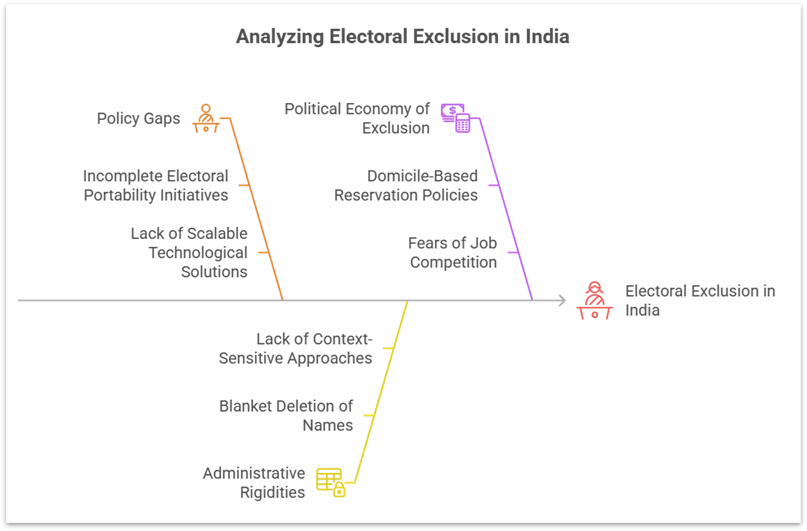
- Incomplete Electoral Portability Initiatives – The ECI’s Remote Voting Machine (RVM) pilot (2023) aimed to enable migrant voting but stalled. Comparative Example: The Philippines has absentee voting for overseas workers, which India lacks domestically.
- Administrative Rigidities – Blanket deletions during revisions undermine Article 326’s guarantee of adult franchise. Example: Bihar’s SIR, 2025 disenfranchised seasonal returnees during festivals.
- Political Economy of Exclusion – Host states discourage migrant registration due to domicile-based quotas and fears of job competition. Electoral exclusion intertwines with economic exclusion, deepening regionalism. Case Study: Haryana and Maharashtra domicile quota debates reflect this hesitation.
Conclusion
The dual residency and lack of portability in voter identity systems have created a silent crisis of democratic exclusion in India, disproportionately affecting the poor, mobile, and vulnerable. With 7 million annual circular migrants from Bihar (2025 data), the risk of large-scale disenfranchisement looms. The way forward lies in portable voter IDs, cross-verification of rolls, and replicating Kerala’s migration survey model. Unless systemic reforms are introduced, India risks alienating millions from its democratic record. A flexible, portable, and inclusive electoral system—much like ONORC in welfare—is the only sustainable path to strengthen partici
Recap: