
Introduction:
Right to Repair refers to the legal right of consumers to repair and modify the products they own, especially electronics and appliances, by providing access to parts, manuals, and diagnostics. It is globally recognized as a crucial pillar in achieving a circular economy, which emphasizes reuse, repair, and resource efficiency over linear “take-make-dispose” production models.
As per Global E-Waste Monitor 2024, India generated 1.6 million tonnes of e-waste in 2021-22, ranking it the third-largest e-waste generator globally. According to the iFixit 2023 Report, only 23% of smartphones sold in Asia are easily repairable due to restrictive designs.
In response, India introduced its Right to Repair framework in 2022 and launched a national Right to Repair portal in 2023 covering electronics, automobiles, and farming equipment, aligning with UN Sustainable Development Goal 12 (Responsible Consumption and Production). However, the impact of this initiative on sustainability and circularity requires a balanced and detailed evaluation.
Positive Contributions of Right to Repair to Circular Economy and Sustainability
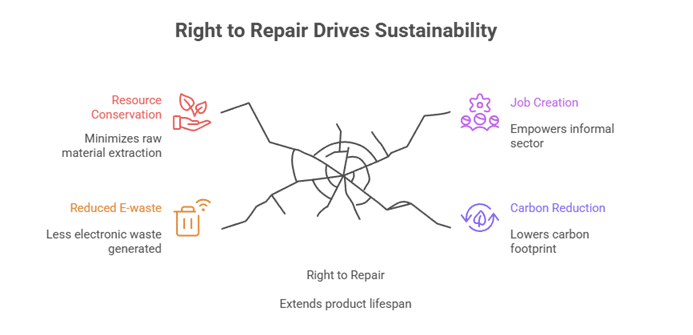
1. Reducing E-Waste and Resource Extraction
- Extension of Product Life: Allowing consumers and informal repairers to fix devices delays disposal, directly reducing e-waste. For instance, technicians in Delhi's Karol Bagh and Chennai’s Ritchie Street extend device life well past their planned obsolescence.
- Reduced Raw Material Demand: Frequent device replacements increase demand for rare earth elements. By promoting repair, India can minimize resource extraction, conserving finite materials like cobalt and lithium.
- Supporting National Policies: The E-Waste (Management) Rules, 2022, based on Extended Producer Responsibility (EPR), complement the Right to Repair by mandating eco-friendly product disposal, though repair is still under-emphasized.
2. Empowering Informal Sector and Job Creation
- Preservation of Tacit Knowledge: Informal repair work, often passed through observation and mentorship, sustains a reservoir of skill-based employment.
- Local Employment Opportunities: Repair economy provides work for lakhs, reducing urban unemployment. For example, Ritchie Street alone employs over 3,000 informal repairers.
- Alignment with Skill India Mission: While PMKVY focuses on formal skilling, inclusion of tacit repair work within vocational curricula can bridge the informal-formal gap and increase employability.
3. Promoting Sustainable Consumption Patterns
- Behavioural Shift Towards Reuse: Right to Repair can alter consumer habits from disposability to responsible consumption, aligning with Mission LiFE (Lifestyle for Environment).
- Incentivising Responsible Choices: New policy suggestions (May 2025) include a Repairability Index, encouraging users to choose repair-friendly products.
- Digital Public Infrastructure Synergy: Integration with platforms like e-Shram can digitally recognize and support informal repairers, ensuring social protection and policy inclusion.
4. Environmental Benefits and Carbon Reduction
- Lower Carbon Footprint: Repairing instead of manufacturing new devices reduces embodied carbon emissions. According to the European Environment Agency, electronics repair can reduce GHG emissions by up to 80% per device.
- Circularity in Design: Concepts like 'designing for unmaking' ensure that breakdowns become learning feedback loops rather than terminal ends.
- Global Best Practices: The EU’s 2023 Directive mandates repairability and access to spare parts, which India can emulate through procurement guidelines and regulatory design standards.
Limitations And Gaps in Current Implementation
1. Limited Policy Integration Across Ministries
- Narrow Scope: The existing Right to Repair portal is limited in accessibility and scope, without mandatory legal obligations on manufacturers.
- Lack of Inter-Ministerial Synergy: Coordination is missing between MeitY, MoSPI, MoLE, and MSDE in embedding repair into policy, procurement, and skilling.
- Missed NEP 2020 Alignment: Despite NEP’s emphasis on experiential learning, there is no targeted push to institutionalize tacit repair knowledge.
2. Industry Pushback and Manufacturer Resistance
- Restrictive Design Norms: Proprietary designs and software locks prevent third-party repair.
- Lack of Manufacturer Incentives: No binding laws to compel companies to adopt repair-friendly standards.
- Repair Monopolies: High-cost authorized service centres reduce accessibility for common consumers.
3. Invisibility of Informal Repair Sector
- No Formal Recognition: Informal repairers are excluded from national workforce data and benefit schemes.
- No IP Acknowledgement: Improvisational skills of repairers are unrecognized, even when AI leverages them.
- Urban-Centric Initiatives: Semi-urban and rural repair ecosystems remain unsupported.
4. Consumer Awareness and Behavioural Barriers
- Low Awareness: Consumers are unaware of their repair rights or the environmental benefits of repair.
- Negative Perceptions: Repaired goods are often perceived as low-quality.
- Trust Deficit: Lack of trust in informal technicians due to absence of certification mechanisms.
Potential Pathways for Enhancing Effectiveness
1. Institutional and Regulatory Reforms
- Repairability Index: Enforce a legal repairability score on all electronics.
- Public Procurement Reform: Prioritize repairable products on Government e-Marketplace (GeM).
- Codify Tacit Knowledge: Use AI and LLMs to document indigenous repair practices responsibly.
2. Inclusive Skilling and Recognition Framework
- Formal Certification: Use RPL to certify and upgrade skills of informal repairers.
- Community Repair Labs: Establish rural labs via public-private partnerships.
- Curriculum Innovation: NEP 2020 should incorporate repair ecosystems in experiential learning.
3. Consumer Awareness and Digital Literacy
- Awareness Campaigns: Launch nationwide awareness programs about Right to Repair and sustainability.
- School Curriculum Integration: Promote repair education via eco-clubs and projects.
- Digital Mapping Platforms: Build apps to connect consumers with local trusted repairers.
4. Technological and Design Innovations
- AI Diagnostics: Develop AI tools to guide consumers through basic repair.
- Design Mandates: Enforce standards for modular, disassemblable devices.
- Startup Support: Encourage repair-tech startups via government grants and incubators.
Conclusion:
In evaluating the role of the Right to Repair in promoting circular economy and sustainability, it is clear that the initiative holds transformative potential. It can reduce e-waste, empower grassroots livelihoods, and catalyse sustainable consumption — all pillars of the circular economy.
However, its impact is currently limited by regulatory gaps, industrial resistance, lack of integration with informal sectors, and poor awareness. To truly mainstream repair into India’s sustainability vision, inter-ministerial coordination, community recognition, and inclusive innovation are essential.
India’s technological future, if truly inclusive and sustainable, must be rooted
Recap: