
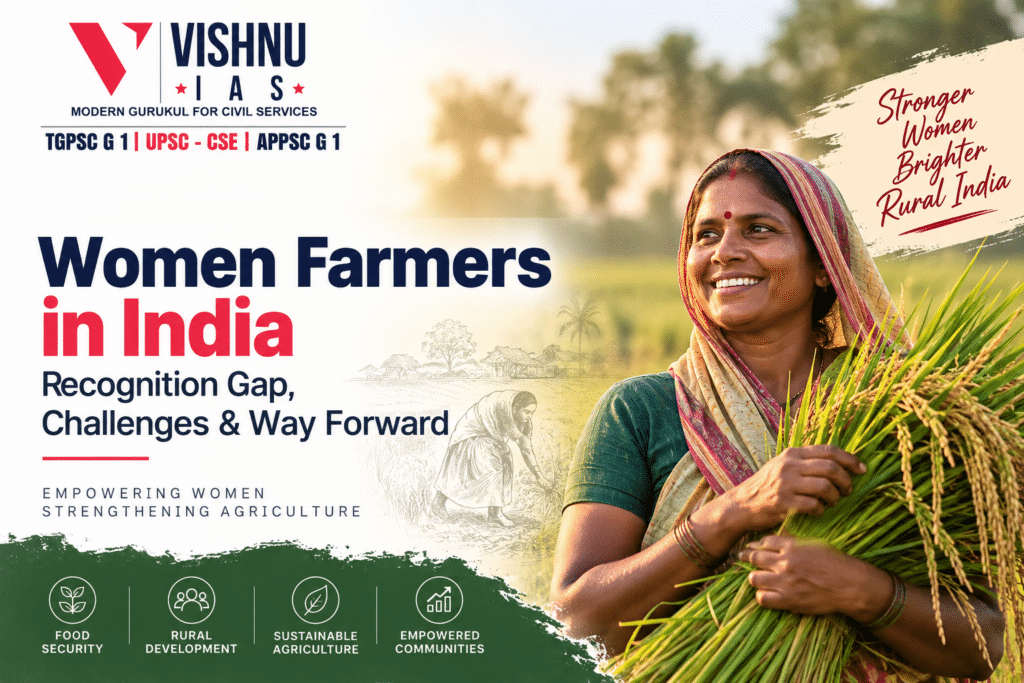
Women Farmers in India: Recognition Gap, Challenges & Way Forward
Women Farmers in India have always played a substantial role in Indian agriculture, from sowing and transplanting to livestock rearing, harvesting, post-harvest processing and farm decision-making. However, the institutional definition of a “farmer” has often been tied to land ownership and land records, making many women agricultural workers invisible as farmers. Thus, India faces a paradox wherein women’s participation in agriculture is increasing, while their formal recognition as farmers remains limited.
1. Women’s growing participation in agriculture
Rising participation
- According to the Government, the share of rural female employment engaged in agriculture increased from 73.2% in 2017–18 to 76.9% in 2023–24. The female labour force participation rate also rose substantially during this period.
Women as agricultural producers
- Women are involved not merely as agricultural labourers but also in crop cultivation, livestock rearing, dairy, fisheries, horticulture, seed production and allied activities.
Contribution to food security
- Their work supports household food security, local agricultural production and rural livelihoods, particularly in smallholder and subsistence farming systems.
International recognition
- The UN has declared 2026 as the International Year of the Woman Farmer, recognising the importance of women farmers to sustainable agrifood systems and rural development.
2. Women and inadequacy of farmer recognition
A. Land ownership-based identification
Land records as the administrative gateway
- Agricultural schemes and databases frequently use land records to identify beneficiaries. Since land is disproportionately registered in men's names, women working on family farms may not be formally identified as farmers.
Ownership-work mismatch
- A woman may cultivate, sow, harvest and manage agricultural activities on family land without legally owning that land. Therefore, the person performing agricultural work and the person recognised in official records may be different.
B. Limited access to agricultural schemes
- When land ownership becomes the eligibility criterion, women without land titles face barriers in accessing institutional credit, subsidies, crop insurance, agricultural inputs and extension services.
- For example, PM-KISAN is primarily structured around eligible landholding farmer families, creating difficulties for women who perform agricultural work without being recorded as landholders.
- Consequently, the problem is not simply lack of participation but lack of institutional visibility.
C. Unpaid and informal work
- A substantial proportion of women in agriculture work as unpaid family workers, reducing the visibility of their economic contribution.
- The distinction between “farmer” and “agricultural labourer” can further obscure women who simultaneously perform cultivation, livestock management and household responsibilities.
- Women's agricultural work is therefore affected by both gender norms and the design of administrative databases.
3. Consequences of the recognition gap
- Women may find it more difficult to obtain formal agricultural credit, insurance and productive assets when they lack recognised farmer status or land titles.
- Exclusion from agricultural extension systems can reduce women's access to modern technology, improved seeds, mechanisation, climate-resilient practices and market information.
- Formal recognition can strengthen women's bargaining position within households, farmer organisations and local institutions. Its absence can reinforce the perception that women are merely “helpers” rather than agricultural producers.
- If agricultural databases identify only landowners, policymakers cannot accurately determine who actually performs agricultural work. This can result in poorly targeted policies and underestimation of women's contribution to agriculture.
- The National Policy for Farmers, 2007 adopted a broader activity-oriented understanding of farmers, but translating such a conception into administrative recognition has remained challenging.
- Maharashtra's Women Farmers Empowerment Act, 2026 represents an important institutional response. It provides for a Woman Farmer Certificate and recognises agricultural activity independently of land ownership. The state's official portal specifically states that land ownership is not a condition and covers activities such as crop cultivation, seed production, livestock rearing, fishing and beekeeping.
- The Maharashtra system also provides for assistance officers at the taluka and district levels and allows recognition through the Gram Sabha in appropriate cases.
4. Other pathways towards recognition
Collective farming
- Kerala's Kudumbashree model has enabled women to participate in collective agricultural activities, providing an alternative institutional route to agricultural participation.
Support for landless cultivators
- Schemes such as Odisha's KALIA have attempted to extend support beyond conventional landholding categories.
Self-help groups and FPOs
- SHGs, Farmer Producer Organisations and cooperatives can give women greater access to credit, technology, inputs and markets even where individual land ownership is absent.
5. Way forward
- States shall develop common criteria for identifying women farmers, including landless cultivators, sharecroppers, agricultural labourers and women engaged in allied activities.
- A dedicated registry should be interoperable with existing agricultural databases while preventing duplication and exclusion.
- Recognised women farmers should be integrated into the digital agricultural ecosystem, Agristack, through Farmer IDs, allowing their identities to be linked with relevant schemes and services.
- Woman Farmer Certificates should facilitate access to eligible credit, insurance, subsidies, extension services and agricultural inputs, subject to individual scheme conditions.
- Gram Sabhas, SHGs, Panchayati Raj Institutions and agricultural extension workers should participate in identifying women who are actually engaged in farming.
- Alongside recognition of cultivators, governments should encourage joint land titles and inheritance rights for women, addressing the underlying asset-ownership gap.
Conclusion
The central issue is not merely women's participation in agriculture but the institutional visibility of that participation. When agricultural identity is determined primarily by land ownership, millions of women who cultivate, rear livestock, manage farms and contribute to agricultural decisions can remain outside the formal category of “farmer”. The emerging shift towards activity-based, land-delinked recognition, exemplified by Maharashtra's 2026 legislation, can help bridge this worker-owner dichotomy and institutional empowerment of women farmers.