Urban Flood Management India: Evaluating Strategies Amid Climate Change
Introduction:
Urban Flood Management in India faces increasing challenges due to evolving rainfall patterns and climate change. Urban floods occur when intense or prolonged rainfall overwhelms drainage capacity, leading to waterlogging, disruption of essential services, and loss of lives and property. Floods have been the most damaging natural disaster in India in the past two decades, accounting for maximum economic losses and casualties among disasters.
A single flood event today can cause damages upwards of ₹8,700 crore, highlighting the scale of vulnerability. Moreover, 64% of Indian tehsils have recorded an increase in the frequency of heavy rainfall days by 1–15 days, reflecting how climate change has altered rainfall intensity, duration, and distribution. In this context, evaluating the adequacy of India’s existing urban flood strategies is critical.
Body:
1. Existing Measures and Strengths
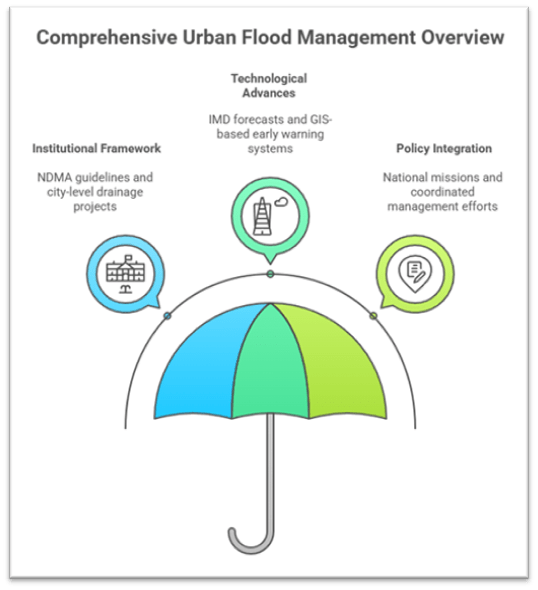
Institutional Framework
- The National Disaster Management Authority (NDMA) provides guidelines for urban flooding, recognizing it as distinct from riverine flooding.
- Several cities (e.g., Mumbai under BMC’s Storm Water Drainage Project) have initiated large-scale drainage upgrades to handle high-intensity rainfall.
- State Disaster Management Authorities and municipal corporations regularly prepare monsoon action plans.
Technological and Forecasting Advances
- The India Meteorological Department (IMD) has enhanced short-term and nowcasting forecasts for extreme rainfall events.
- Cities such as Chennai and Hyderabad have adopted GIS-based flood early warning systems integrated with real-time monitoring.
- National Urban Flood Risk Mitigation Project (NUFRMP) and pilot projects in smart cities have incorporated digital mapping of flood-prone zones.
Policy Integration
- The National Mission on Sustainable Habitat under NAPCC emphasizes climate-resilient urban planning.
- The Atal Mission for Rejuvenation and Urban Transformation (AMRUT) promotes stormwater drainage improvement.
- Examples such as Vijayawada’s monsoon response teams demonstrate the success of coordinated solid waste and stormwater management.
2. Persistent Gaps and Weaknesses
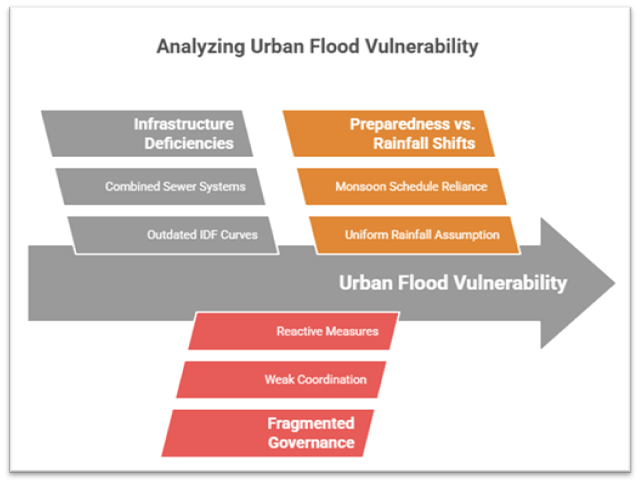
Infrastructure Deficiencies
- Drainage designs often rely on outdated Intensity–Duration–Frequency (IDF) curves, failing to match present-day rainfall extremes.
- Many cities continue to depend on combined sewer–stormwater systems, leading to frequent overflow and contamination.
- Poorly maintained urban lakes and wetlands (e.g., Bengaluru’s encroached stormwater drains) reduce natural flood buffering capacity.
Fragmented Governance
- Multiple agencies handle drains, solid waste, and roads with weak coordination.
- For instance, drain cleaning and garbage collection often follow separate schedules, causing quick re-clogging of stormwater channels.
- Lack of accountability leads to reactive firefighting measures rather than proactive planning.
Preparedness vs. Rainfall Shifts
- Flood management calendars are tied to the June–September monsoon schedule, but rainfall is increasingly occurring in May and September.
- Events like Mumbai’s 2023 pre-monsoon downpour (135 mm in a single day) highlight a mismatch between preparedness and reality.
- Maintenance assumes a uniform spread of rainfall, ignoring short, high-intensity bursts that overwhelm infrastructure.
3. Climate Change and Emerging Challenges
Increased Intensity and Frequency
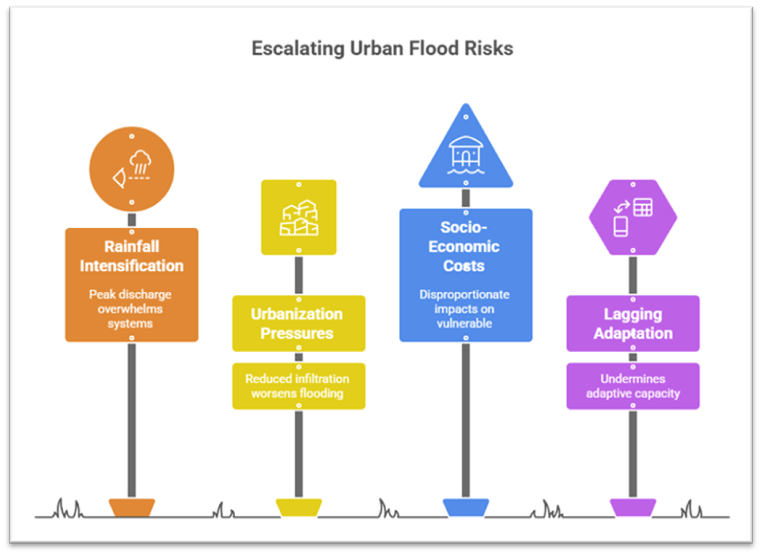
- Short-duration, high-intensity rainfalls are more common; in Thane, one-hour rainfall of 50 mm now recurs once every two years.
- This compression of rainfall into fewer hours increases peak discharge, straining existing stormwater systems.
Urbanization Pressures
- Rapid concretization reduces infiltration capacity; paved surfaces in Delhi NCR and Gurugram amplify waterlogging risk.
- Encroachment on river floodplains (e.g., Yamuna in Delhi) reduces natural drainage, worsening floods.
Economic and Social Costs
- Informal settlements and slums, often located in low-lying areas, face disproportionate impacts from floods.
- Flood-related economic losses impact not just infrastructure but also livelihoods in transport, trade, and services sectors.
Global and Comparative Lessons
- Cities like Singapore and Tokyo use updated rainfall data every few years to recalibrate drainage systems.
- In contrast, India lags in periodic IDF curve updates and catchment-level hydrological studies, undermining adaptive capacity.
Evaluation
- On the positive side, India has recognized urban flooding as a distinct hazard, initiated institutional mechanisms (NDMA guidelines, AMRUT, smart city projects), and strengthened forecasting capacity.
- On the negative side, urban flood management remains largely reactive, fragmented, and tied to outdated monsoon assumptions. Lack of integration between waste and drainage management, outdated rainfall benchmarks, and neglect of ecological buffers undermine resilience.
- While progress is visible in metropolitan areas (Mumbai, Chennai, Hyderabad), smaller tier-2 and tier-3 cities remain inadequately prepared, widening the urban flood vulnerability gap.
Conclusion:
- India’s current urban flood management strategies are partially adequate but insufficient in light of evolving rainfall patterns and climate change. While forecasting, institutional awareness, and urban infrastructure projects mark progress, persistent challenges such as outdated design standards, weak coordination, and encroachment of natural buffers hinder resilience.
- Going forward, cities must:
- Update IDF curves every 5–10 years,
- Integrate drainage and solid waste calendars with IMD alerts,
- Preserve wetlands and floodplains as natural sponges,
- Adopt climate-resilient urban planning based on micro-catchment hydrology.
- As urban India grows, adaptat
Recap: