Implications of Undervaluing Unpaid Care Work on India’s GDP and Minimum Wage Policies
Introduction
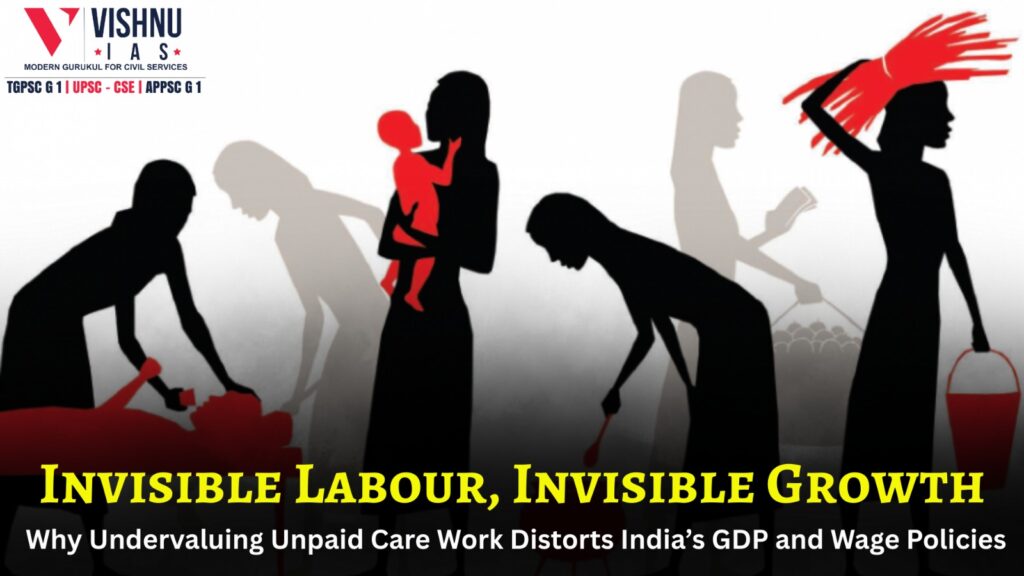
Unpaid care work in India refers to non-market activities such as cooking, cleaning, childcare, eldercare, and household management, which though essential for the economy, are neither monetised nor recognised in GDP calculations. As per the State Bank of India (SBI) Report 2023, if unpaid domestic work done by women were monetised, it would amount to ₹22.5 lakh crore annually (around 7% of GDP). Similarly, the Time Use Survey (2024) shows that women spend seven hours daily on domestic chores, compared to men’s 26 minutes. This invisibility of women’s contribution has direct implications for India’s GDP measurement and minimum wage frameworks, creating distortions in policy design and socio-economic justice.
1. Impact on GDP Estimation
- Exclusion of unpaid labour from national accounts
- The System of National Accounts (SNA) excludes unpaid domestic services, despite their significant contribution to social reproduction of labour.
- This underestimates India’s real economic productivity, leading to a skewed GDP structure that overvalues formal sectors and undervalues social sectors.
- Example: SBI Survey (2023) showed India’s GDP could rise by 7% if unpaid labour were included.
- Gendered nature of GDP invisibility
- Women constitute the majority of unpaid care workers. The NFHS-5 reveals 93% of women engage in unpaid household work daily, compared to 30% men.
- This makes GDP an inherently gender-biased indicator, overlooking women’s contribution to economic stability.
- Case Study: OECD countries like the UK and Australia include “satellite accounts” for household production, whereas India does not.
- Impact on labour force participation measurement
- Women performing unpaid household work are not counted in Labour Force Participation Rate (LFPR).
- India’s female LFPR remains at ~25% (PLFS 2023-24), among the lowest globally, despite women working long hours.
- This creates a false narrative of low productivity and under-utilisation of women’s labour.
2. Implications for Minimum Wage Policies
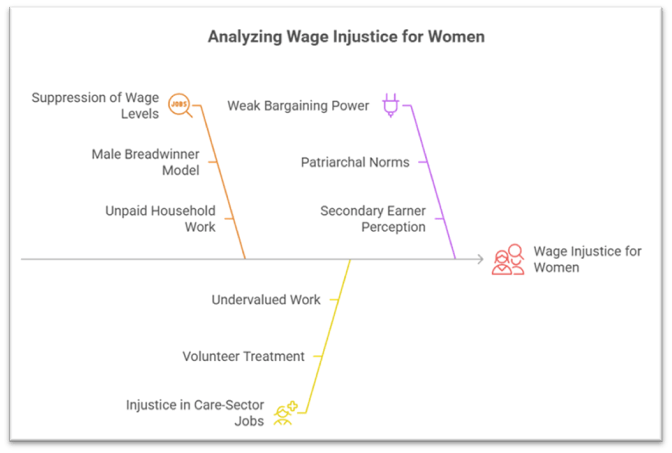
- Suppression of wage levels
- Minimum wages are calculated based on a male breadwinner model, assuming women’s domestic labour as subsistence support.
- By not recognising unpaid household work, wages are fixed at artificially lower levels, as women’s invisible labour subsidises household consumption.
- Example: Fair Wage Committee (2019) highlighted that ignoring unpaid care work distorts living wage calculations.
- Injustice to women in care-sector jobs
- Millions of women working as ASHA workers, Anganwadi workers, Mid-Day Meal cooks are treated as “volunteers” receiving honorariums, not wages.
- Their work mirrors “domestic responsibilities” and hence gets undervalued in labour law.
- Example: Supreme Court Case (2022) upheld ASHA workers’ demand for recognition, but government continues treating them as non-employees.
- Weak bargaining power of women workers
- Unpaid household roles reinforce patriarchal norms, leading to low negotiation power for women in wage markets.
- Women often accept lower wages in informal work due to the “secondary earner” perception.
- Example: Agricultural sector women labourers (NSSO data 2022) earn 20–30% less than men for the same work, partly due to this undervaluation.
3. Broader Socio-Economic Consequences
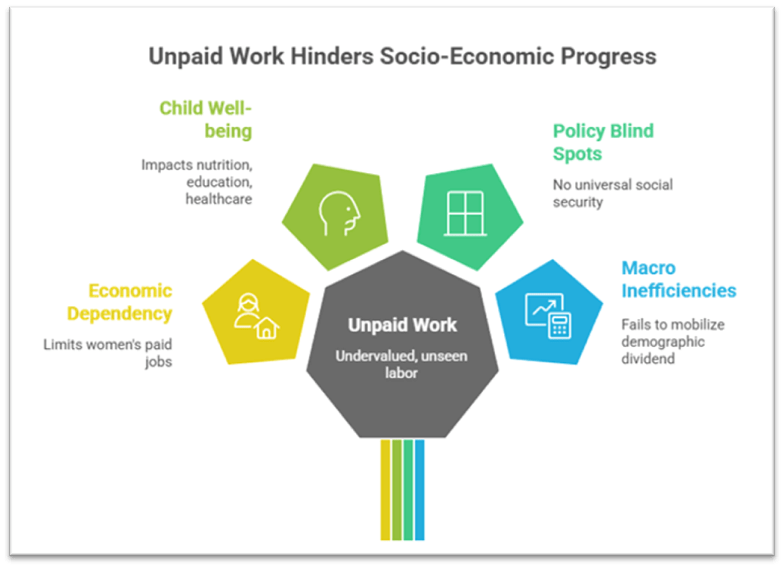
- Inter-generational poverty cycles
- Women’s unpaid work reduces their access to paid jobs, reinforcing female economic dependency.
- This limits household income, impacting nutrition, education, and healthcare investments for children.
- Case Study: UNICEF 2023 Report linked women’s unpaid care burden to higher child malnutrition rates in India.
- Policy blind spots in social protection
- Schemes like PMMVY, PM Janani Suraksha Yojana provide maternity benefits, but there is no universal social security for unpaid caregivers.
- Exclusion from minimum wage laws and absence of pensions leaves women vulnerable in old age.
- Example: SEWA’s demand (2021) for pensions for unpaid caregivers highlights this gap.
- Macroeconomic inefficiencies
- By undervaluing unpaid work, India fails to mobilise its demographic dividend effectively.
- The ILO (2021) estimated that reducing unpaid care work could boost India’s GDP by $770 billion by 2030 through higher female participation.
- This creates a missed opportunity in aligning with SDG-5 (Gender Equality) and SDG-8 (Decent Work).
Conclusion:
Undervaluing unpaid care work leads to a systematic underestimation of India’s GDP and a distortion in minimum wage policies, reinforcing gender inequality. Recognising this contribution is not just a matter of social justice but of economic necessity. The SBI Report (2023) and ILO studies clearly show that monetising women’s unpaid labour could add 5–7% to GDP. Going forward, India must:
- Develop satellite accounts for unpaid work (as done in OECD nations).
- Redesign minimum wage policies by factoring in the economic value of unpaid care work.
- Recognise frontline women workers like ASHAs and Anganwadi workers as government employees with fair wages.
- Promote shared domestic responsibility campaigns under schemes like Beti Bachao Beti Padhao.
Only by integrating unpaid care work into the formal economic framework can India move towards a gender-just and inclusive growth trajectory, ensuring both women’s dignity and economic efficiency.
Recap: