Introduction:
- The United Nations (UN), established in 1945 under the UN Charter, was envisioned as the principal institution for maintaining international peace and security, based on collective security, sovereign equality, and peaceful dispute resolution. Yet, in an era marked by unilateral interventions, strategic rivalries, and weakening multilateralism, its peacekeeping legitimacy is increasingly under scrutiny.
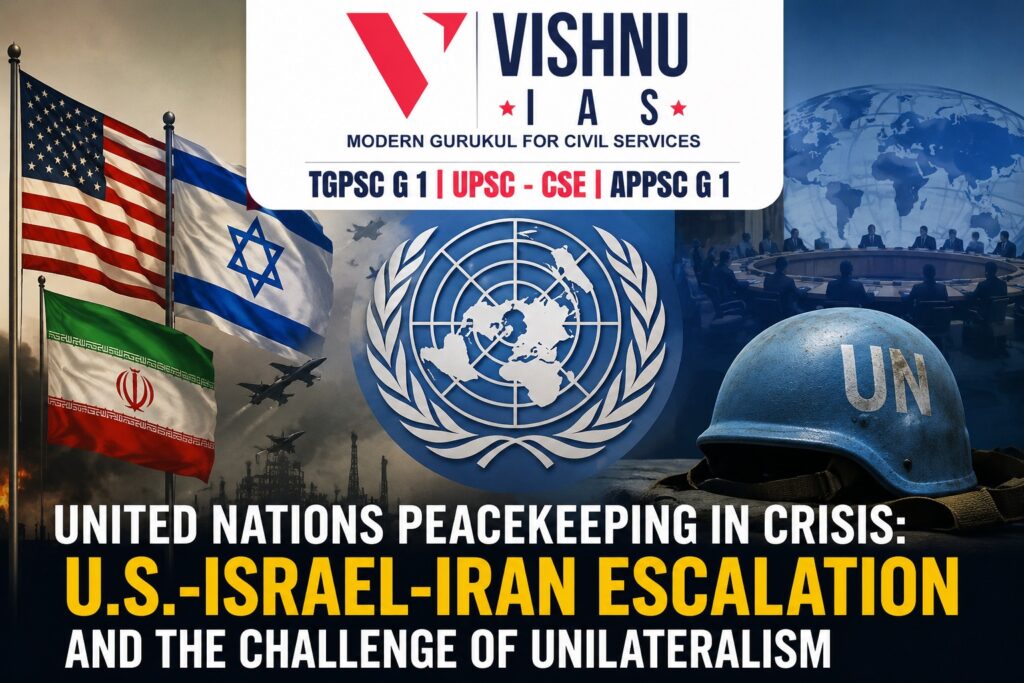
- The recent S.-Israel-Iran escalation, involving direct military strikes, retaliatory threats, and risks to critical chokepoints like the Strait of Hormuz, has exposed the institutional limits of the UN. This comes at a time when global conflict levels are at historic highs, while the UN peacekeeping system—with nearly 70,000 personnel deployed globally and a peacekeeping budget of around $5.38 billion (2025–26)—faces a severe credibility and funding crisis.
Body:
1. Why the recent escalation exposes the limitations of the UN as a peacekeeper
(a) Security Council paralysis due to great power politics
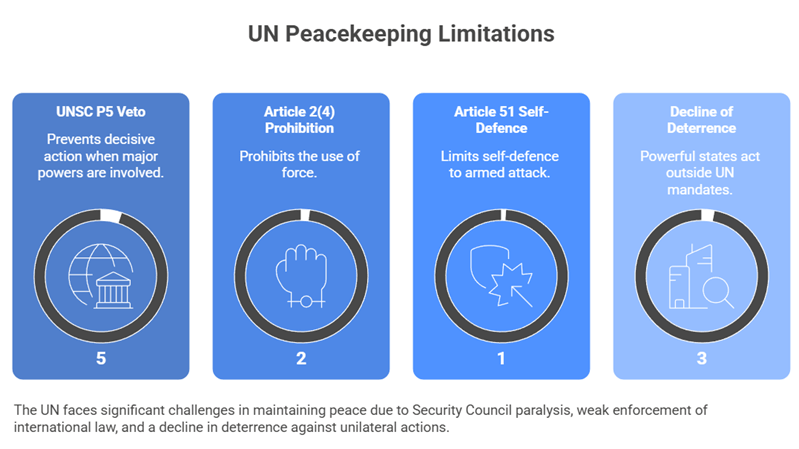
- The UN Security Council (UNSC) remains structurally constrained by the P5 veto, often preventing decisive action when major powers or their allies are directly involved.
- In the U.S.-Israel-Iran crisis, competing geopolitical alignments blocked meaningful enforcement, reducing the UN largely to a forum for statements rather than action.
- Example: Similar paralysis was visible during the Russia-Ukraine conflict, where repeated vetoes stalled collective enforcement.
(b) Weak enforcement under international law
- Though Article 2(4) prohibits use of force and Article 51 limits self-defence to armed attack, states increasingly invoke “anticipatory self-defence” to justify unilateral strikes.
- This expands legal ambiguity and weakens UN authority over the use of force.
- Case Study: The 2003 Iraq invasion, justified partly through preventive logic, created a major precedent for bypassing collective authorization.
(c) Decline of deterrence against unilateralism
- The UN lacks an independent military capability and depends on member-state willingness.
- Powerful states can act outside UN mandates with minimal immediate institutional cost.
- Example: Israeli strikes in Syria, Russian operations in Georgia, and NATO’s Kosovo intervention (1999) reflected this erosion.
2. Despite limitations, the UN still retains significant peacekeeping relevance
(a) Normative legitimacy and diplomatic platform
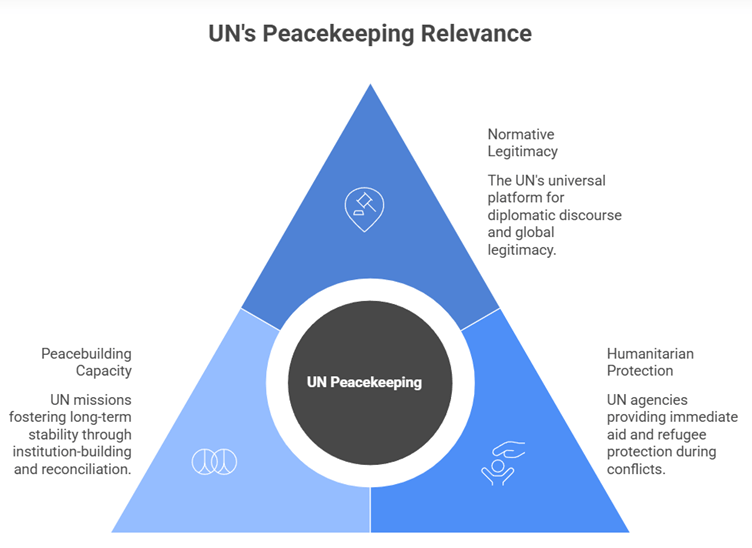
- The UN remains the only universal platform where all 193 member states can formally contest military actions.
- Even when unable to stop conflict, it shapes global legitimacy, influences narratives, and builds diplomatic pressure.
- Example: Emergency sessions under the “Uniting for Peace” mechanism have repeatedly mobilized wider international opinion.
(b) Humanitarian and civilian protection role
- UN agencies provide immediate humanitarian coordination even during military escalation.
- In West Asia, agencies such as UNHCR, UNICEF and WFP remain central to refugee protection and aid delivery.
- Case Study: In Gaza, UN humanitarian networks became indispensable despite operational constraints.
(c) Long-term peacebuilding capacity
- Peace is not only ceasefire enforcement but also institution-building, electoral support, and reconciliation.
- UN missions in Liberia, Cambodia, and Timor-Leste demonstrated successful post-conflict stabilization.
- Example: The UN Mission in Liberia (UNMIL) helped transition from civil war to democratic governance.
3. Structural reforms needed to restore UN effectiveness
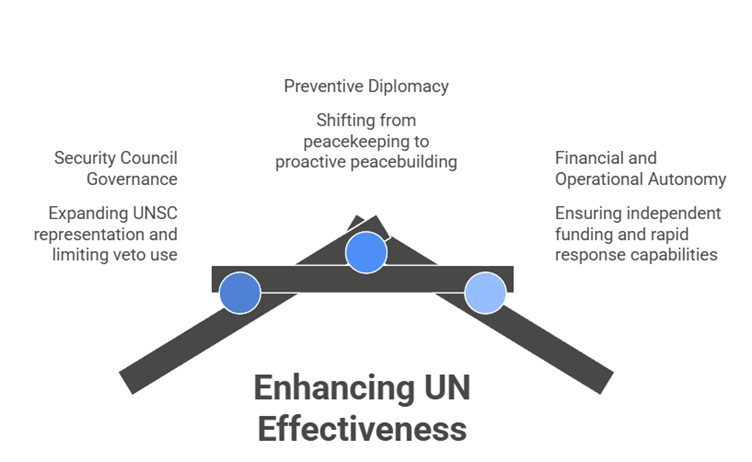
(a) Reforming Security Council governance
- Expansion of the UNSC to reflect contemporary realities is increasingly necessary.
- Inclusion of countries like India, Brazil, Germany, and Japan would improve legitimacy.
- Restricting veto use in cases involving mass atrocities or aggression could reduce paralysis.
(b) Strengthening preventive diplomacy
- The UN must move from reactive peacekeeping to preventive peace architecture.
- Early warning systems, stronger mediation, and regional partnerships are essential.
- Example: Collaboration with the African Union in Sudan and Sahel provides a working model.
(c) Financial and operational autonomy
- Chronic arrears and dependence on major contributors weaken operational independence.
- Diversified funding, standing rapid-response capabilities, and stronger mandate clarity are needed.
- Case Study: Delays in deployments during South Sudan and Lebanon highlighted this weakness.
Conclusion:
- The recent S.-Israel-Iran escalation demonstrates that the UN is not obsolete—but it is increasingly institutionally constrained. It often fails as an immediate coercive peacekeeper when major powers act unilaterally, yet it remains indispensable as a normative anchor, humanitarian coordinator, and long-term peacebuilder.
- The future of global peace depends not on abandoning the UN, but on revitalising multilateralism through institutional reform, stronger preventive diplomacy, and renewed political commitment. With over 130 countries recently reaffirming support for UN peacekeeping, the enduring relevance of the institution remains clear: the challenge is not whether the UN matters, but whether states are willing to let it function as intended