
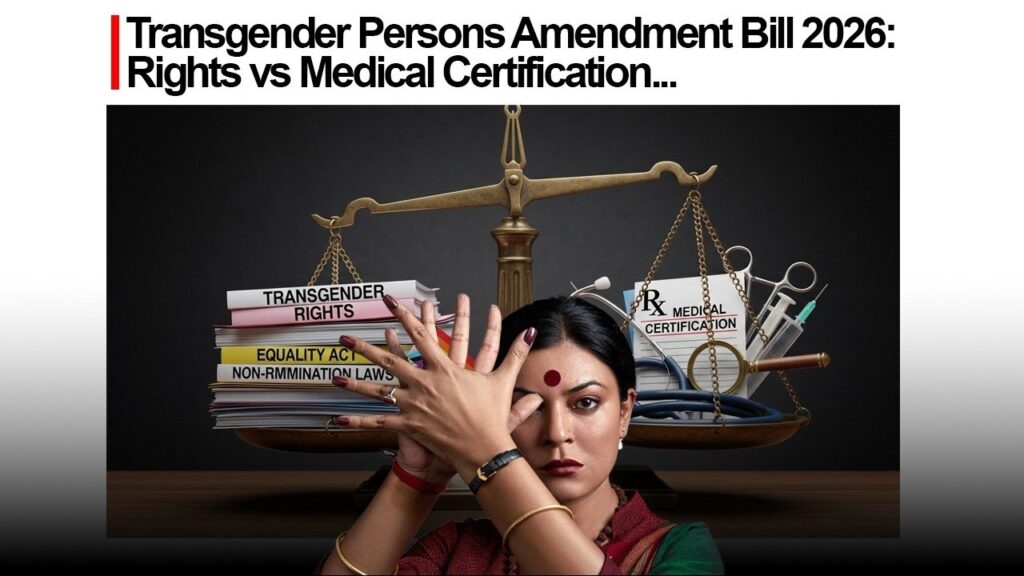
Transgender Persons Amendment Bill 2026: How It Undermines the NALSA Judgment
Transgender Persons Amendment Bill 2026 has sparked significant debate as it removes self perceived gender identity and introduces a medical board authority, raising serious concerns about its impact on the landmark NALSA judgment and constitutional rights in India.
Introduction
The recognition of gender identity as an intrinsic aspect of personal autonomy was firmly established by the NALSA v. Union of India judgment, where the Supreme Court upheld the right to self-perceived gender identity under Articles 14, 19, and 21. The Transgender Persons (Protection of Rights) Act, 2019 partially operationalized this by allowing self-identification, though with procedural constraints.
The 2026 Amendment Bill, by removing self-perceived identity and introducing a medical-board certification system, marks a shift toward biological determinism and state control. This raises concerns about its consistency with constitutional morality, human dignity, and global human rights standards, especially when India already records millions identifying outside binary gender categories.
1. Erosion of Self-Identification and Personal Autonomy
a) Violation of the Core Principle of Self-Perceived Identity
- The NALSA judgment recognised gender identity as a matter of individual self-determination, independent of biological sex or medical procedures.
- Removal of this right replaces psychological and social identity with externally validated criteria, contradicting the idea that identity is internally experienced.
- Example: Many transgender persons who do not undergo surgery (due to cost, health, or choice) may now be excluded from legal recognition.
b) Undermining Article 21: Right to Dignity and Privacy
- The Supreme Court linked gender identity to dignity, bodily integrity, and privacy, later reinforced in the K.S. Puttaswamy judgment.
- Mandatory certification by authorities intrudes into intimate personal decisions, effectively subjecting identity to state surveillance.
- Case Study: Instances of transgender individuals facing humiliation during verification procedures under earlier district screening committees highlight risks of institutional discrimination.
c) Reinforcement of Binary and Heteronormative Frameworks
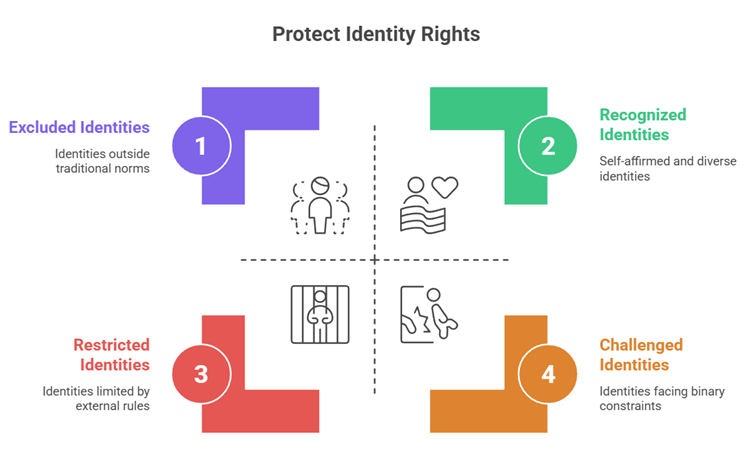
- By narrowing the definition to specific socio-cultural categories (e.g., hijra, kinner), the Bill excludes gender-fluid and non-binary identities.
- This creates a hierarchy of identities, privileging certain traditional categories over evolving identities.
- Example: Persons identifying as non-binary or genderqueer may lose recognition despite increasing visibility.
2. Medicalisation of Gender Identity and Institutional Control
a) Shift from Rights-Based to Medical Model
- NALSA explicitly rejected the requirement of medical procedures for identity recognition.
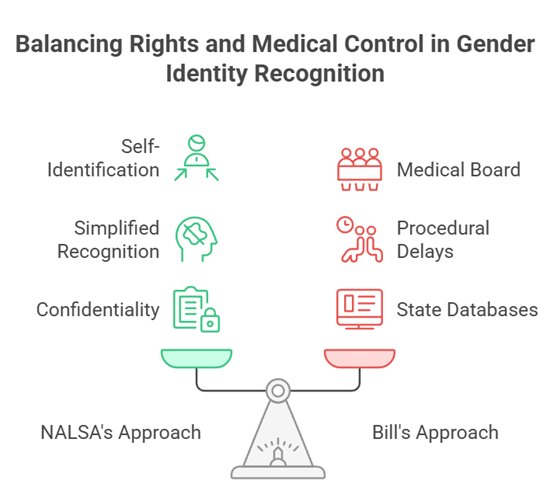
- The Bill introduces a medical board headed by a Chief Medical Officer, effectively pathologising gender identity.
- Example: Similar frameworks globally have been criticised for treating transgender identity as a “disorder”.
b) Barriers to Accessibility and Inclusion
- Medical boards create procedural delays, costs, and bureaucratic hurdles.
- This disproportionately affects marginalised groups (rural, poor, disabled).
- Case Study: Documentation barriers already prevent access to schemes like SMILE Scheme.
c) Privacy and Surveillance Concerns
- Mandatory reporting of surgeries raises serious privacy issues.
- This risks exposing individuals to stigma and discrimination.
- Example: Data misuse concerns increase without strong data protection safeguards.
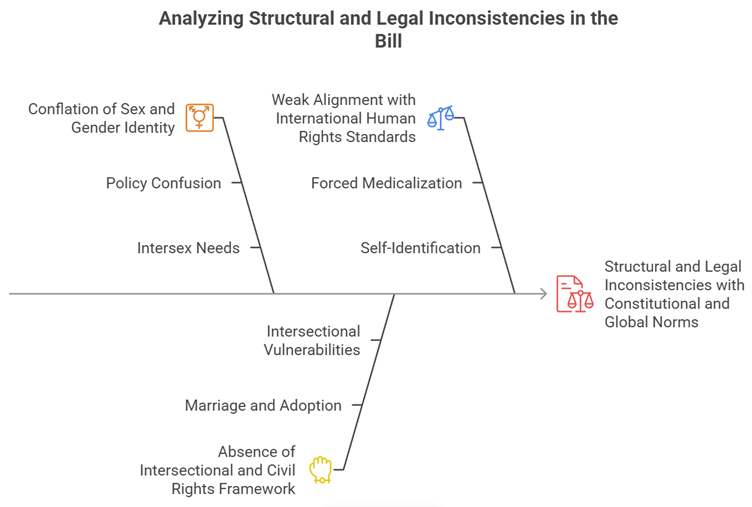
3. Structural and Legal Inconsistencies
a) Conflation of Sex and Gender Identity
- The Bill conflates biological sex with gender identity, contradicting NALSA and global standards.
- This creates policy confusion, especially regarding intersex persons.
- Example: Lack of recognition leads to continued non-consensual surgeries on infants.
b) Absence of Intersectional and Civil Rights Framework
- NALSA directed affirmative action for transgender persons.
- The Bill is silent on marriage, adoption, inheritance, and intersectional vulnerabilities.
- Case Study: Transgender persons from Scheduled Castes face dual discrimination.
c) Weak Alignment with International Standards
- Global frameworks emphasise self-identification and informed consent.
- The Bill diverges from evolving UN human rights norms.
- Example: Countries like Argentina show better outcomes with self-ID models.
Conclusion
The removal of self perceived gender identity under the Transgender Persons Amendment Bill 2026 marks a fundamental departure from the transformative vision of the NALSA judgment. It shifts from a rights-based framework to a regulatory and medicalised regime.
A progressive path forward requires restoring self-identification, ensuring privacy safeguards, legally separating sex and gender identity, and expanding civil rights protections. Global evidence shows that inclusive legal recognition significantly improves access to education, healthcare, and employment for gender-diverse communities.
Recap: