
Technological Sovereignty and National Security: Why India Needs Digital Independence
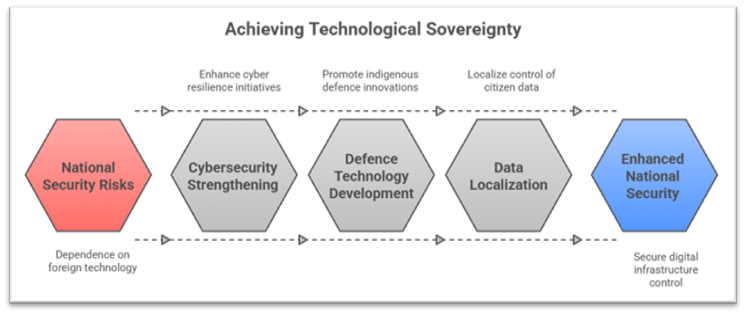
Technological sovereignty refers to a nation’s ability to design, develop, control, and maintain its own critical technologies—both in hardware and software—without dependence on external powers. In today’s interconnected world, technology has become as fundamental to governance, economy, and security as political decision-making. The World Economic Forum (2023) highlights that cybersecurity risks rank among the top five global threats. For India, where over 820 million internet users (TRAI 2024) depend on digital systems for banking, governance, healthcare, and defence, reliance on foreign software, cloud systems, and semiconductor supply chains poses a strategic vulnerability. Thus, technological sovereignty is no longer a matter of economic growth alone—it is an issue of national security, autonomy, and resilience.
National Security Dimensions of Technological Sovereignty
- Cybersecurity and Digital Infrastructure Modern wars involve cyberattacks, drones, and AI-based misinformation, making reliance on foreign digital infrastructure risky. Case Study: The 2020 SolarWinds cyberattack in the USA and India’s 2020 Mumbai power outage highlight vulnerabilities. India’s National Cyber Security Strategy (draft, 2020) and CERT-In initiatives aim to reduce risks, but indigenous platforms remain weak.
- Defence and Strategic Technology Modern defence depends on AI-enabled drones, encrypted communication, and satellite systems. Dependence on imports risks supply disruptions during crises. Example: The Russia–Ukraine war showed how satellite internet like Starlink influenced battlefield outcomes. India’s Defence AI Council (2021) and iDEX initiatives reflect progress but gaps persist.
- Data Sovereignty Control of citizen data is critical. With 70% of India’s cloud market dominated by US companies, external management remains a concern. The Digital Personal Data Protection Act (2023) and India Stack aim to strengthen sovereignty. Example: China’s “Great Firewall” shows integration of sovereignty into digital governance.
Economic and Developmental Dimensions
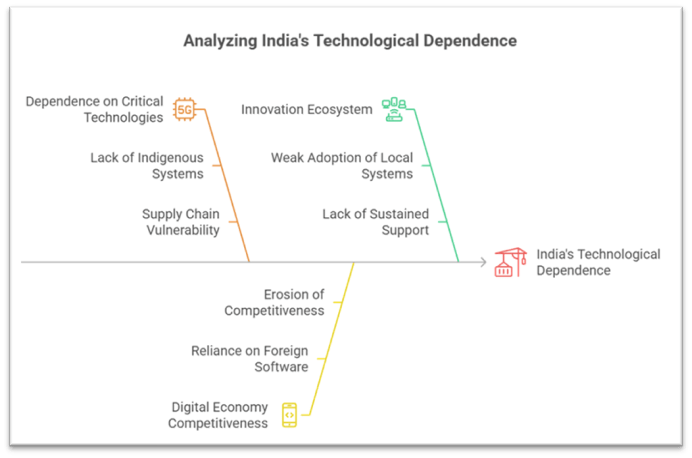
- Dependence on Critical Technologies India lacks indigenous OS, chip fabs, and robotics. Taiwan’s TSMC controls 60% of the global semiconductor market, leaving India vulnerable. The India Semiconductor Mission (2021) and Micron partnership (2023) show steps forward.
- Digital Economy Competitiveness India’s $245 billion IT industry depends on foreign foundational software. Example: South Korea’s indigenous chip design and Japan’s RISC-V projects strengthen sovereignty. India’s Digital India, UPI, Aadhaar, and ONDC show scalable indigenous models.
- Innovation Ecosystem Lack of adoption weakened Bharat Operating System Solutions (BOSS). Open-source projects like Linux show collective innovation can drive sovereignty. Startup India and PLI schemes can succeed if aligned with sovereignty goals.
Socio-Political and Strategic Autonomy Dimensions
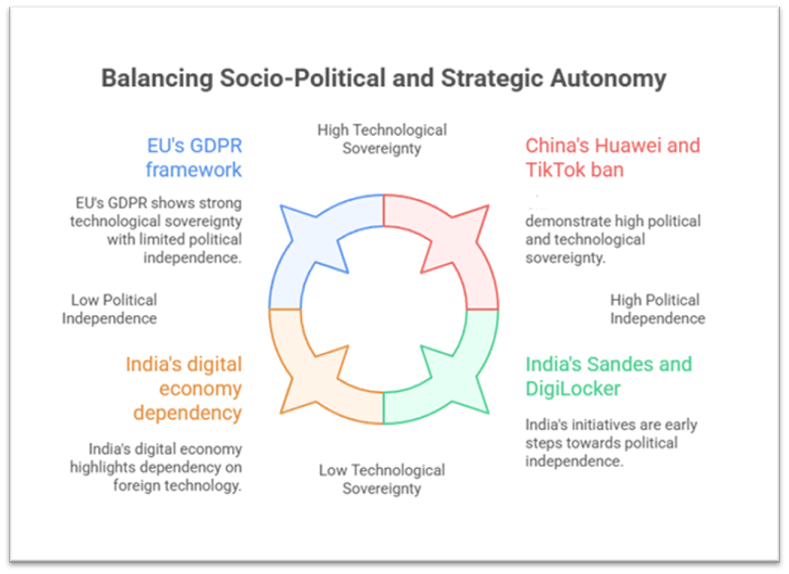
- Political Independence vs. Technological Dependence Despite political freedom in 1947, India’s digital economy remains tied to foreign platforms. Cloud service suspensions under political influence demonstrate risks. Sovereignty here means reducing dependency, not rejecting globalization.
- Social and Citizen-Centric Concerns Daily life depends on Android, iOS, Gmail, and WhatsApp, limiting national control. Example: The 2019 WhatsApp Pegasus spyware case revealed surveillance risks. Efforts like Sandes app and DigiLocker are steps towards autonomy.
- Geopolitical Leverage Technological sovereignty strengthens global bargaining power. Examples: EU’s GDPR and China’s Huawei model. India’s 1.4 billion digital users provide potential leverage if self-reliance grows. Quad’s Critical and Emerging Tech Working Group reflects balancing cooperation with sovereignty.
Conclusion:
Technological sovereignty is no longer optional but as vital to national security as political sovereignty. India’s dependence on external platforms for defence, economy, and governance makes this clear. The World Bank (2024) stresses that technological resilience is integral to economic resilience. The way forward requires:
- Strengthening indigenous capability in semiconductors, AI, and cybersecurity through sustained investment.
- Leveraging open-source ecosystems for foundational software development.
- Building a public-private-academia alliance with viable business models.
India’s freedom struggle proves the power of collective resolve. With India projected to be the world’s third-largest digital economy by 2030 (McKinsey 2024), achieving technological independence will secure not just sovereignty but also leadership in the global digital order.
Recap: