ICJ Interpretation of NDCs: How It Strengthens the Paris Agreement Legal Framework
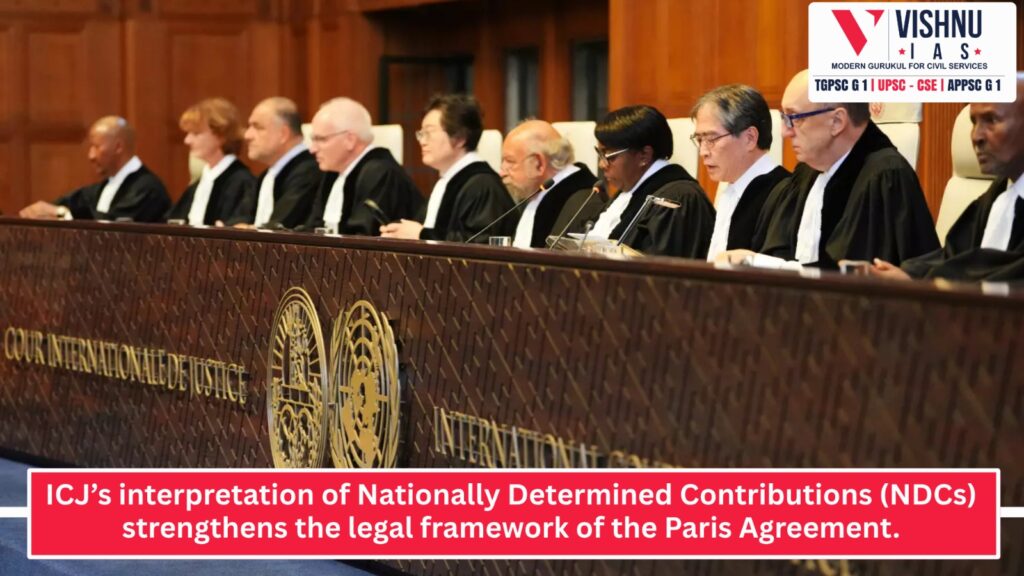
The ICJ interpretation of NDCs — delivered in the International Court of Justice’s landmark 23 July 2025 advisory opinion on States’ obligations in respect of climate change — significantly reframes Nationally Determined Contributions (NDCs) under the Paris Agreement. While advisory opinions are not strictly binding, this authoritative interpretation ties NDCs to duties of due diligence, scientific benchmarks such as the 1.5°C goal, and human-rights considerations, thereby bolstering the Paris Agreement legal framework and raising the normative floor for global climate action.
Introduction
- The International Court of Justice (ICJ), in its landmark 23 July 2025 advisory opinion on States’ obligations in respect of climate change, offered authoritative guidance on the legal nature of Nationally Determined Contributions (NDCs) under the Paris Agreement.
- While advisory opinions are not legally binding, they are highly persuasive interpretations of international law. This opinion is particularly significant in the context of the UNEP Emissions Gap Report 2024, which warns that to keep the 1.5°C target within reach, global greenhouse gas (GHG) emissions must decline by ~42% by 2030 and ~57% by 2035 — far steeper reductions than current NDCs imply.
- The ICJ’s interpretation reframes NDCs from purely political commitments into legally relevant obligations tied to customary international law, environmental treaties, and human rights norms, thereby potentially strengthening the Paris framework.
ICJ’s Interpretation: Key Features
The ICJ rejected the argument that NDCs are entirely discretionary and without legal force. It held that States have a duty of due diligence, cooperation, and prevention of significant harm to the climate system, which constrains both the preparation and implementation of NDCs. This includes:
- Highest possible ambition — NDCs must reflect each country’s best effort, judged against capabilities, historical emissions, and scientific benchmarks.
- Science integration — 1.5°C was endorsed as the relevant threshold, based on the latest IPCC consensus and COP decisions.
- Attribution feasibility — The Court affirmed that it is scientifically possible to assess a State’s share of global emissions (historical and present), enabling responsibility claims.
- Human rights linkages — NDCs must consider the rights of vulnerable communities and ensure just transitions.
Strengthening the Paris Legal Architecture
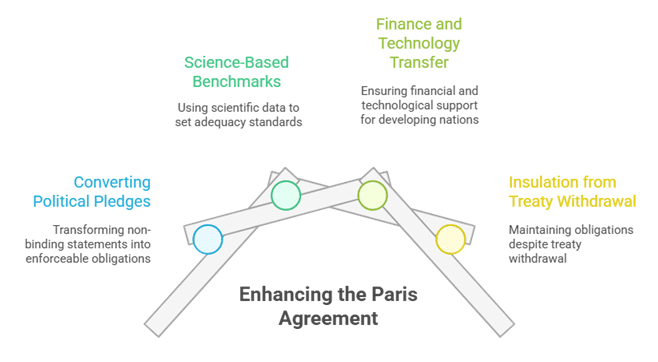
- Converting political pledges into obligations of conduct
- By interpreting NDCs as subject to due diligence and good faith, the ICJ narrows the gap between non-binding political statements and enforceable obligations. While the Paris Agreement itself avoids prescribing the outcomes of NDCs, the ICJ’s reading attaches procedural and substantive duties, thereby raising the normative floor.
- For example, if a major emitter submits a weak NDC inconsistent with its capacity, this can be challenged as a breach of international duties — a tool small island states actively sought by pushing for the advisory opinion.
- Science-based benchmarks for adequacy
- The Paris Agreement’s aim of keeping temperature rise “well below 2°C” is now reinforced by the ICJ’s legal recognition of 1.5°C as the operative benchmark.
- This elevates the evidentiary role of scientific reports such as UNEP’s Emissions Gap Report, making them relevant in assessing the adequacy of NDCs. This in turn will pressure Parties to revise their targets in line with decadal carbon budgets.
- Finance and technology transfer as binding duties
- The Court interpreted Common But Differentiated Responsibilities and Respective Capabilities (CBDR-RC) to mean developed countries have a legally binding obligation to provide financial and technological assistance for both mitigation and adaptation.
- OECD data shows developed countries mobilised USD 115.9 billion in 2022, but disputes over adequacy and accounting persist. This interpretation provides the Global South with stronger leverage in demanding predictable climate finance, critical for NDC implementation.
- Insulation from treaty withdrawal
- The ICJ clarified that obligations under general international law and other environmental treaties (e.g., Law of the Sea, customary environmental norms) continue to bind states even if they withdraw from Paris.
- Thus, the U.S.’s 2020–21 withdrawal did not remove its core climate obligations — a precedent that may deter future “treaty shopping” or strategic withdrawals.
Operational Implications
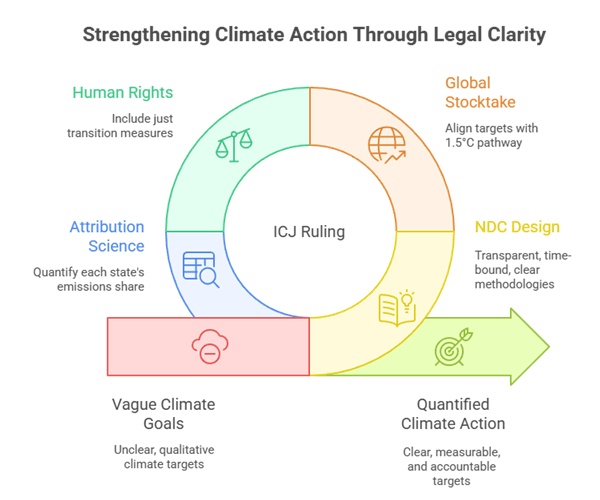
- NDC design and transparency
- The ruling implies NDCs should be transparent, time-bound, and accompanied by clear baselines and methodologies.
- For example, India’s updated NDC (2022) targets 45% reduction in emissions intensity of GDP by 2030 (from 2005 levels), 50% cumulative non-fossil fuel electricity capacity, and creation of a 2.5–3 billion tonne CO₂ equivalent carbon sink via afforestation.
- Such quantified metrics align better with the ICJ’s interpretation than vague qualitative goals.
- Global Stocktake as a legal touchstone
- The Paris Agreement’s five-yearly Global Stocktake is designed to inform future NDCs. The ICJ’s view strengthens its role: ignoring stocktake findings could be considered bad faith.
- For India, stocktake integration would mean aligning domestic renewable energy targets (e.g., PM-KUSUM, Green Hydrogen Mission) with the 1.5°C pathway.
- Human rights integration
- By linking climate obligations with human rights, the ICJ opens the door for litigation like the Ridhima Pandey case in India, where inadequate climate action is framed as a violation of rights to life and environment.
- This could shape NDC content to include just transition measures, job retraining, and social protection.
- Attribution for accountability
- The ICJ accepted that attribution science can quantify each state’s share of emissions. This strengthens the evidentiary basis for climate liability claims, especially from vulnerable states such as Vanuatu or Tuvalu against major emitters.
Critical Appraisal: Strengths and Limitations
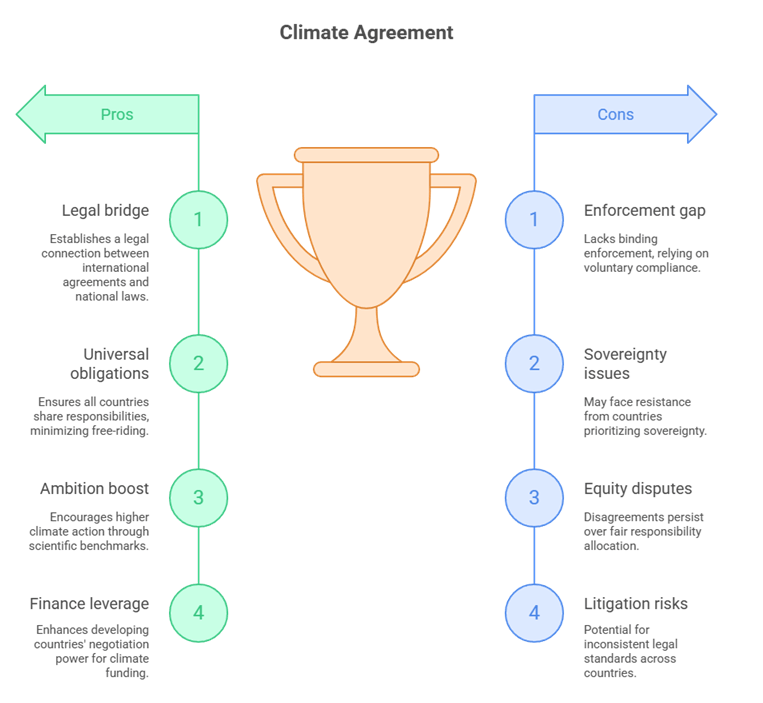
Strengths:
- Creates a legal bridge between the Paris regime and customary/environmental law, giving NDCs a firmer legal basis.
- Clarifies that obligations are differentiated but universal, reducing “free rider” risks.
- Raises ambition expectations through science-based standards.
- Strengthens leverage for developing countries in climate finance negotiations.
Limitations:
- Enforcement gap: Advisory opinions lack binding force; compliance relies on political will and domestic legal uptake.
- Sovereignty concerns: Some major emitters may resist prescriptive interpretations as judicial overreach.
- Equity disputes: Measurement of “highest possible ambition” and fair shares remains contested, particularly on historical vs per-capita responsibility.
- Litigation fragmentation: Increased domestic litigation may lead to inconsistent standards across jurisdictions.
Way Forward
- Reform NDC submission process — Mandate explicit alignment statements with the 1.5°C goal, sectoral pathways, and financing plans.
- Enhance transparency and compliance — Institutionalise responses to Global Stocktake findings through domestic legislation and budgetary integration.
- Finance reform — Translate the ICJ’s binding finance interpretation into predictable multi-year public finance with clear accounting rules to resolve adequacy disputes.
- Capacity building for Global South — Strengthen legal, technical, and policy capacity in developing countries to use the ICJ opinion in negotiations and litigation.
- Rights-based climate action — Integrate just transition policies into NDC implementation to align with the ICJ’s human rights framing.
Conclusion:
The ICJ interpretation of NDCs meaningfully strengthens the Paris Agreement’s legal framework by transforming NDCs from purely voluntary pledges into obligations grounded in international law, science, and human rights. It reinforces the 1.5°C target, integrates CBDR-RC into legal obligations for finance and technology transfer, and closes exit routes via treaty withdrawal. However, the opinion’s impact will depend on domestic legal incorporation, robust transparency mechanisms, predictable finance, and political will. It is a classic example of how persuasive legal interpretation can shift the operational and normative boundaries of global governance — but sustained follow-up action will determine whether this shift translates into real-world emissions cuts consistent with the 1.5°C limit.
Recap: