Introduction:
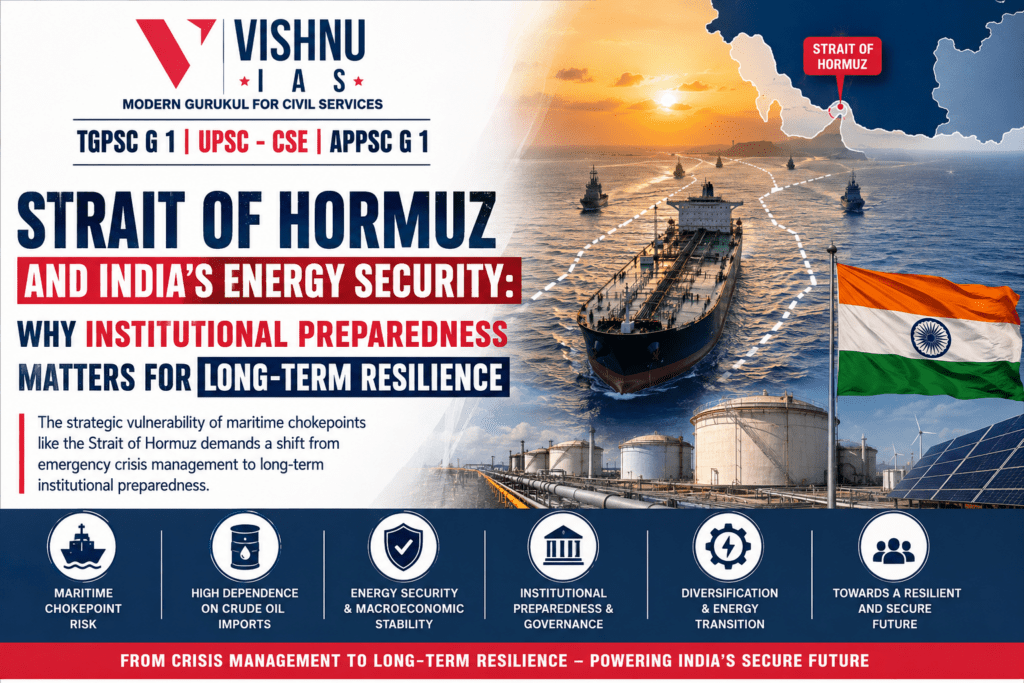
- The Strait of Hormuz is a narrow maritime passage connecting the Persian Gulf with the Gulf of Oman and the Arabian Sea, through which nearly one-fifth of global oil consumption and a substantial share of global LNG trade transit.
- For India, which imports around 90% of its crude oil requirements, disruptions in this strategic chokepoint have direct implications for energy security, inflation, fiscal stability, external sector resilience, and economic growth. India’s recent response reflects a gradual transition from reactive crisis management towards institutional preparedness, supply diversification, and strategic resilience, consistent with its long-term developmental objectives.
Body:
I. Strategic vulnerability of the Strait of Hormuz and its implications for India
1. Energy security and macroeconomic vulnerability
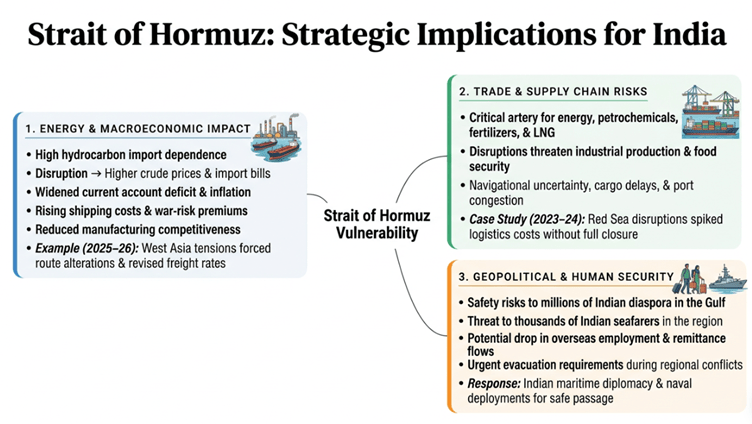
- India’s high dependence on imported hydrocarbons makes any disruption in the Strait capable of triggering higher crude prices, increased import bills, widening current account deficit, and inflationary pressures, thereby affecting overall macroeconomic stability.
- Rising shipping costs, freight charges, war-risk insurance premiums, and longer voyage durations increase the landed cost of energy and industrial raw materials, affecting manufacturing competitiveness.
- Example: Escalation of tensions in West Asia during 2025–26 resulted in heightened shipping risks, compelling global shipping companies to alter routes and revise freight rates.
2. Strategic risks to maritime trade and supply chains
- The Strait functions as a critical artery for energy trade, petrochemicals, fertilizers, and LNG supplies, making disruptions capable of affecting both industrial production and food security.
- Maritime insecurity creates navigational uncertainty, delays in cargo movement, port congestion, and supply-chain disruptions, influencing domestic availability of essential commodities.
- Case Study: The Red Sea shipping disruptions (2023–24) demonstrated how attacks on commercial vessels significantly increased logistics costs even without complete closure of major sea routes.
3. Geopolitical and human security concerns
- India’s interests extend beyond energy imports to the safety of millions of Indian diaspora members and thousands of Indian seafarers operating in the Gulf region.
- Regional conflicts may simultaneously threaten merchant shipping, overseas employment, remittance flows, and evacuation requirements, necessitating coordinated diplomatic and naval responses.
- Example: India’s maritime diplomacy and naval deployments have consistently ensured safe passage for Indian-flagged vessels and merchant ships during periods of regional instability.
II. India’s recent institutional response: From crisis management to resilience building
1. Whole-of-government crisis management architecture
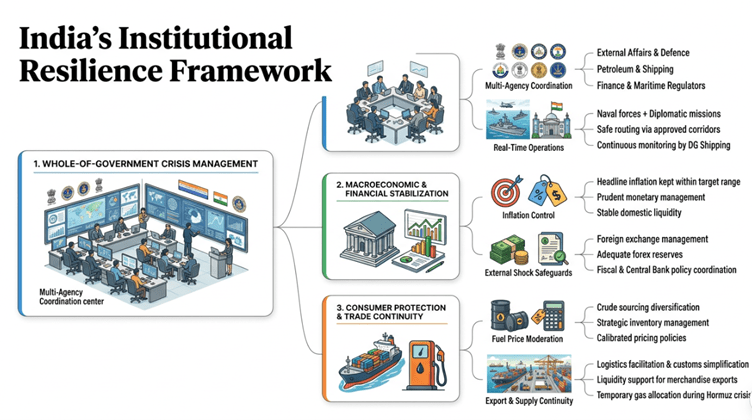
- India adopted a multi-agency coordinated approach, integrating the efforts of the Ministries dealing with External Affairs, Defence, Petroleum, Shipping, Finance, and maritime regulators for continuous monitoring and response.
- Real-time coordination among shipping companies, naval forces, diplomatic missions, oil marketing companies, and international partners ensured uninterrupted movement of Indian vessels.
- Example: Safe routing of commercial ships through approved maritime corridors and continuous monitoring by the Directorate General of Shipping minimized operational disruptions.
2. Macroeconomic and financial stabilization measures
- Despite elevated global oil prices, India managed to maintain headline inflation broadly within the central bank’s target range, supported by prudent monetary management and stable domestic liquidity.
- Measures such as foreign exchange management, adequate forex reserves, external sector safeguards, and financial market stabilization reduced the transmission of external shocks into the domestic economy.
- Example: Flexible policy coordination between fiscal authorities and the central bank helped cushion the economy against volatility in global commodity markets.
3. Consumer protection and trade continuity
- India moderated domestic fuel price volatility through crude sourcing diversification, strategic inventory management, calibrated pricing policies, and coordinated action by public sector oil marketing companies.
- Export competitiveness was protected through logistics facilitation, customs simplification, and liquidity support, enabling merchandise exports to maintain strong growth despite higher shipping costs.
- Case Study: During the Hormuz-related uncertainties, temporary domestic gas allocation measures ensured uninterrupted supply before being rolled back after normalization of global conditions.
III. Why long-term institutional preparedness is the sustainable strategy
1. Diversified and resilient energy architecture
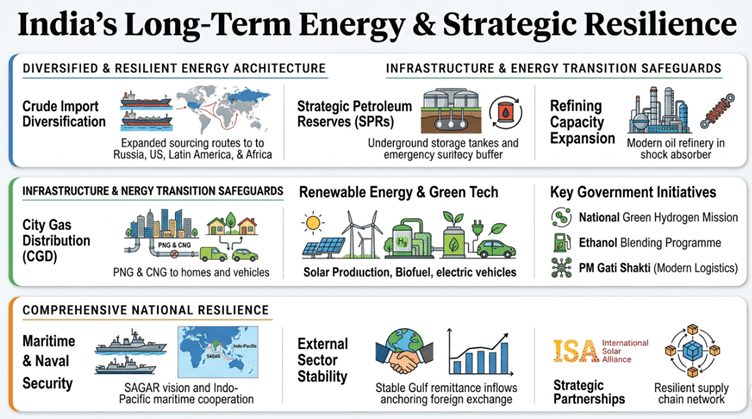
- India has steadily diversified crude imports beyond traditional Gulf suppliers by expanding sourcing from regions such as Russia, the United States, Latin America, and Africa, reducing concentration risk.
- Expansion of Strategic Petroleum Reserves (SPRs) provides an emergency buffer against temporary supply disruptions while strengthening national energy security.
- Government Initiative: Strategic Petroleum Reserve Programme alongside expansion of domestic refining capacity has enhanced India’s ability to absorb short-term supply shocks.
2. Infrastructure and energy transition as strategic safeguards
- Expansion of the City Gas Distribution (CGD) network, increasing access to Piped Natural Gas (PNG) and Compressed Natural Gas (CNG), has diversified domestic energy consumption patterns.
- Accelerated investments in renewable energy, green hydrogen, biofuels, electric mobility, LNG infrastructure, and modern logistics reduce long-term dependence on imported crude oil.
- Government Initiative: National Green Hydrogen Mission, Ethanol Blending Programme, PM Gati Shakti, and renewable energy expansion collectively strengthen long-term energy resilience.
3. Building comprehensive national resilience
- Institutional preparedness extends beyond energy to encompass maritime domain awareness, naval modernization, diplomatic engagement, resilient supply chains, digital logistics, and strategic partnerships.
- Stable remittance inflows from the Gulf continue to strengthen India’s external sector because they are anchored in long-term labour market linkages rather than short-term geopolitical fluctuations, while precautionary remittance transfers during crises further support foreign exchange stability.
- Example: India’s SAGAR vision, Indo-Pacific maritime cooperation, and participation in initiatives such as the International Solar Alliance complement traditional energy security with broader strategic resilience.
Conclusion:
- The experience of recent tensions around the Strait of Hormuz demonstrates that energy security is inseparable from maritime security, economic resilience, and institutional capacity.
- While effective crisis response remains essential, durable resilience depends on diversified energy sourcing, strategic reserves, resilient infrastructure, financial stability, clean energy transition, and integrated governance mechanisms.
- With India among the world’s fastest-growing major economies and expanding investments in strategic infrastructure and energy transition, sustained institutional preparedness will remain the cornerstone of safeguarding national interests amid an increasingly uncertain geopolitical environment while advancing the vision of Viksit Bharat 2047.