Sixth Schedule and Indigenous Autonomy: Safeguarding Tribal Rights from Resource Extraction Projects
The Sixth Schedule of the Indian Constitution plays a crucial role in safeguarding indigenous autonomy and tribal rights in Northeast India. Designed to empower Autonomous District Councils (ADCs), it provides legislative, judicial, and financial powers over land, forests, and local customs. However, in recent decades, its protections have been increasingly tested by centrally-driven resource extraction projects, such as uranium and coal mining.
Introduction
The Sixth Schedule of the Indian Constitution (Articles 244(2) and 275(1)) provides for the administration of autonomous districts and regions in the northeastern states of Assam, Meghalaya, Tripura and Mizoram. Its key objective is to protect indigenous tribal autonomy, particularly over land, resources, customs and local administration.
Under it, Autonomous District Councils (ADCs) and Regional Councils are endowed with legislative, executive, judicial and financial powers over specified subjects including land, forests, social customs, village administration, and mineral royalties.
Recent decades have seen tensions between these protections and centrally-driven resource‐extraction projects (e.g. mining of uranium, coal), particularly when administrative instruments (such as Office Memoranda) seek to bypass or reduce procedural safeguards such as public consultations.
Constitutional & Legal Powers Under the Sixth Schedule: Potentials and Limits
a. Legislative & Regulatory Powers over Land and Resources
- ADCs under the Sixth Schedule have the power to make laws on land, forest management, shifting cultivation, inheritance, social customs etc.
- They also have financial powers: under Paragraph 9 of the Sixth Schedule, ADCs are entitled to a share of royalties from leases or licenses granted by the state government for mineral prospecting/extraction.
- However, the power to actually grant licenses or leases for mineral extraction is generally not vested in ADCs. They can regulate or raise objections, but do not have absolute veto in many cases.
b. Judicial and Customary Law Protections
- Sixth Schedule councils can establish village or district courts to try disputes where parties belong to Scheduled Tribes in matters covered by the Schedule.
- Customary laws – on inheritance, land tenure, social customs – are explicitly safeguarded.
- Yet there are limitations: state law may prevail where inconsistent; central or state Acts of Parliament may be exempted by Presidential notification under the Sixth Schedule (especially in Meghalaya under “12A”).
c. Procedural Safeguards: Consent, Consultation, and Local Participation
- ADCs’ involvement in royalty sharing and decision-making provides procedural safeguards.
- Example: Meghalaya Assembly in 2015 passed a resolution under section 12A to seek exemption from central mining laws.
- Recent OMs exempting critical/atomic minerals from public consultation challenge these safeguards.
- Judicial reviews remain crucial in striking down executive overreach.
Challenges Posed by Centrally‐Driven Resource Extraction Projects
a. Executive Instruments & Dilution of Procedural Safeguards
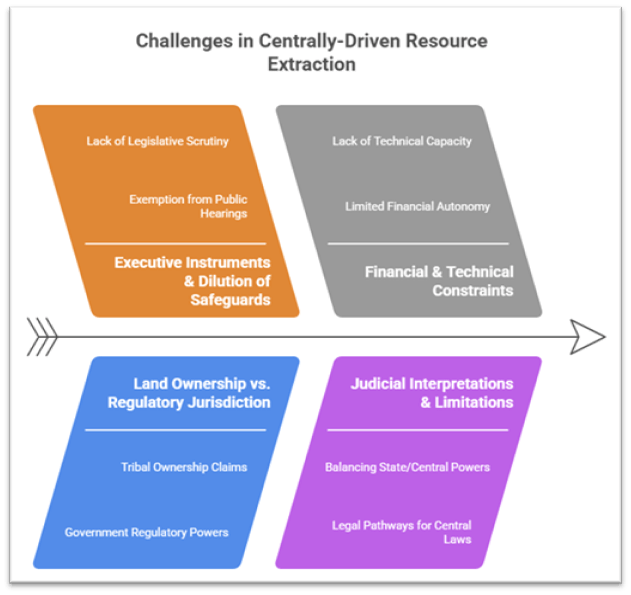
Central OMs can exempt projects from public hearings, bypassing tribal consultation.
b. Land Ownership vs. Regulatory Jurisdiction Tensions
Customary land ownership often clashes with central claims under the MMDR Act. The Meghalaya coal-mining case highlights this tension.
c. Financial, Technical, and Capacity Constraints of ADCs
ADCs lack financial autonomy, technical expertise, and institutional strength to effectively regulate extraction or assess environmental risks.
d. Judicial Interpretations & Limitations in Precedent
Court rulings recognize ADC rights but generally uphold state/central authority, limiting blanket veto powers.
Impact on Indigenous Communities & Policy Responses
a. Environmental, Health, Social Impacts
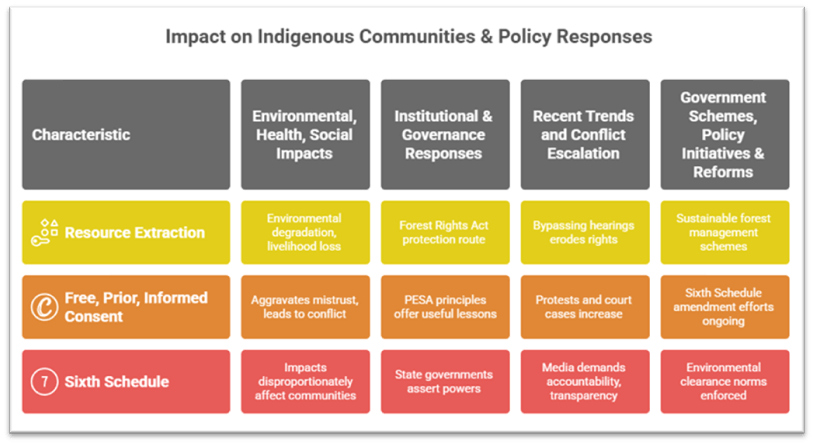
Resource extraction threatens deforestation, water contamination, displacement, radiation exposure (uranium mining), and cultural disruption.
b. Institutional & Governance Responses
- Forest Rights Act (2006) strengthens community land rights.
- PESA Act (1996) principles offer lessons for participatory governance.
- State governments and ADCs have sought exemptions or clarification on central laws to protect autonomy.
c. Recent Trends and Conflict Escalation
Use of OMs to bypass hearings is rising, while civil society and judiciary push back to defend procedural rights.
Conclusion:
The Sixth Schedule remains a crucial constitutional instrument for protecting indigenous autonomy in northeastern tribal areas. Despite the challenges, it has secured rights over land, forests, royalties, customs and local administration, enabling communities to resist resource extraction that threatens their livelihoods and identity.
If indigenous autonomy under the Sixth Schedule is preserved and strengthened, a more sustainable and inclusive model of development is possible. Resource extraction need not be automatic; with well‐defined rights, strong institutions and consent mechanisms, development can proceed without marginalisation.
Recap: