The Shift in FDI Towards Short-Term Profit-Seeking Investments and Its Challenge to India's Long-Term Economic Development
The shift in FDI towards short-term, profit-seeking investments poses a major challenge to India’s long-term economic development. Foreign Direct Investment (FDI) refers to cross-border investments where an individual or company from one country makes a significant investment of capital into a business or asset in another country, establishing lasting interest and control. In the context of India, FDI has historically fuelled industrial modernization, technological capability, and global integration since the 1991 reforms, with gross inflows reaching around $81 billion in FY 2024–25, a 13.7% increase over the previous year. However, recent evidence shows a decisive shift: investments are increasingly short-term and profit-driven, reflected in a decline in net FDI inflows (to as low as $0.4 billion after outflows in FY 2024–25), rising disinvestments, and growing capital outflows.
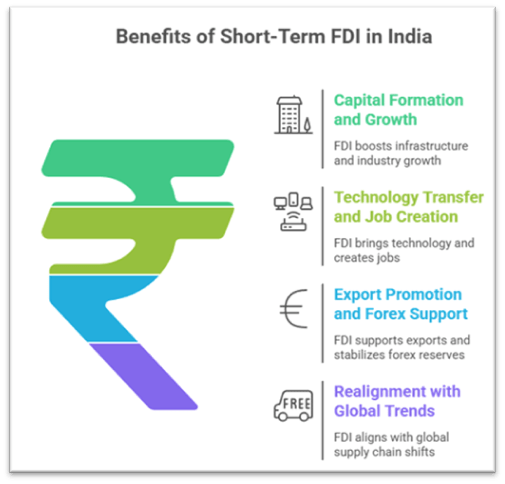
Pros – Contribution of FDI, Even Short-Term
- Capital Formation and Growth – FDI supplements domestic savings, funds infrastructure and industry (e.g., Apple, Amazon, Walmart-Flipkart, Foxconn).
- Technology Transfer and Job Creation – Cutting-edge tech, 1.2M+ jobs via PLI schemes, 100% FDI in MRO, telecom, insurance.
- Export Promotion and Forex Support – Boosts pharma, IT exports; supports forex reserves; strengthens Make-in-India hubs.
- Realignment with Global Trends – India benefits as a China-plus-one destination (Apple, Tesla, Kia, Samsung investments).
Cons – Risks of Short-Term, Profit-Driven FDI
- Declining Net FDI – Net retained FDI fell to $0.4 billion in FY 2024–25; growth concentrated in services, finance, and real estate rather than manufacturing.
- Capital Outflows – Outward FDI rose 90% YoY in April 2025; domestic firms seek opportunities abroad due to regulatory inefficiency.
- Short-Termism and Multiplier Loss – Only 12% of FDI goes into manufacturing; volatile flows reduce long-term economic resilience.
- Macro-Stability Risks – Rising disinvestment ($51.4 billion in FY 2024–25) stresses rupee and balance of payments.
Balancing the Evidence & Reform Responses
- Temporary and Cyclical Factors – Global FDI declined 11% in 2024 (UNCTAD). Outward FDI reflects global ambitions (Tata in UK).
- Policy Correctives – FDI liberalization in insurance, nuclear, MRO; corporate tax cuts; PLI schemes in electronics and pharma.
- Emerging Sectors – Clean energy, fintech, AI, and EV attract knowledge-driven, long-term FDI (Databricks, Tesla, Start-up India ecosystem).
- Structural Reforms Still Needed – Greater transparency, infrastructure upgrades, and skill development needed for sustainable FDI.
Conclusion:
In light of recent evidence, it is clear that the increasing short-term, profit-seeking character of FDI is a double-edged sword for India. While these investments generate capital, jobs, and innovation in certain sectors, they fail to achieve the sustained developmental gains of long-tenure FDI. Structural bottlenecks—such as regulatory unpredictability and sectoral imbalances—have exacerbated net outflows and limited FDI’s multiplier effect. However, with reforms like PLI schemes, tax rationalization, and competitive federalism, along with India’s large market strengths, there remains significant potential to realign FDI with lasting developmental goals. Thus, the shift in FDI towards short-term profit-seeking investments does pose a meaningful challenge to India’s long-term economic development.
Recap: