Security Camps in Left Wing Extremism Affected Areas: Strengthening Security and Governance
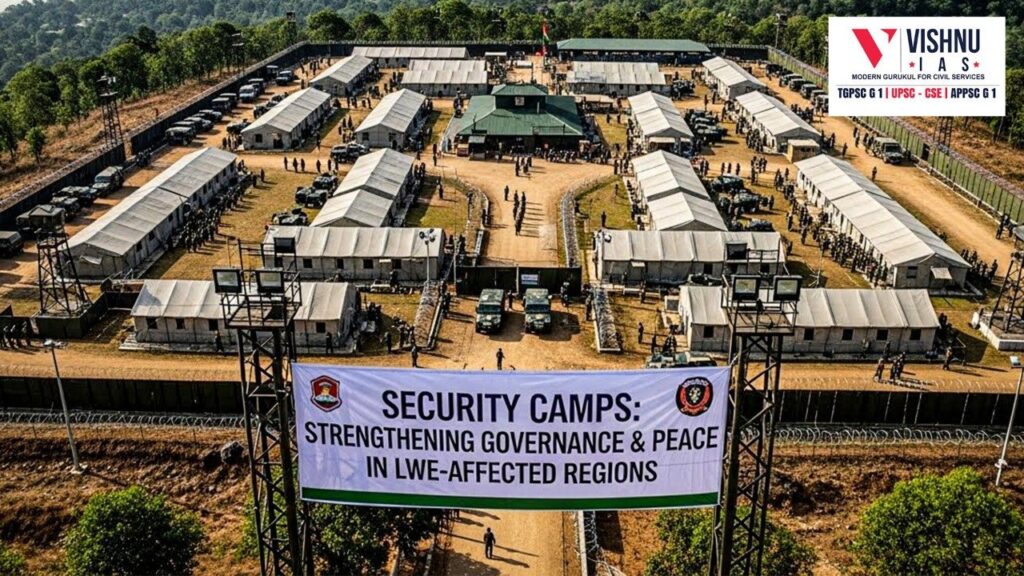
Security Camps in Left Wing Extremism Affected Areas have emerged as one of the most significant tools for restoring peace, rebuilding governance and re-establishing State legitimacy in regions historically impacted by Maoist insurgency. Their presence has played a crucial role in addressing both the security vacuum and governance deficit that once fuelled extremist mobilisation.
Introduction:
- Left Wing Extremism (LWE) in India refers to an armed insurgency inspired by Maoist ideology that challenges the authority of the Indian State, particularly in tribal-dominated, forested and under-governed regions.
- Over the past decade and a half, India has witnessed a dramatic decline in Maoist violence, with violent incidents reducing by nearly 90% between 2010 and 2025, and the geographical spread shrinking from over 120 affected districts to barely a dozen concentrated in parts of south Bastar.
- This turnaround reflects a strategic shift from reactive counter-insurgency to area domination and governance restoration, with security camps in remote LWE zones emerging as a critical institutional innovation to simultaneously address security vacuum and governance deficit—the two foundational enablers of Maoist expansion.
I. Security Stabilisation and Operational Superiority
1. Area Domination and Deterrence of Armed Cadres
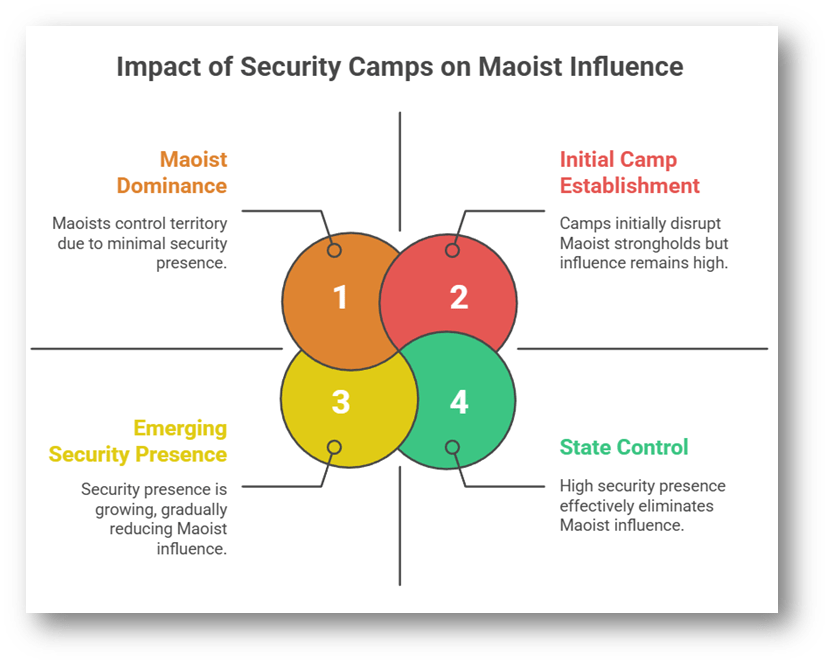
- Permanent security camps in remote interiors have ended Maoist monopoly over territory, denying insurgents safe havens and rear bases that once enabled free movement, extortion and armed mobilisation.
- EXAMPLE: The establishment of forward camps in south Bastar (Bijapur–Sukma axis) fragmented Maoist strongholds that had earlier functioned as quasi-liberated zones, forcing cadres into defensive postures.
- Government initiatives such as SAMADHAN doctrine and Security Related Expenditure (SRE) Scheme institutionalised sustained deployment rather than episodic operations, ensuring continuity of pressure.
2. Reduced Response Time and Tactical Advantage
- Proximity of camps to vulnerable villages has significantly shortened reaction time for security forces during ambushes, IED blasts or civilian intimidation.
- CASE STUDY: In interior Chhattisgarh, quicker medical evacuation and reinforcement from nearby camps has lowered casualty ratios and improved morale of forces.
- Integration of camps with CRPF, CoBRA units, state police and District Reserve Guards has strengthened jointness and operational confidence.
3. Psychological Impact and Intelligence Gains
- Visible and sustained presence of the State through camps has reversed fear dynamics, reassuring villagers and undermining Maoist narratives of State absence.
- Improved trust translated into better human intelligence (HUMINT), weakening Maoist networks in a zero-sum manner.
- Surrender and rehabilitation policies under State Surrender-cum-Rehabilitation Schemes gained traction as cadres perceived the inevitability of State control.
II. Governance Outreach and Administrative Penetration
1. Enabling Civil Administration in No-Go Areas
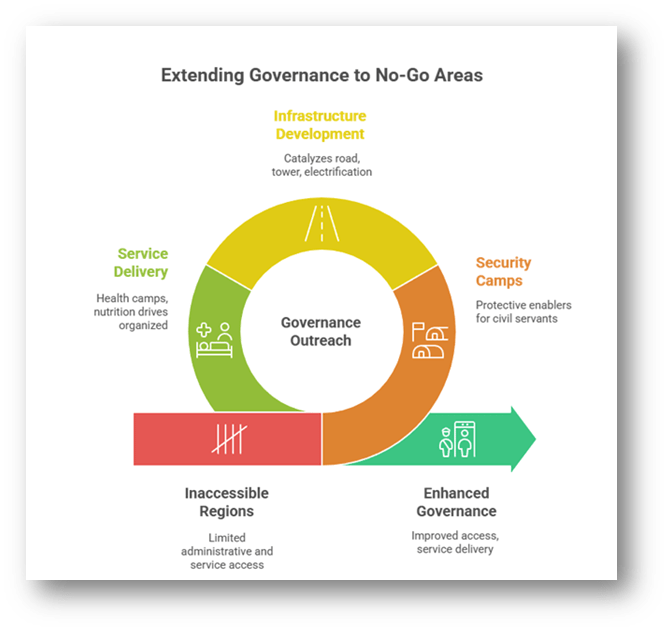
- Security camps function as protective enablers, allowing collectors, tehsildars, patwaris, health workers and teachers to operate in previously inaccessible regions.
- EXAMPLE: Villages that had only encountered forest guards or armed actors are now witnessing routine delivery of land records, caste certificates and welfare services.
- Initiatives like Aspirational Districts Programme and District Mineral Foundation (DMF) leveraged the security umbrella to deepen administrative reach.
2. Infrastructure Development as Governance Multiplier
- Camp establishment has catalysed road construction, mobile tower installation and electrification, breaking the physical isolation that sustained insurgency.
- CASE STUDY: Interior Bastar villages connected under PMGSY and BharatNet experienced improved market access, emergency communication and service delivery.
- Infrastructure also strengthened electoral participation and institutional legitimacy, reinforcing democratic processes.
3. Service Delivery and Welfare State Visibility
- Camps often become nodes around which health camps, nutrition drives, school enrolment and skill initiatives are organised.
- Schemes such as Ayushman Bharat, Poshan Abhiyaan, Jal Jeevan Mission and PM Awas Yojana gained last-mile traction once security was assured.
- The State’s welfare presence diluted Maoist parallel governance structures that once mediated dispute resolution and resource access.
III. Socio-Economic Transformation and Conflict De-escalation
1. Erosion of Maoist Recruitment Base
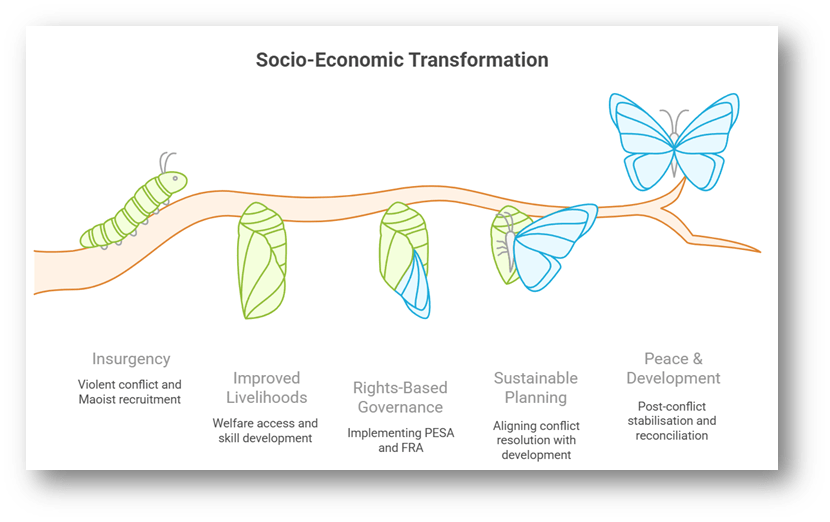
- With improved livelihoods, connectivity and welfare access, the appeal of violent insurgency has steadily declined, especially among tribal youth.
- EXAMPLE: Skill development and self-employment initiatives linked to Van Dhan Yojana and NRLM provided alternatives to armed mobilisation.
- Enhanced policing-population ratios deterred coercive recruitment and extortion practices.
2. Integration of Tribal Aspirations within Constitutional Framework
- Security camps created conditions for rights-based governance to replace insurgent mediation over land and forest issues.
- Implementation of Panchayats (Extension to Scheduled Areas) Act (PESA) and Forest Rights Act (FRA) is now feasible with administrative access and protection.
- Surrendered Maoist leaders advocating democratic struggle underscore a transition from armed resistance to constitutional engagement.
3. Foundation for Sustainable Peace and Development
- The consolidation of security has provided a platform for long-term planning, aligning conflict resolution with development visions such as Viksit Bharat 2047.
- CASE STUDY: Multi-sectoral planning in former LWE pockets integrates education, health, livelihoods and local self-governance rather than security-first approaches alone.
- The shift reflects a move from counter-insurgency to post-conflict stabilisation and reconciliation.
Conclusion:
- The experience of LWE-affected regions demonstrates that security camps are not merely instruments of force projection but catalysts of state legitimacy, bridging the historic gap between authority and accountability. By simultaneously ensuring territorial control, administrative access and socio-economic transformation, they have contributed to a steep decline in violence and geographic contraction of Maoism.
- However, durable peace will depend on deepening governance reforms, particularly effective implementation of PESA and FRA, strengthening local self-government, and ensuring that development is participatory, rights-based and ecologically sensitive.
- With only a handful of districts now affected and sustained reductions in violence, India stands at a critical juncture where security-led stabilization must seamlessly transition into governance-led empowerment, ensuring that the vacuum once exploited by extremism is permanently filled by constitutional democracy and inclusive development.
Recap: