
Elucidate the Role and Powers of the Governor under Article 200 of the Constitution and Discuss Whether Judicial Intervention is a Valid Recourse to Address Legislative Deadlock
Introduction
The Governor of a State is the constitutional head under Article 153, whose powers and functions are defined by the Constitution. One of the most debated provisions is Article 200, which deals with the Governor’s assent to Bills passed by the State legislature. Though designed to be a routine constitutional process, recent developments have highlighted instances of legislative deadlock, where Governors have indefinitely withheld decisions on Bills, leading to tensions in Centre–State relations.
In 2023, India witnessed over 20 Bills pending for more than a year across various States, drawing judicial scrutiny. Against this backdrop, understanding the scope of gubernatorial powers, their constitutional limits, and the role of judicial intervention is crucial for sustaining federal balance.
Body
Role and Powers of the Governor under Article 200
-
Options Available to the Governor
- The Governor may grant assent, withhold assent, return a Bill (not Money Bills) for reconsideration, or reserve it for the President’s consideration.
- This framework derives from Section 75 of the Government of India Act, 1935, though the phrase “in his discretion” was deliberately omitted in the Constitution, indicating the intent to restrict unilateral gubernatorial action.
- For instance, in State of Punjab vs Principal Secretary to the Governor (2023), the Court emphasized that delay or inaction cannot be a constitutionally valid option.
-
Aid and Advice of Council of Ministers
- Under Article 163, the Governor ordinarily acts on the aid and advice of the elected Council of Ministers, except in areas explicitly mentioned (e.g., reserving Bills on matters derogating from High Court powers under Article 201).
- The Shamsher Singh vs State of Punjab (1974) judgment reiterated that the Governor is a constitutional head and not an independent authority.
- Commissions such as Sarkaria (1988) and Punchhi (2010) reaffirmed that Governors should avoid interfering with the democratic mandate.
-
Discretionary Ambiguity
- The Supreme Court in Nabam Rebia (2016) held that Governors cannot exercise discretionary powers in matters not explicitly stated by the Constitution.
- While the Sarkaria Commission allowed discretion in rare cases of patently unconstitutional Bills, judicial interpretations increasingly reject unfettered discretion.
- Comparative practice in the UK shows that even the monarch cannot withhold assent independently, reinforcing the principle of parliamentary supremacy.
-
Impact on Federalism
- Misuse of gubernatorial powers to delay or block Bills undermines cooperative federalism.
- For example, Bills relating to NEET exemption in Tamil Nadu and Punjab’s agricultural laws remained stalled, creating governance paralysis.
- This raises concerns of Governors becoming “super-constitutional authorities”, disrupting legislative processes.
Issues Leading to Legislative Deadlock
-
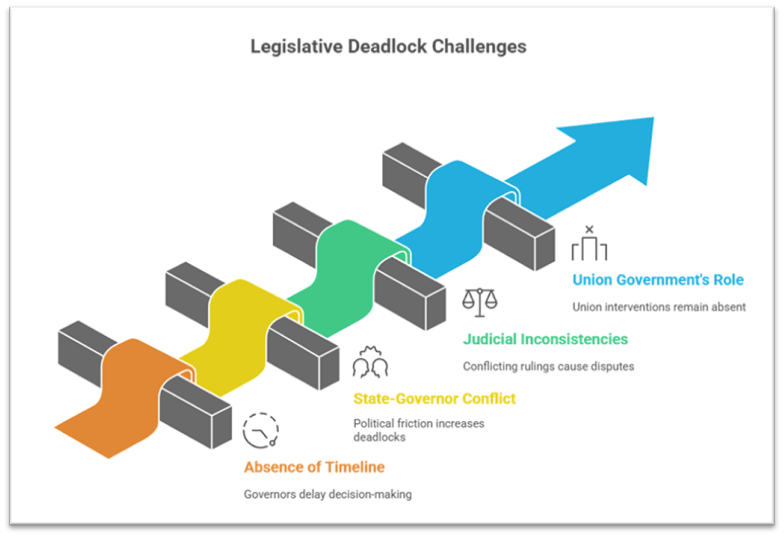
Absence of a Constitutional Timeline
- Articles 200 and 201 prescribe no time limit for decision-making, enabling Governors to sit indefinitely on Bills.
- In several States, Bills have been pending for over two years, leading to public policy delays.
- Judicial directions fixing a three-month limit attempt to plug this constitutional gap.
-
Conflict Between State Governments and Governors
- Increasing political friction between ruling parties in States and Governors appointed by the Union has heightened deadlocks.
- Examples include Tamil Nadu, Kerala, and Punjab, where Governors were accused of withholding assent for political reasons.
- Such standoffs undermine the principle that the real executive authority rests with the elected government.
-
Judicial Inconsistencies
- Earlier cases like Shamsher Singh hinted at limited discretion, but later cases like State of Tamil Nadu vs The Governor of Tamil Nadu (2025) categorically ruled against independent gubernatorial discretion.
- This evolving jurisprudence reflects the judiciary’s attempt to balance textual silences with constitutional morality.
- The absence of clear codification still leaves space for interpretative disputes.
-
Union Government’s Role
- Under Article 355, the Union has the duty to ensure States function in accordance with the Constitution.
- Creative interpretation suggests the Union could direct Governors to act, but in practice, such interventions remain absent.
- The lack of executive checks has forced States to rely on judicial remedies.
Judicial Intervention as a Remedy
-
Necessity of Judicial Oversight
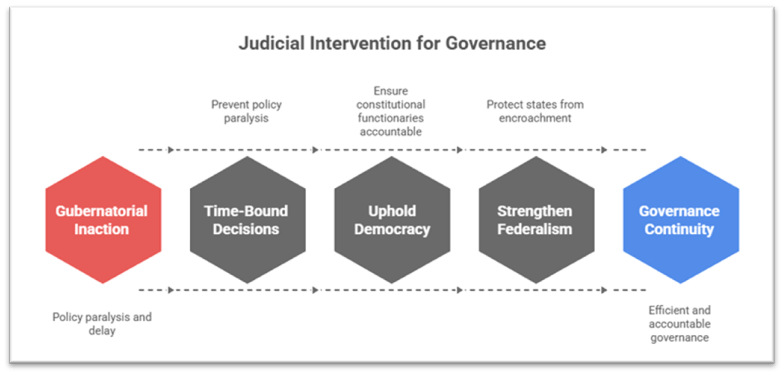
- Judicial intervention ensures that constitutional functionaries remain accountable, particularly when gubernatorial inaction thwarts the legislature.
- Courts in Punjab (2023) and Tamil Nadu (2025) affirmed that indefinite delay is unconstitutional and directed time-bound decision-making.
- Such interventions uphold the spirit of representative democracy.
-
Concerns of Judicial Overreach
- Critics argue that the judiciary, by prescribing timelines, enters the domain of constitutional amendment, which is the prerogative of Parliament.
- The government maintains that courts cannot impose conditions absent in the constitutional text.
- However, judicial expansion has precedent—such as in Maneka Gandhi (1978), where the scope of Article 21 was vastly widened.
-
Ensuring Legislative Efficiency
- Time-bound decisions prevent policy paralysis and ensure governance continuity.
- For instance, in Punjab, critical fiscal legislation was delayed due to gubernatorial inaction, risking administrative functioning.
- Judicial timelines act as a safeguard against constitutional subversion through delay.
-
Balancing Federal Principles
- Judicial pronouncements reinforce that Governors are not parallel power centers but constitutional heads.
- By clarifying ambiguities, courts protect States from central encroachment, thereby strengthening federalism.
- These judgments mark a progressive step in ensuring constitutional accountability without rewriting the text.
- The Governor may grant assent, withhold assent, return a Bill (not Money Bills) for reconsideration, or reserve it for the President’s consideration.
- This framework derives from Section 75 of the Government of India Act, 1935, though the phrase “in his discretion” was deliberately omitted in the Constitution, indicating the intent to restrict unilateral gubernatorial action.
- For instance, in State of Punjab vs Principal Secretary to the Governor (2023), the Court emphasized that delay or inaction cannot be a constitutionally valid option.
- Under Article 163, the Governor ordinarily acts on the aid and advice of the elected Council of Ministers, except in areas explicitly mentioned (e.g., reserving Bills on matters derogating from High Court powers under Article 201).
- The Shamsher Singh vs State of Punjab (1974) judgment reiterated that the Governor is a constitutional head and not an independent authority.
- Commissions such as Sarkaria (1988) and Punchhi (2010) reaffirmed that Governors should avoid interfering with the democratic mandate.
- The Supreme Court in Nabam Rebia (2016) held that Governors cannot exercise discretionary powers in matters not explicitly stated by the Constitution.
- While the Sarkaria Commission allowed discretion in rare cases of patently unconstitutional Bills, judicial interpretations increasingly reject unfettered discretion.
- Comparative practice in the UK shows that even the monarch cannot withhold assent independently, reinforcing the principle of parliamentary supremacy.
- Misuse of gubernatorial powers to delay or block Bills undermines cooperative federalism.
- For example, Bills relating to NEET exemption in Tamil Nadu and Punjab’s agricultural laws remained stalled, creating governance paralysis.
- This raises concerns of Governors becoming “super-constitutional authorities”, disrupting legislative processes.
- Articles 200 and 201 prescribe no time limit for decision-making, enabling Governors to sit indefinitely on Bills.
- In several States, Bills have been pending for over two years, leading to public policy delays.
- Judicial directions fixing a three-month limit attempt to plug this constitutional gap.
- Increasing political friction between ruling parties in States and Governors appointed by the Union has heightened deadlocks.
- Examples include Tamil Nadu, Kerala, and Punjab, where Governors were accused of withholding assent for political reasons.
- Such standoffs undermine the principle that the real executive authority rests with the elected government.
- Earlier cases like Shamsher Singh hinted at limited discretion, but later cases like State of Tamil Nadu vs The Governor of Tamil Nadu (2025) categorically ruled against independent gubernatorial discretion.
- This evolving jurisprudence reflects the judiciary’s attempt to balance textual silences with constitutional morality.
- The absence of clear codification still leaves space for interpretative disputes.
- Under Article 355, the Union has the duty to ensure States function in accordance with the Constitution.
- Creative interpretation suggests the Union could direct Governors to act, but in practice, such interventions remain absent.
- The lack of executive checks has forced States to rely on judicial remedies.
- Judicial intervention ensures that constitutional functionaries remain accountable, particularly when gubernatorial inaction thwarts the legislature.
- Courts in Punjab (2023) and Tamil Nadu (2025) affirmed that indefinite delay is unconstitutional and directed time-bound decision-making.
- Such interventions uphold the spirit of representative democracy.
- Critics argue that the judiciary, by prescribing timelines, enters the domain of constitutional amendment, which is the prerogative of Parliament.
- The government maintains that courts cannot impose conditions absent in the constitutional text.
- However, judicial expansion has precedent—such as in Maneka Gandhi (1978), where the scope of Article 21 was vastly widened.
- Time-bound decisions prevent policy paralysis and ensure governance continuity.
- For instance, in Punjab, critical fiscal legislation was delayed due to gubernatorial inaction, risking administrative functioning.
- Judicial timelines act as a safeguard against constitutional subversion through delay.
- Judicial pronouncements reinforce that Governors are not parallel power centers but constitutional heads.
- By clarifying ambiguities, courts protect States from central encroachment, thereby strengthening federalism.
- These judgments mark a progressive step in ensuring constitutional accountability without rewriting the text.
Conclusion:
The role of the Governor under Article 200 is meant to be formal and facilitative, not discretionary or obstructive. The Constitution envisages the Governor as a neutral arbiter, ensuring that the elected legislature’s will prevails, except in cases where constitutional validity is in question. However, in practice, indefinite delays have led to legislative paralysis, necessitating judicial intervention as a corrective measure. While concerns of judicial overreach persist, the Supreme Court’s recent directions have smoothened legislative processes and reinforced federal balance.
Going forward, a constitutional amendment or parliamentary law prescribing a reasonable time frame for gubernatorial assent, coupled with adherence to constitutional morality, can provide lasting clarity. With over 60% of State-level governance outcomes dependent on timely legislative enactments, ensuring procedural efficiency is not just a matter of constitutional propriety but also of democratic legitimacy.
The way ahead lies in harmonizing the Governor’s formal role with the sovereignty of elected legislatures, supported by judicial safeguards and Union accountability.
Recap: