Evaluate the Role of Public Policy in Preventing Prolonged Wage Stagnation and Inequality During AI-Led Technological Transitions
Introduction
Artificial Intelligence (AI), as a general-purpose technology (GPT) like steam power or electricity, has the potential to transform economies by enhancing productivity across multiple industries. Yet, as history shows through the Engels’ Pause of 19th-century Britain, productivity gains do not automatically translate into widespread welfare improvements.
Recent studies suggest similar risks today: while PwC projects AI adding $15.7 trillion to global GDP by 2030, the IMF estimates 40% of jobs worldwide are exposed to AI, with disproportionate impacts across economies. Public policy therefore plays a decisive role in ensuring that the benefits of technological change are distributed equitably, preventing wage stagnation and widening inequality.
Body
Positive Role of Public Policy in Mitigating Inequality
Skill Development and Human Capital Creation
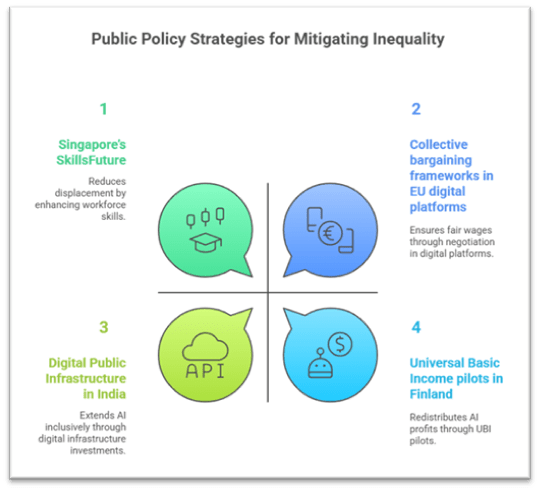
- National programmes like Singapore’s SkillsFuture and India’s Skill India Mission show how state-led reskilling can reduce displacement.
- AI requires complementary skills such as data analysis, cybersecurity, and coding. Publicly funded upskilling initiatives and AI universities (e.g., Mohamed bin Zayed University of AI in Abu Dhabi) equip workers for future roles.
- Case studies like Philippines’ call centres adopting AI copilots demonstrate that with training, workers can shift from routine to supervisory tasks, mitigating stagnation.
Redistribution Mechanisms
- Policy tools such as Universal Basic Income (UBI) pilots in Finland and the UK highlight ways to redistribute AI-driven profits.
- Progressive taxation, including proposals for robot taxes, can fund social security nets to cushion workers during technological disruptions.
- In India, Direct Benefit Transfers (DBT) provide a foundation for delivering redistributive income support in an AI-driven economy.
Public Goods Provision in AI Infrastructure
- Governments can lower entry barriers by treating data, compute, and cloud access as public goods, reducing cost pressures on firms and workers.
- Initiatives like K2Think.ai in UAE and Apertus in Switzerland show how publicly available AI reasoning models democratise access.
- For India, investments in Digital Public Infrastructure (DPI) such as Aadhaar and UPI provide models to extend AI inclusively.
Strengthening Labour Institutions
- Historically, trade unions and welfare states in Europe during the Industrial Revolution transformed productivity gains into higher wages.
- Today, labour codes in India and collective bargaining frameworks in EU digital platforms are crucial in negotiating fair wages amid AI adoption.
- Worker representation in technology governance ensures that wage suppression does not deepen structural inequality.
Challenges and Limitations of Public Policy
Policy Lag and Technological Speed
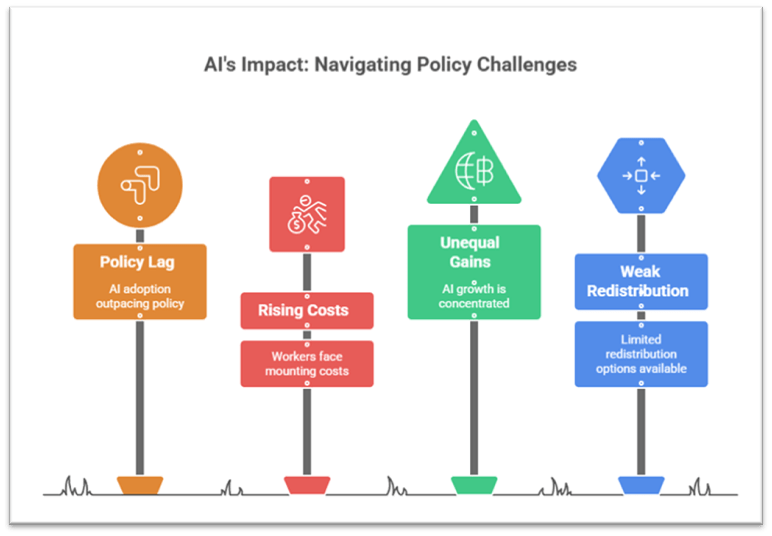
AI adoption is outpacing institutional adaptation, as seen in the 12,000 job cuts by a major Indian IT firm shifting to AI. Bureaucratic inertia delays effective safety nets, risking an interim period of prolonged wage stagnation, akin to historical Engels’ pause. Even strong welfare economies struggle: MIT research shows 95% of AI pilots are yet to deliver tangible productivity gains, reflecting mismatch between policy intent and industry readiness.
Rising Costs of Complements
Workers face mounting costs of staying relevant: coding boot camps, certification courses, and retraining. Similar to 19th-century households where rising food costs offset wage gains, today’s workforce may see modest salary growth eroded by digital survival costs. Without subsidies for lifelong learning, inequalities deepen despite productivity increases.
Unequal Global Gains
AI growth is concentrated: benefits accrue disproportionately to U.S., China, and a few firms controlling foundational models. Developing countries risk being left behind, with limited access to compute and training infrastructure. Evidence from India’s stronger IPR regime widening wage inequality in technology-intensive sectors shows how global race conditions can worsen inequality.
Institutional Weaknesses in Redistribution
Experiments with UBI remain limited in scale, and fiscal constraints in developing nations constrain redistribution options. Political economy factors—like lobbying by technology firms—may prevent taxation of AI rents. Weak enforcement of labour codes in the informal sector, where most workers in India are employed, undermines wage security.
Neutral/ Mixed Outcomes – Areas of Ambiguity
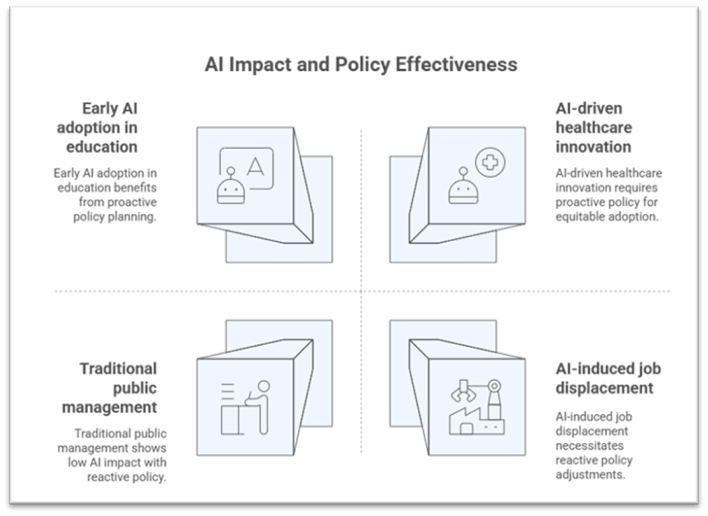
- AI as Both Displacer and Complement: AI complements doctors (e.g., AI hospital in China’s Tsinghua University) but displaces routine service jobs, creating mixed labour market effects.
- Potential for Welfare Gains if Managed Well: Unlike 19th-century Britain, today’s societies have social security frameworks, faster tech diffusion, and democratic accountability.
- Public Policy as Necessary but Insufficient: While policy can redistribute, long-term gains also depend on market adjustments, innovation ecosystems, and private sector strategies.
Conclusion:
Evaluating the role of public policy shows that it is central to preventing prolonged wage stagnation and inequality during AI-led transitions, but its effectiveness depends on speed, design, and political will. On the positive side, skilling initiatives, redistributive mechanisms, and AI infrastructure as public goods can democratise benefits, while stronger labour institutions safeguard fair wages. On the negative side, policy lag, unequal global distribution, rising reskilling costs, and weak welfare mechanisms threaten to prolong inequality. Neutral outcomes suggest that AI may still deliver consumer welfare benefits but with uneven labour market impacts.
The verdict is that public policy cannot fully eliminate the risks of an AI Engels’ pause, but it can significantly shorten and soften it if governments act with foresight. The challenge is to ensure AI becomes not just a productivity revolution but a human welfare revolution. With global GDP gains of over $15 trillion at stake and 40% of jobs exposed to AI, the stakes are high. Thus, anticipatory governance, inclusive skilling, and redistributive innovation policies are essential to convert technological progress into shared prosperity.
Recap: