

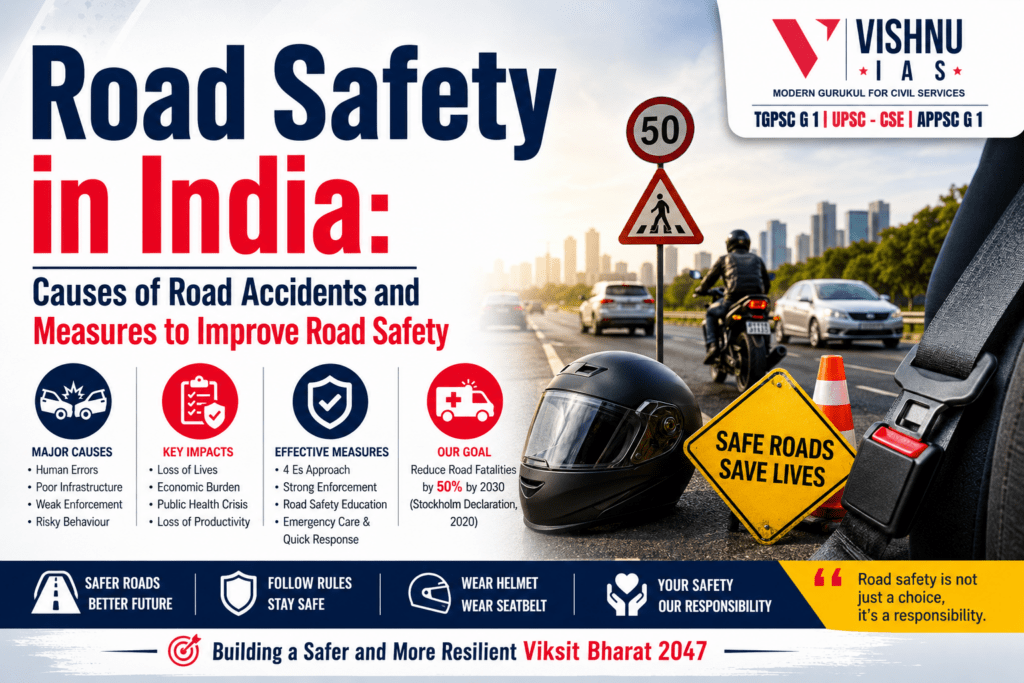
Introduction
Road Safety in India has emerged as one of the most critical public policy and disaster management concerns. Road traffic accidents constitute a silent, preventable human-induced disaster, imposing enormous human, social and economic costs. India records one of the highest numbers of road accident fatalities globally.
With around 1.77 lakh fatalities annually (one death every three minutes), road safety has become not merely a transport issue but also a constitutional obligation under Article 21 (Right to Life), a public health challenge, and an integral component of Disaster Risk Reduction (DRR).
Body
I. Road Accidents as a Major Disaster Management Challenge
1. Human and Behavioural Vulnerabilities
- Human errors such as over-speeding, drunk driving, distracted driving (mobile phone use), red-light jumping, wrong-side driving, and non-use of helmets and seat belts account for the majority of fatalities.
- Weak road safety culture, inadequate driver training, and poor compliance with traffic regulations increase both accident frequency and severity.
2. Infrastructure and Governance Deficiencies
- Poor road engineering, unsafe junctions, potholes, inadequate signage, black spots, and poorly maintained vehicles significantly increase accident risks.
- Fragmented institutional responsibilities across roads, police, transport, and public health departments result in weak coordination, inconsistent enforcement, and limited accountability.
- In S. Rajaseekaran v. Union of India (2014), the Supreme Court observed that road accidents are preventable human failures and highlighted deficiencies in Engineering, Enforcement, Education, and Emergency Care (4 Es).
3. Socio-Economic and Public Health Consequences
- Road accidents disproportionately affect the 18–45 years productive age group, leading to loss of human capital, livelihood insecurity, and increased poverty.
- They impose an economic burden exceeding 3% of GDP through healthcare expenditure, productivity loss, and infrastructure damage while overwhelming emergency medical systems.
- India has committed under the Stockholm Declaration (2020) to reduce road fatalities by 50% by 2030.
II. Measures Required for Strengthening Road Safety and Disaster Resilience
1. Strengthening the ‘4 Es’ Approach
Engineering
- Conduct regular road safety audits.
- Rectify black spots.
- Improve road geometry.
- Enhance street lighting.
- Develop pedestrian and cycling infrastructure.
- Adopt the Safe System Approach.
Enforcement
- Ensure strict implementation of the Motor Vehicles (Amendment) Act, 2019.
- Use AI-enabled surveillance.
- Deploy ANPR cameras.
- Expand e-challan systems.
- Install speed cameras.
- Impose deterrent penalties.
Education
- Introduce road safety education in schools.
- Reform driver training and licensing systems.
- Promote behavioural change campaigns such as Sadak Suraksha Jeevan Raksha and Traffic Pathshala.
- Increase awareness regarding helmet and seat belt usage.
Emergency Care
- Strengthen trauma centres and ambulance networks.
- Improve Golden Hour emergency response.
- Expand the National Highway Accident Relief Service Scheme (NHARSS).
- Ensure effective implementation of Good Samaritan Guidelines.
2. Building Institutional and Emergency Response Capacity
- Strengthen the National Road Safety Board.
- Empower District Road Safety Committees.
- Improve Centre-State coordination for integrated road safety governance.
- Expand trauma care centres and ambulance services.
- Enhance Golden Hour emergency response systems.
- Effectively implement Good Samaritan Guidelines.
3. Promoting Behavioural Change and Data-Driven Governance
- Institutionalise road safety education in schools.
- Reform driver licensing mechanisms.
- Conduct sustained public awareness campaigns to promote responsible road behaviour.
- Develop an integrated national crash database using GIS, AI, and real-time analytics for evidence-based policymaking and identification of accident hotspots.
- Campaigns such as Sadak Suraksha Jeevan Raksha and Delhi’s Traffic Pathshala demonstrate the importance of behavioural interventions alongside stricter enforcement.
Conclusion
Road accidents are not inevitable tragedies but preventable events, requiring a shift from reactive accident response to proactive disaster risk reduction. A comprehensive strategy combining safe infrastructure, technology-driven enforcement, behavioural transformation, institutional coordination, and resilient emergency care is essential for achieving SDG 3.6, fulfilling the constitutional mandate under Article 21, and building a safer and more resilient Viksit Bharat 2047.