Introduction
The concept of Spheres of Influence refers to an informal geopolitical arrangement in which a powerful state claims predominant strategic, political, or security interests over a defined region, limiting the autonomy of other states and discouraging external intervention.
Though never codified in international law, this practice shaped 19th- and early 20th-century imperial politics and was formally challenged after 1945 by the United Nations Charter, which enshrined sovereign equality, non-intervention, and collective security as foundational norms.
However, contemporary geopolitics reveals a discernible erosion of this order.
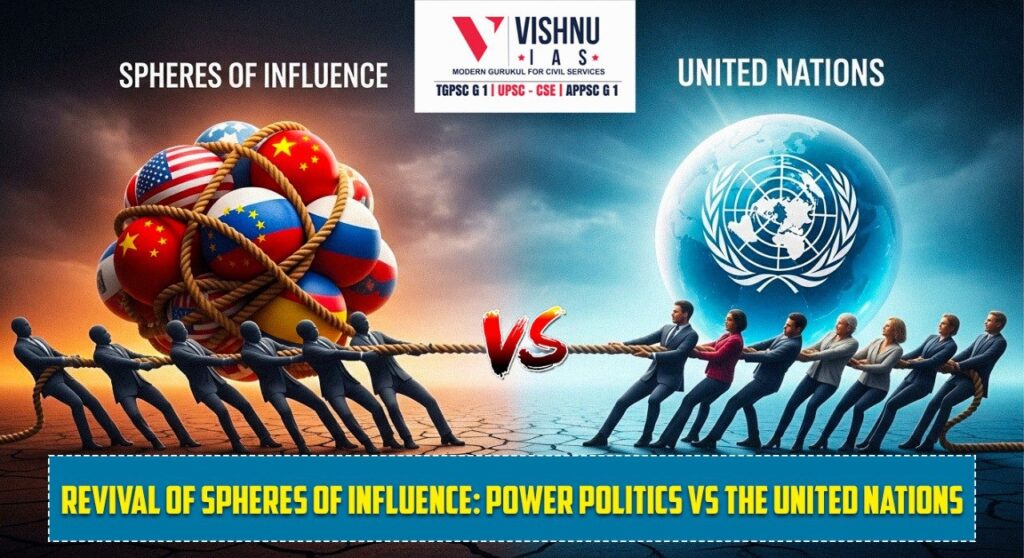
The reassertion of unilateral power, declining faith in multilateral institutions, and intensified great-power rivalry have revived sphere-based behaviour.
Recent developments in the Western Hemisphere and Southeast Asia exemplify this shift, raising serious questions about the central authority, legitimacy, and enforcement capacity of the United Nations in the current international system.
Body
I. Revival of Spheres of Influence: Strategic Assertiveness in Practice
1. Western Hemisphere: Reinterpretation of Regional Primacy
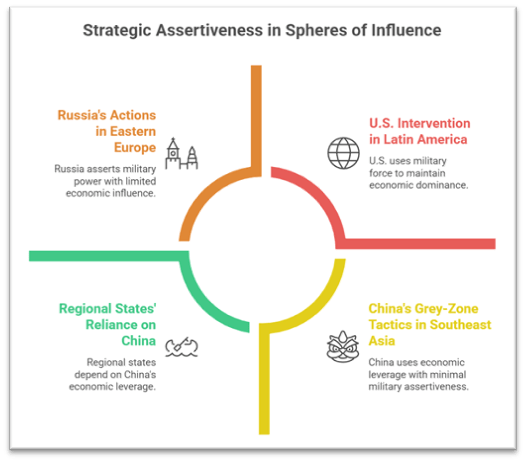
The United States’ renewed emphasis on exclusive security responsibility in the Western Hemisphere signals a modern reinterpretation of the Monroe Doctrine, now framed through doctrines of pre-emptive security and denial of extra-regional access.
Example: Direct interventionist actions in Latin America reflect a shift from diplomatic pressure to coercive enforcement of regional dominance, prioritising perceived national security over sovereign consent.
This approach aligns with the U.S. National Security Strategy’s emphasis on preventing non-hemispheric competitors from establishing military or strategic footholds, reinforcing a hierarchical regional order.
The muted international response underscores the normalisation of power asymmetry, where regional hegemons act with limited reputational cost.
2. Southeast Asia: Incremental Assertion through Grey-Zone Tactics
China’s expanding presence in Southeast Asia reflects a layered sphere of influence built through economic leverage, infrastructure integration, and maritime assertiveness rather than overt territorial conquest.
Case Study: Persistent activities in contested waters of the South China Sea illustrate a strategy of salami slicing, altering facts on the ground while avoiding thresholds that trigger collective military response.
The growing reliance of regional states on Chinese trade, supply chains, and development finance has constrained their strategic autonomy.
The gradual marginalisation of multilateral maritime norms reveals how regional power projection can coexist with formal treaty adherence while undermining their spirit.
3. Eurasian Parallels Reinforcing the Trend
Russia’s actions in its near abroad demonstrate how historical influence zones are being reasserted under the logic of strategic depth and civilisational space.
Case Study: Protracted conflicts in Eastern Europe illustrate the rejection of post-Cold War security arrangements in favour of unilateral redrawing of influence boundaries.
Together, these cases indicate that spheres of influence are no longer aberrations but an emerging organising principle of global politics.
II. Structural Drivers Behind the Resurgence
1. Decline of Liberal Multilateralism
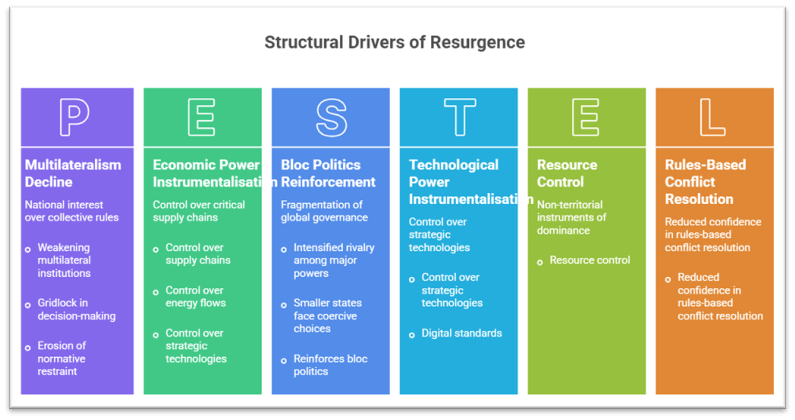
The weakening credibility of multilateral institutions has encouraged major powers to prioritise national interest over collective rules.
Persistent gridlock in global decision-making bodies has reduced confidence in rules-based conflict resolution, incentivising unilateral action.
The erosion of normative restraint reflects a transition from consensus-based governance to power-based ordering.
2. Strategic Competition and Security Dilemmas
Intensified rivalry among major powers has transformed regions into contested theatres of influence, where neutrality is increasingly untenable.
Smaller states face coercive choices between competing blocs, undermining their strategic autonomy.
Example: Southeast Asian states balancing economic dependence on China with security partnerships elsewhere illustrate the pressures created by overlapping spheres.
This dynamic reinforces bloc politics and accelerates the fragmentation of global governance.
3. Instrumentalisation of Economic and Technological Power
Control over critical supply chains, energy flows, and strategic technologies has become central to influence projection.
Economic statecraft now complements military power in shaping regional hierarchies.
Infrastructure corridors, digital standards, and resource control function as non-territorial instruments of dominance.
III. Implications for the United Nations and Global Order
1. Erosion of Normative Authority
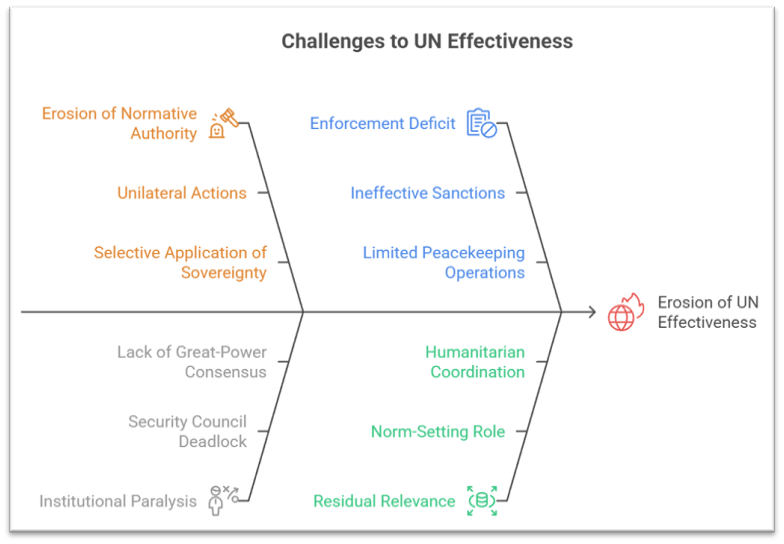
Repeated unilateral actions without credible consequences have weakened the UN’s role as the custodian of international norms.
The principles of sovereignty and non-use of force are increasingly applied selectively, diminishing their universality.
Silence or inaction by global institutions is often interpreted as tacit acceptance of faits accomplis.
2. Institutional Paralysis and Enforcement Deficit
The Security Council’s inability to act decisively in major power disputes has reinforced perceptions of irrelevance.
Example: Veto-induced deadlock has prevented timely collective responses to crises involving influential states or their allies.
Peacekeeping, mediation, and sanctions mechanisms struggle to operate where great-power consensus is absent.
This paralysis encourages states to bypass multilateral channels altogether.
3. Residual Relevance and Adaptive Functions
Despite these challenges, the United Nations retains importance as a norm-setting, humanitarian, and coordination platform.
UN agencies continue to shape development priorities, manage refugee crises, and provide neutral forums for dialogue.
The organisation’s authority is undermined but not extinguished; it persists as a constrained but indispensable institution.
Conclusion:
The contemporary revival of Spheres of Influence reflects a broader transformation in global politics marked by strategic rivalry, declining multilateral trust, and the resurgence of power hierarchies. Developments in the Western Hemisphere and Southeast Asia illustrate how regional dominance is being asserted through military, economic, and normative means, often at the expense of smaller states’ autonomy.
While this trend significantly weakens the operational authority of the United Nations, it does not render the institution obsolete. The UN’s diminished enforcement capacity contrasts with its continuing relevance in humanitarian action, norm articulation, and crisis coordination.
The way forward lies in strengthening multilateral legitimacy through institutional reform, expanding representativeness in global decision-making, and reinforcing preventive diplomacy. As global surveys consistently indicate that a majority of states still favour cooperative security over unilateralism, revitalising collective mechanisms remains both a strategic necessity and a practical possibility in an increasingly fragmented world order.
Recap: