
Procurement Reforms in India: Transforming the Public Sector from Compliance to Innovation
Procurement Reforms in India are reshaping how the government acquires goods, works, and services—moving the public sector from a rigid compliance-driven framework to an innovation-driven ecosystem. With procurement accounting for nearly 20–22% of India’s GDP, these reforms under GFR 2025 hold the potential to act as a powerful catalyst for research, development, and technological advancement.
Introduction
- Public procurement, defined as the process by which governments acquire goods, works, and services, has historically been designed with transparency, accountability, and cost-efficiency as its primary goals.
- However, global experiences show that procurement frameworks can also serve as catalysts for innovation, spurring research and development (R&D) by creating stable demand for advanced technologies. In India, procurement accounts for nearly 20–22% of GDP, making it a critical policy lever.
- Recent reforms in India’s General Financial Rules (GFR 2025) — such as raising financial thresholds, allowing exemptions from the Government e-Marketplace (GeM), and delegating approval powers — mark a significant shift from rigid compliance to a more flexible, innovation-supportive system. The challenge lies in balancing fraud prevention and efficiency with the need to empower public institutions to act as early adopters of new technologies.
Procurement as a Barrier to Innovation
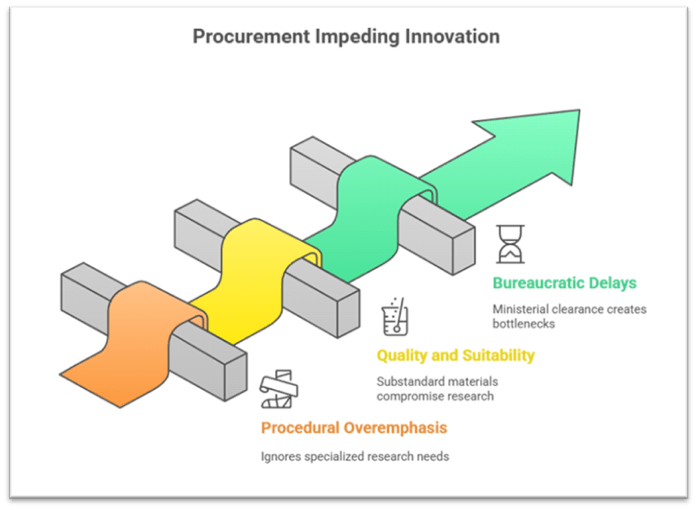
Overemphasis on Procedural Compliance
- Historically, India’s procurement rules mandated GeM purchases for all sub-₹200 crore equipment, often ignoring the specialised needs of scientific research.
- This forced institutions to undergo lengthy exemption processes, delaying time-sensitive projects.
- Example: Indian labs working in biotechnology and quantum computing faced months-long delays due to non-availability of niche instruments on GeM.
Quality and Suitability Issues
- Vendors listed on GeM often provided substandard or generic materials, compromising the quality of research outcomes.
- The rigidity of “lowest-cost bidding” undervalued technical sophistication, reducing incentives for private firms to innovate.
- Case Study: Multiple CSIR laboratories reported that procurement delays and unsuitable tools led to underutilisation of grant funds.
Bureaucratic Delays and Centralisation
- Approvals for high-value global tenders often required ministerial clearance, creating bottlenecks.
- This hampered India’s ability to compete globally in high-tech fields.
- Example: The Prime Minister’s Economic Advisory Council flagged procurement delays as a major barrier to R&D efficiency.
Procurement Reforms as an Enabler of Innovation
Flexibility through GFR 2025 Reforms
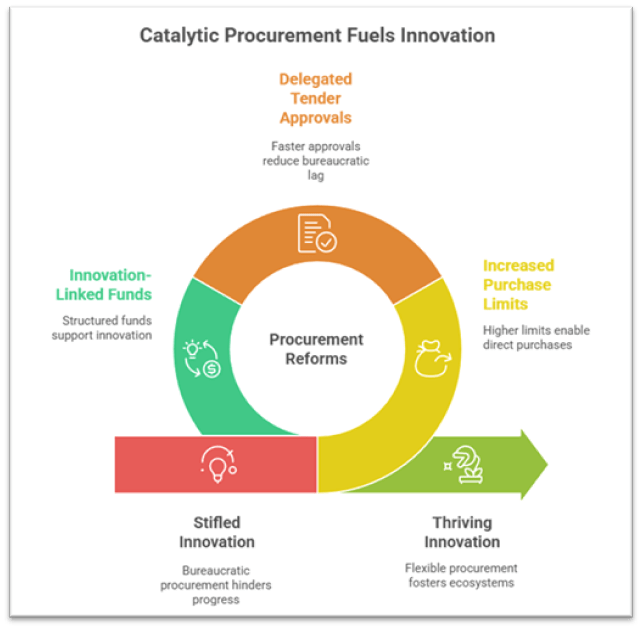
- Recent reforms raised the direct purchase limit from ₹1 lakh to ₹2 lakh and allowed institutional heads to bypass GeM for specialised equipment.
- Delegating approval for global tenders up to ₹200 crore to vice-chancellors and directors reduced bureaucratic lag.
- This shift reflects the principle of “catalytic procurement”, where flexibility fuels innovation ecosystems.
Global and Comparative Lessons
- Germany’s High-Tech Strategy institutionalises innovation procurement through agencies like KOINNO, promoting “mission-oriented procurement.”
- The US Small Business Innovation Research (SBIR) program reserves 3% of federal R&D funds for startups, creating ecosystems for early-stage innovation.
- South Korea’s pre-commercial procurement rewards prototype development, even at higher costs, to push moonshot technologies.
Case Studies in Public Innovation Procurement
- The European Union’s Green Procurement model helped create demand for renewable technologies, shaping markets ahead of time.
- NASA’s contracts for semiconductor development during the Cold War directly shaped the global IT industry.
- India’s GeM reforms align partially with these models but still lack structured innovation-linked procurement funds.
Challenges and Critiques of the Reform Process
Risk of Misuse and Ethical Concerns
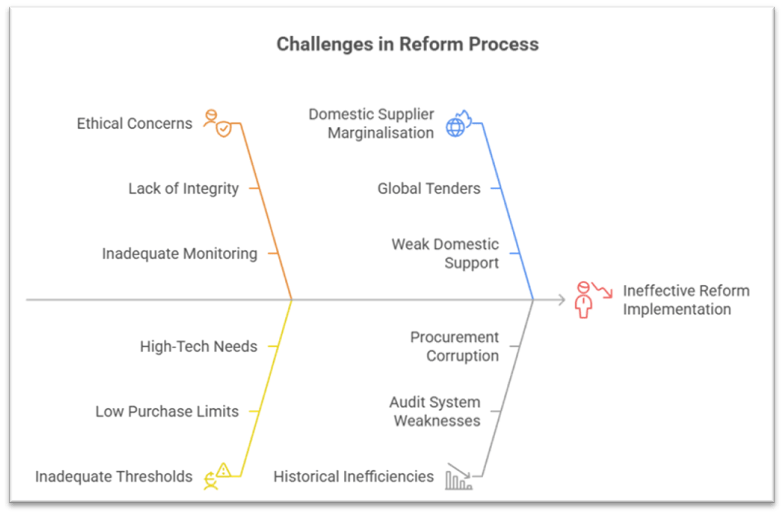
- Granting more discretion to institutional heads assumes high standards of integrity and accountability, which are not uniform across institutions.
- Without strong monitoring mechanisms, there is a risk of procurement corruption or misuse.
- India’s historical inefficiencies in audit systems highlight this concern.
Inadequacy of Thresholds for High-Tech Fields
- While the ₹2 lakh direct purchase limit is helpful for routine needs, it is insufficient for capital-intensive sectors like quantum computing, space research, or medical biotechnology, where equipment costs run into crores.
- This may limit the reform’s transformative potential in cutting-edge fields.
Domestic Supplier Marginalisation
- The focus on global tenders may ensure high-quality tools but risks sidelining local manufacturers unless domestic R&D ecosystems are simultaneously strengthened.
- Example: South Korea nurtured domestic firms through premium-priced prototype procurement, while India still lacks such safeguards.
Future Directions for Procurement-led Innovation
Outcome-Weighted Tenders
- Bids should be evaluated not only on cost but also on supplier innovation capacity, R&D investment, and scalability potential.
- Example: Finland’s procurement model incorporates innovation indices in evaluation criteria.
Sandbox Exemptions for Premier Institutions
- Granting institutions like IITs, IISc, and TIFR partial exemptions from GFR for a fixed percentage of procurement could allow experimental flexibility.
- Innovation targets could be audited by third parties annually to maintain accountability.
AI-Augmented Procurement Systems
- Leveraging the INDIAai ecosystem, AI could scan global catalogues, predict customs delays, and recommend alternatives, reducing decision cycles from months to hours.
- Example: During the Pfizer COVID-19 vaccine project, AI-driven procurement identified multiple suppliers within hours, compressing timelines.
Collaborative Procurement Models
- Adopting a Joint Procurement Agreement similar to the EU could allow Indian labs to pool demand for high-cost items like cryogenic coolers.
- This would generate economies of scale, reduce duplication, and incentivise suppliers to invest in R&D.
Conclusion
Procurement reforms in India represent an important shift from rigid, compliance-driven rules to a more flexible and innovation-driven framework. While the recent GFR 2025 reforms — such as raising purchase limits, bypassing GeM for specialised equipment, and delegating approval powers — address key pain points, their impact will depend on implementation, accountability, and alignment with national innovation goals. International experiences from Germany, the US, and South Korea highlight that procurement can shape markets and accelerate technological breakthroughs when linked explicitly to R&D outcomes.
Moving forward, India must integrate outcome-based evaluation, AI-assisted procurement, sandbox exemptions for premier institutions, and collaborative alliances. With procurement accounting for nearly one-fifth of India’s GDP, even marginal improvements can have a multiplier effect on innovation. If implemented effectively, procurement can transform India’s public sector into an innovation catalyst, helping the nation achieve its aspiration of becoming a global R&D hub.
Recap: