Presumption of Innocence and the 130th Amendment Bill 2025: Balancing Accountability and Due Process
Introduction
The principle of presumption of innocence—that an accused person is deemed innocent until proven guilty—forms a foundational pillar of criminal jurisprudence. It safeguards individual liberty and rights, ensuring that the mere accusation or detention does not equate to guilt. However, recent legislative developments in India—specifically the proposed amendment to Articles 75, 164 and 239AA of the Constitution through the Constitution (One Hundred And Thirtieth Amendment) Bill, 2025—raise questions about its interplay with this principle.
According to data from the Association for Democratic Reforms (ADR), nearly 47% of ministers at state and central levels have declared criminal cases against themselves, and about 31–40% of Chief Ministers face such cases. These statistics underscore the underlying governance and accountability concerns that the legislative move seeks to address—but also signal the need for a careful balance between accountability and fundamental rights.
Legal and Jurisprudential Dimension
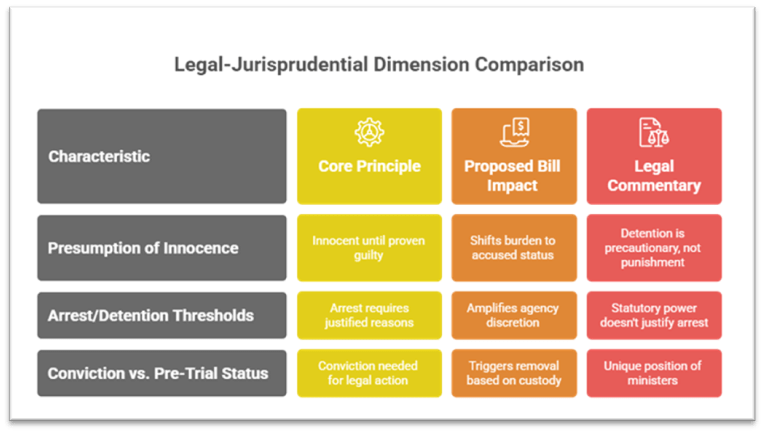
(a) Principle of Presumption of Innocence
The right to be presumed innocent until proven guilty is implicit in Article 21 of the Constitution of India and reflected in global human-rights jurisprudence. Deviating from it risks eroding fair-trial rights and undermining civil liberties.
The proposed Bill allows for removal of a minister if detained for 30 consecutive days for an offence punishable with five or more years’ imprisonment—before any conviction. This shifts the trigger from conviction to detention, thereby placing a burden on the accused’s status rather than proven guilt.
Legal commentary flags that detention is a precautionary measure, not a substitute for adjudication; using it as a basis for disqualification may convert process into punishment.
(b) Arrest and Detention Thresholds, and Discretion
Under the Bharatiya Nyaya Sanhita, 2023 (BNSS) and the Code of Criminal Procedure, 1973 (CrPC), powers of arrest (e.g., Section 41 CrPC) are framed in discretionary terms: “may arrest”. The courts have held that mere statutory power doesn’t justify arrest unless reasons are recorded.
For example, in Joginder Kumar vs State of U.P. (1994), the Supreme Court emphasised that arrest must be justified, and an arbitrary arrest undermines dignity and reputation of a person. Hence, grounding disqualification on arrest/detention may unduly amplify discretion of investigation/enforcement agencies, when safeguards are only procedural and not normative for removal of public office.
(c) Relevance of Conviction vs Pre-Trial Status
The legislative proposal treats continuous custody of 30 days as a trigger for removal, regardless of trial outcome. This calls into question whether the officebearer has been found guilty, or merely subject to detention for investigation.
From a jurisprudential standpoint, unless conviction is achieved, the accused retains the status of presumed innocent; changing tenure in office based on custody shifts the burden from proving guilt to surviving detention.
The counter-argument is the unique position of ministers (who hold executive functions) and the risk of conflict of interest, possible misuse of office, or subversion of investigation—meriting a distinct, stricter threshold. But that itself demands rigorous safeguards and clarity in criteria.
Governance and Accountability Dimension
(a) Problem of Criminalisation of Politics
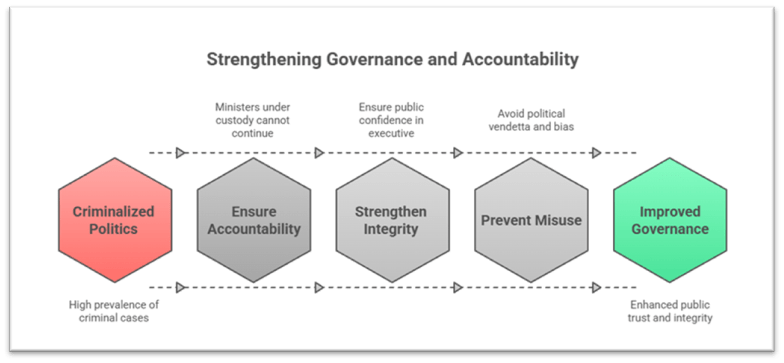
ADR data indicates that 47% of ministers examined across states and the Union have declared criminal cases; 174 ministers faced serious charges such as murder, kidnapping and crimes against women. Similarly, around 46% of Lok Sabha MPs, and 31% of them facing serious charges, are reported to have pending criminal cases. Such high prevalence raises questions of constitutional morality, public trust and the capacity of office-holders with serious allegations to perform executive functions without conflict.
(b) Executive Power, Investigation Risk and Ministerial Accountability
Ministers wield executive authority and may have indirect influence over investigative agencies, law-and-order machinery or administrative machinery. This creates a risk of undermining investigations if accused remain in office. The Bill’s intent is to ensure that a minister under long custody cannot continue in office unchecked, thus strengthening integrity of governance and ensuring public confidence in executive accountability.
(c) Risk of Misuse, Political Vendetta and Institutional Bias
The flip side: arrest and detention are vulnerable to political influences, agency bias or selective targeting—especially when special laws permit extended detention and limited bail. For example, under the Unlawful Activities (Prevention) Act, 1967 (UAPA), only ~2% of cases led to conviction, meaning large numbers remained in custody awaiting trial. High Courts have observed that many arrests are unjustified or unnecessary: the National Police Commission (1977) stated nearly 60% of arrests were unnecessary. Thus, basing removal from office on mere arrest or 30-day detention may create incentives for misuse: political opponents could be targeted for enforced removal rather than conviction, undermining rule of law and fairness.
Constitutional, Institutional and Public Policy Dimension
(a) Constitutional Office and Public Mandate
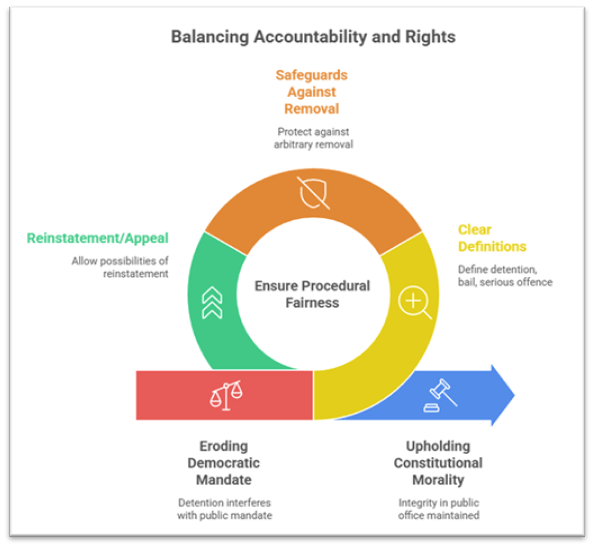
Ministers (including Prime Minister or Chief Ministers) derive office through democratic mandate via legislature and indirectly via electorate. Eroding their position due to arrest/detention may interfere with that mandate. The Bill proposes automatic cessation of office if the PM/CM does not resign by day 31 of detention, posing constitutional questions: does the electorate’s choice get sidelined on the basis of pre-trial detention? Critics assert this undermines representative democracy.
(b) Balance between Accountability and Rights of Accused
The Bill aims to enforce constitutional morality—ensuring individuals holding public office maintain integrity and are above serious criminal cloud. This is aligned with governance reform aspirations. However, any framework for removal must ensure procedural fairness, clear definitions (what constitutes “detention”, when bail is granted, what counts as “serious offence”), safeguards against arbitrary removal, and possibilities of reinstatement or appeal. The current threshold of 30 days may be too low, especially when judicial remand and investigation often exceed this.
For example, under Section 167(2) CrPC, default bail kicks in if investigation isn’t completed within 60 or 90 days—so detention of 30 days may not reflect guilt or serious procedural failure.
(c) Public Policy and Administrative Implications
On the positive side, the Bill could act as a deterrent against criminality in high office, reinforce administrative ethics and improve public trust in governance. On the negative side: If many ministers are removed automatically due to detention, governmental functioning may be disrupted (cabinet vacancies, policy paralysis). Further, incumbents may avoid bail to maintain office, or resign pre-emptively to avoid removal—even when they might be innocent.
Example: The arrest and long detention under special statutes such as PMLA, NDPS, UAPA often means bail is difficult due to twin burdens; this can create unintended disqualification even without trial. The Bill must account for these structural realities of the criminal justice system.
Conclusion:
The proposed legislative framework seeks to reconcile the twin imperatives of ministerial accountability and public trust in governance on the one hand, and the presumption of innocence and fair trial rights on the other. While the high prevalence of criminal cases among elected ministers (47% ministers facing cases; 40% Chief Ministers facing cases) underscores the urgency for reform, shifting the trigger from conviction to 30-day detention raises significant jurisprudential and policy concerns. By embedding due process safeguards and balancing the presumption of innocence with ministerial responsibility, the legislation can enhance integrity without undermining fundamental rights.
Recap: