Preamble of the Indian constution:
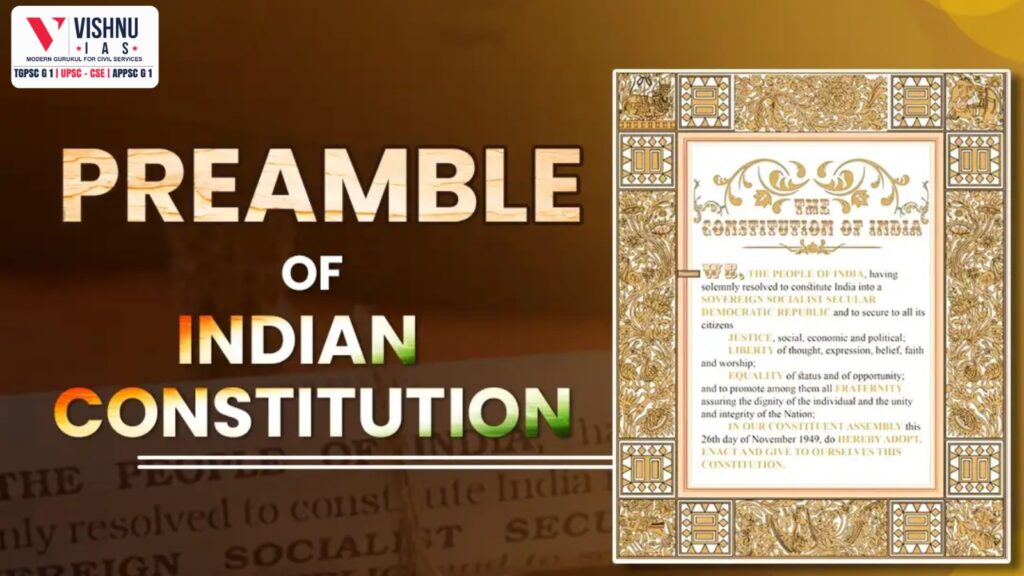
- The Preamble serves as the introduction or preface to the Constitution, containing its summary or essence.
- A. Palkhivala, an eminent jurist, called it the “Identity Card of the Constitution.”
Background & Evolution
- Inspiration: The idea of a Preamble was borrowed from the Constitution of the USA (the first to begin with one).
- Foundation: It is based on the “Objectives Resolution” drafted and moved by Pandit Jawaharlal Nehru on December 13, 1946.
- Adoption: The Constituent Assembly adopted this resolution on January 22, 1947.
- Enactment Timeline: The Preamble was enacted after the rest of the Constitution was already drafted and enacted, specifically to ensure it conformed with the finalized document.
The text of the Preamble reveals four essential components:
- Source of authority of the Constitution: It derives its authority from the people of India (“We, the people of India”).
- Nature of Indian State: It declares India to be of a sovereign, socialist, secular, democratic, and republican polity.
- Objectives of the Constitution: It specifies justice, liberty, equality, and fraternity as the objectives.
- Date of adoption: It stipulates November 26, 1949, as the date.
Key Terms & Their Meanings
Nature of the State:
- Sovereign: India is a completely independent state. It is neither a dependency nor a dominion of any other nation. It is free to conduct its own internal and external affairs without outside interference.
- Socialist: India follows “Democratic Socialism” (a mixed economy where public and private sectors coexist), aiming to end poverty, ignorance, disease, and inequality of opportunity.
- Secular: India follows “Positive Secularism.” The state does not have an official religion, and all religions enjoy the same status and support from the state.
- Democratic: Supreme power rests with the people. India operates as a representative parliamentary democracy with universal adult franchise, rule of law, and an independent judiciary.
- Republic: The head of the state (the President) is elected (indirectly for a fixed term of five years). It also means political sovereignty vests in the people, not in a single hereditary ruler like a monarch, and all public offices are open to every citizen.
Objectives of the State:
- Justice: Avoids purely legal justice and focuses on three dimensions (borrowed from the Russian Revolution):
- Social: Equal treatment of all citizens without discrimination based on caste, color, race, religion, or sex.
- Economic: Non-discrimination based on economic factors; eliminating glaring inequalities in wealth, income, and property.
- Political: Equal political rights, equal access to all political offices, and an equal voice in the government.
- Liberty: The absence of restraints on individuals, coupled with providing opportunities for the development of individual personalities. It explicitly guarantees liberty of thought, expression, belief, faith, and worship. (Note: Liberty is not absolute, but qualified).
- Equality: The absence of special privileges for any section of society and the provision of adequate opportunities for all individuals. It encompasses civic (Article 14-18), political (Article 325, 326), and economic (Article 39) equality.
- Fraternity: A sense of brotherhood, promoted primarily through the system of single citizenship and Fundamental Duties (Article 51A). It aims to ensure two things:
- The dignity of the individual.
- The unity and integrity of the nation. (Ideals of Liberty, Equality, and Fraternity are borrowed from the French Revolution).
Is the Preamble a Part of the Constitution?
- The Supreme Court’s stance has evolved over time, making this a crucial area for objective questions:
- Berubari Union Case (1960): The Supreme Court specifically opined that the Preamble is not a part of the Constitution.
- Kesavananda Bharati Case (1973): The Supreme Court rejected its earlier opinion and held that the Preamble is a part of the Constitution. It observed that the Preamble is of extreme importance and the Constitution should be read and interpreted in the light of its grand and noble vision.
- LIC of India Case (1995): The Supreme Court again held that the Preamble is an integral part of the Constitution.
Amendability of the Preamble
- The Preamble can be amended under Article 368 of the Constitution, provided the “basic structure” of the Constitution is not destroyed (established in the Kesavananda Bharati case).
- It has been amended only once so far, in 1976, by the 42nd Constitutional Amendment Act.
- This amendment added three new words: Socialist, Secular, and Integrity.
Amendments to the Preamble
- Can it be amended? Yes. The Supreme Court established in the Kesavananda Bharati Case (1973) that the Preamble is a part of the Constitution and can be amended under Article 368, provided the “Basic Structure” is not altered.
How many times has it been amended? Only once.
- The Amendment: 42nd Constitutional Amendment Act, 1976.
- Words Added: It added three new words: Socialist, Secular, and Integrity (often remembered by the mnemonic SSI).
Vital Facts
- The Preamble is neither a source of power to the legislature nor a prohibition upon the powers of the legislature.
- It is non-justiciable, meaning its provisions are not enforceable in courts of law.