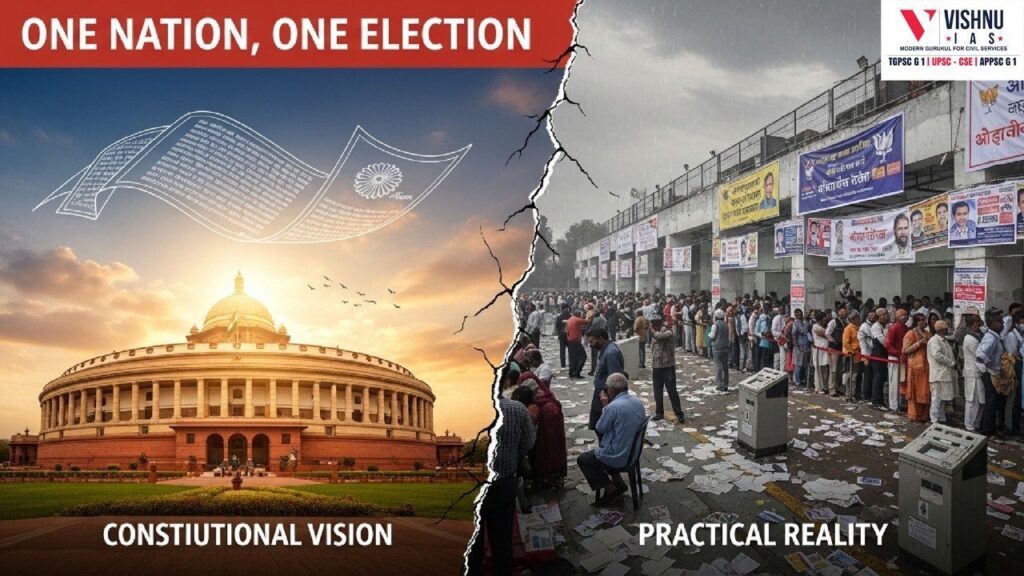
Constitution (129th Amendment) Bill, 2024: Constitutional Challenges of One Nation One Election
The Constitution (129th Amendment) Bill, 2024 seeks to implement the concept of One Nation, One Election (ONOE) by synchronising elections to the Lok Sabha and State Legislative Assemblies across India. The proposal aims to streamline the electoral cycle, reduce governance disruptions caused by frequent elections, and optimise administrative resources. However, the Constitution (129th Amendment) Bill, 2024 has triggered significant constitutional debate regarding its implications for federalism, parliamentary accountability, and democratic representation.
Introduction
- ‘One Nation, One Election (ONOE)’ refers to the proposal of synchronising elections to the Lok Sabha and State Legislative Assemblies so that they are conducted simultaneously across India. The proposal has taken legislative form through the Constitution (129th Amendment) Bill, 2024, based largely on recommendations of the High-Level Committee chaired by former President Ram Nath Kovind (2023–24).
- The Bill proposes major constitutional changes such as Article 82A, modification of Articles 83, 172 and 327, and the introduction of “unexpired-term elections.” While proponents argue that synchronised elections could reduce costs and governance disruptions, critics point out that elections historically account for only around 0.02–0.05% of GDP, raising concerns that such sweeping changes may create serious constitutional tensions relating to federalism, parliamentary accountability, and electoral legitimacy.
1. Constitutional and Institutional Concerns in Implementing ONOE
1.1 Tension with the Parliamentary System and Legislative Accountability
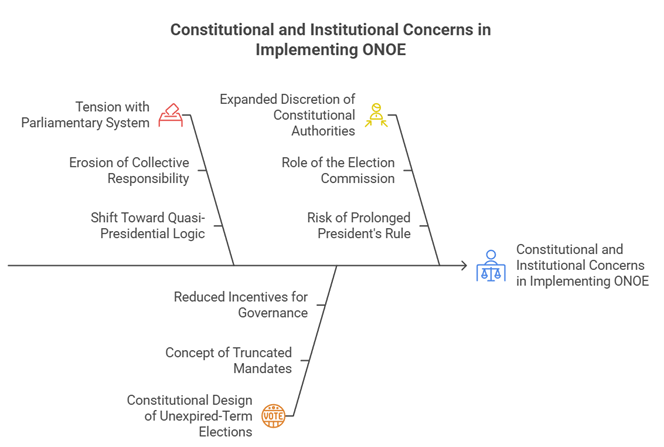
- Erosion of the principle of collective responsibility: India adopted a parliamentary form of government where the executive remains accountable to the legislature under Articles 75 and 164. Synchronised elections may incentivise governments to avoid dissolution even after losing majority, weakening democratic accountability.
- Example: In several states such as Karnataka (2018) and Maharashtra (2019), coalition instability led to government changes through legislative processes rather than fixed-term continuation.
- Shift toward a quasi-presidential logic: The proposal indirectly treats the five-year tenure of legislatures as fixed, while the Constitution only prescribes a maximum tenure under Articles 83 and 172. Early dissolution is constitutionally permitted to renew the mandate when political confidence collapses.
- Impact on caretaker governance: If a legislature collapses but elections must wait for synchronisation, a caretaker government may continue for extended periods, limiting policy decisions such as full budget presentation under Articles 112–117, thereby affecting fiscal governance.
1.2 Constitutional Design of “Unexpired-Term Elections”
- Concept of truncated mandates: The Bill proposes that if a legislature is dissolved early, the new legislature will serve only the remainder of the original term rather than a fresh five-year mandate, which raises concerns about dilution of electoral legitimacy.
- Reduced incentives for governance and reforms: Governments elected for a short residual term may avoid structural reforms and focus on short-term populism, affecting long-term policy continuity.
- Case Study: In many coalition transitions in states like Goa and Uttarakhand, governments with limited tenure struggled to implement major structural reforms.
- Possibility of governance gaps: The Bill does not clearly specify the minimum duration that justifies a residual election, potentially creating a “governance dead zone” where either prolonged President’s Rule or caretaker administration may occur.
1.3 Expanded Discretion of Constitutional Authorities
- Role of the Election Commission of India: The proposed Article 82A(5) allows the Election Commission to recommend deferring state elections if simultaneous conduct is impracticable, but without clearly defined criteria or time limits.
- Risk of prolonged President’s Rule: If elections are deferred for synchronisation, states could remain under Article 356 (President’s Rule) for extended periods, raising concerns about democratic representation.
- Judicial principle of institutional safeguards: Constitutional jurisprudence has emphasised that institutional design matters more than intentions.
- Example: In the NJAC judgment (2015), the Supreme Court emphasised that even potential structural threats to constitutional principles may invalidate amendments.
2. Federalism and Democratic Representation Challenges
2.1 Impact on India’s Federal Structure
- Federalism as part of the constitutional basic structure: The Supreme Court in S.R. Bommai (1994) affirmed that states possess independent constitutional identity, not merely administrative status.
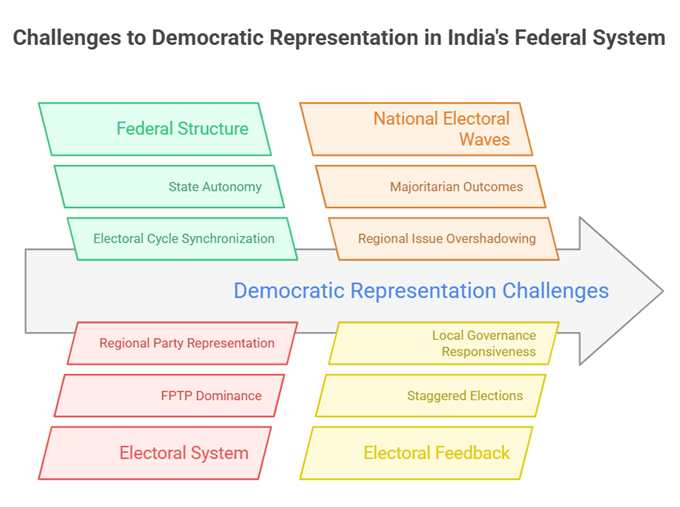
- Truncation of state mandates: Synchronising electoral cycles may require cutting short the tenure of state assemblies, which undermines the autonomy of state legislatures.
- Uneven democratic rhythms in federal systems: In many federations, elections occur independently to preserve regional political dynamics.
- Example: In Canada, federal and provincial elections are conducted independently, reflecting different political mandates.
2.2 Impact of National Electoral Waves in a First-Past-the-Post System
- Dominance of national narratives: India’s First-Past-the-Post (FPTP) electoral system often produces majoritarian outcomes, which may lead to national electoral waves overshadowing regional issues.
- Reduced representation of regional parties: Simultaneous elections could amplify national party advantages, weakening smaller regional formations that play a key role in coalition federalism.
- Comparative institutional design:
- Example: Countries such as South Africa and Indonesia use proportional representation systems, which mitigate the dominance of national waves and protect minority representation.
2.3 Continuous Electoral Feedback and Democratic Accountability
- Staggered elections as accountability mechanisms: Frequent elections at different levels create a continuous democratic feedback loop, allowing governments to gauge public sentiment.
- Local governance responsiveness: Elections to panchayats and urban local bodies under the 73rd and 74th Constitutional Amendments further deepen democratic participation through decentralised electoral cycles.
- Democratic theory perspective: The principle that frequent elections strengthen accountability is widely acknowledged in constitutional thought.
- Example: In Federalist No. 52, James Madison argued that periodic elections maintain governments’ “immediate dependence on the people.”
3. Administrative, Comparative and Practical Concerns
3.1 Administrative Complexity and Electoral Management
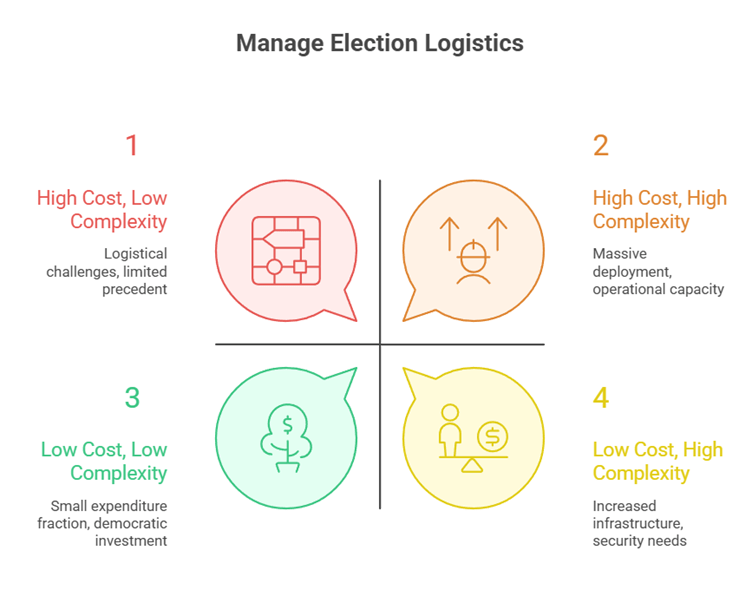
- Logistical challenges: Conducting simultaneous elections across all states would require massive deployment of EVMs, VVPATs, and security forces, reducing the current flexibility of phased elections.
- Election Commission’s operational capacity: Presently, elections are staggered to allow rotation of security forces and polling staff, which would be difficult under a single nationwide schedule.
- Example: The 2024 general elections lasted over 80 days in multiple phases, demonstrating the logistical scale required even for parliamentary elections alone.
3.2 Comparative Global Experience
- Limited international precedent: Most federal democracies maintain independent electoral cycles rather than strict synchronisation.
- Example – Indonesia: In 2019, Indonesia conducted a simultaneous election for the presidency and multiple legislatures, leading to nearly 900 deaths and thousands of illnesses among poll workers due to administrative overload.
- Example – Australia and Germany:
- In Australia, synchronisation is structurally difficult because federal and state legislatures have different constitutional tenures.
- In Germany, political stability stems from mechanisms such as the Constructive Vote of No Confidence, not election synchronisation.
3.3 Cost Argument and Fiscal Considerations
- Relatively low fiscal burden: Election expenditures historically constitute only a small fraction of national expenditure, estimated around 0.25% of the Union Budget and roughly 0.03% of GDP.
- Democratic cost vs administrative savings: Elections serve as essential instruments of public accountability, making them a core democratic investment rather than an avoidable administrative cost.
- Possible increase in logistical expenditure: Conducting simultaneous elections nationwide may actually increase infrastructure requirements, such as procuring additional EVMs and expanding security deployment.
Conclusion
The Constitution (129th Amendment) Bill, 2024 represents one of the most ambitious proposals to restructure India’s electoral architecture. However, the proposal raises significant constitutional challenges relating to parliamentary accountability, federal balance, electoral legitimacy, and institutional safeguards.
Given that elections historically involve less than 0.05% of national economic output, the potential democratic and constitutional risks may outweigh the projected administrative gains.
A balanced path forward may involve incremental reforms such as improving election management, reducing campaign expenditure, strengthening political finance transparency, and exploring voluntary alignment of election cycles where feasible, while preserving the core constitutional principles of federalism, legislative accountability, and democratic representation that underpin India’s constitutional order.
Recap: