

Introduction:
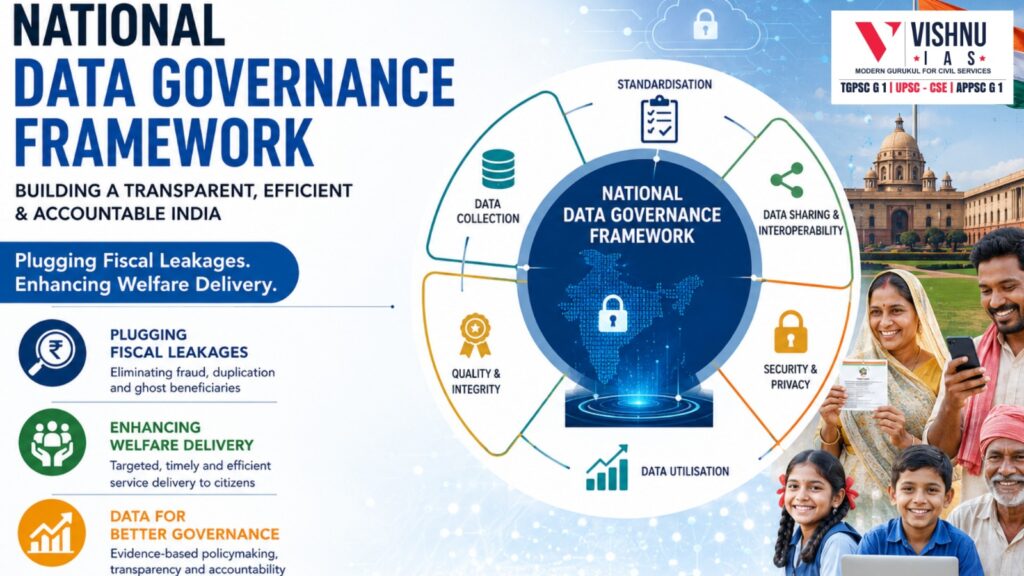
- A National Data Governance Framework (NDGF) refers to the institutional, legal, technological and administrative architecture that governs the collection, standardisation, sharing, interoperability, security and utilisation of public data for evidence-based policymaking and service delivery.
- In a welfare state where nearly ₹30 lakh crore+ is annually spent on social and developmental programmes, the quality of governance increasingly depends on the quality of data. India’s rapid digitalisation through platforms such as Aadhaar, JAM Trinity, DBT, and Digital Public Infrastructure (DPI) has created vast datasets, yet fragmented databases, inconsistent standards and poor interoperability continue to generate fiscal leakages estimated at 4–7% annually, weakening both state capacity and citizen trust.
- A robust national framework thus becomes central to achieving efficient, targeted and accountable welfare governance.
Body:
1. Role of a Robust Data Governance Framework in Plugging Fiscal Leakages
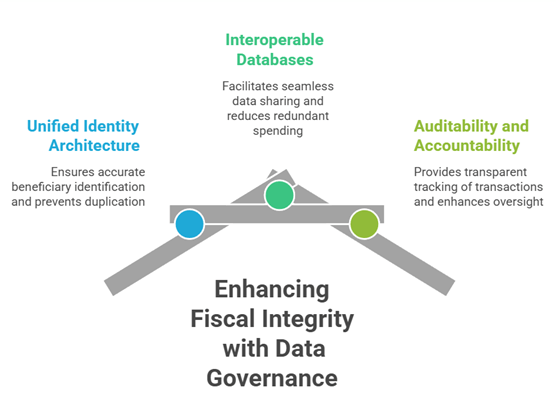
(a) Eliminating duplication and ghost beneficiaries through unified identity architecture
- A standardised national framework enables de-duplication across schemes by integrating databases through common identifiers such as Aadhaar-linked beneficiary registries, preventing multiple claims by the same individual.
- It reduces inclusion errors, where ineligible beneficiaries continue receiving subsidies due to outdated or siloed records.
- By ensuring real-time verification, fiscal resources can be redirected toward genuinely eligible populations.
- Example: Removal of over 17 million ineligible PM-KISAN beneficiaries significantly reduced unnecessary expenditure.
- Case Study: PAHAL (DBTL) Scheme eliminated millions of duplicate LPG beneficiaries through Aadhaar-based authentication, producing major subsidy savings.
- Government Initiative: Direct Benefit Transfer (DBT) Mission has cumulatively reported savings exceeding ₹3 lakh crore by plugging leakages.
(b) Improving expenditure efficiency through interoperable databases
- Ministries often maintain isolated databases, leading to repeated spending on overlapping households across schemes; interoperability helps create a single source of truth.
- Standardised metadata—common definitions for household, income, district and timelines—reduces administrative confusion and budget misallocation.
- Cross-platform analytics enable predictive detection of anomalies, flagging unusual payment patterns.
- Example: Integration of ration card databases with Aadhaar and NPCI systems reduced duplicate food subsidy claims.
- Case Study: One Nation One Ration Card (ONORC) demonstrated how interoperable beneficiary data can curb fraud while improving portability.
- Government Initiative: National Data and Analytics Platform (NDAP) aims to harmonise datasets across ministries for better policy analytics.
(c) Strengthening auditability and accountability
- Robust frameworks create digital audit trails, making every transaction traceable from sanction to delivery.
- Automated dashboards improve Parliamentary oversight, reducing dependence on fragmented departmental reporting.
- Standardised reporting enhances transparency and reduces discretionary manipulation.
- Example: Public Finance Management System (PFMS) tracks expenditure flows across schemes in real time.
- Case Study: Leakages in MGNREGA wage payments were reduced through digital attendance and Aadhaar-seeded payments.
- Government Initiative: Data Governance Quality Index (DGQI) encourages ministries and states to improve data maturity and accountability standards.
2. Role in Enhancing Efficiency of Welfare Delivery
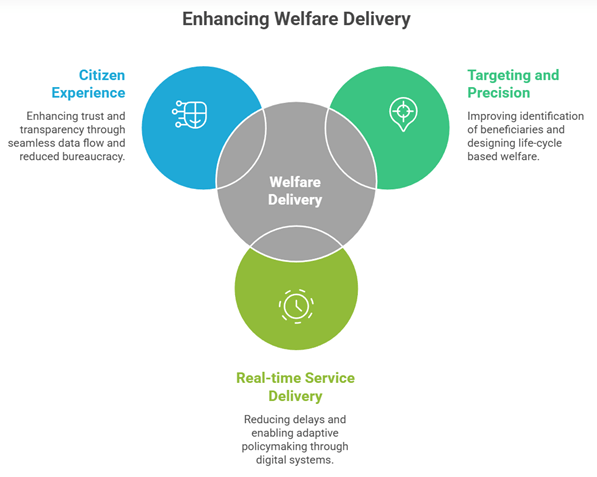
(a) Better targeting and precision welfare
- Clean, standardised datasets improve identification of intended beneficiaries, reducing exclusion and inclusion errors.
- Data convergence enables life-cycle based welfare design, where one citizen can seamlessly access multiple entitlements.
- Supports transition from scheme-centric to citizen-centric governance.
- Example: Linking SECC data, Aadhaar and state registries has improved targeting in housing and food security schemes.
- Case Study: Ayushman Bharat PM-JAY uses integrated databases to identify eligible vulnerable households for cashless healthcare.
- Government Initiative: National Social Registry (proposed) aims to create dynamic beneficiary databases.
(b) Real-time service delivery and faster decision-making
- Interoperable digital systems reduce administrative delays caused by manual verification.
- Enables real-time dashboards, allowing governments to respond quickly to emerging needs.
- Facilitates adaptive policymaking based on dynamic data rather than outdated surveys.
- Example: During pandemic relief, digital platforms enabled rapid cash transfers to millions within days.
- Case Study: CoWIN platform demonstrated how integrated data systems can manage large-scale beneficiary delivery efficiently.
- Government Initiative: India Stack provides APIs enabling scalable public service delivery.
(c) Improved citizen experience and trust
- Citizens benefit when data moves across departments, eliminating repeated documentation burdens.
- Transparency portals improve trust by allowing beneficiaries to verify entitlements and payments.
- Reduced discretion lowers corruption and enhances legitimacy.
- Example: SMS-based payment alerts in DBT schemes improve beneficiary awareness.
- Case Study: DigiLocker reduces paperwork and speeds access to services through trusted digital documents.
- Government Initiative: UMANG platform integrates multiple citizen services into one interface.
3. Key Pillars and Challenges for an Effective National Data Governance Framework
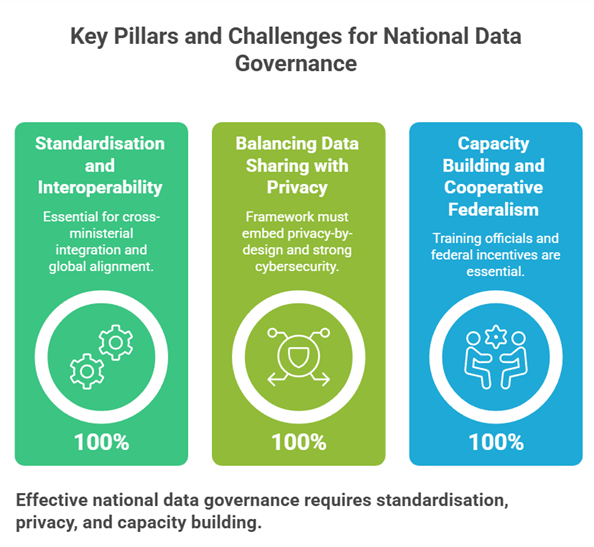
(a) Standardisation and interoperability as foundational principles
- Common national standards for data schemas, definitions and APIs are essential for cross-ministerial integration.
- Alignment with global frameworks improves credibility and comparability.
- A central standards authority is needed to enforce compliance.
- Example: Different ministries defining “youth” or “employment” differently distorts policy outcomes.
- Case Study: Estonia’s X-Road architecture shows how interoperable governance can transform public administration.
- Government Initiative: Proposed India Data Management Office (IDMO) under the National Data Governance Framework Policy.
(b) Balancing data sharing with privacy and security
- Greater data integration increases risks of surveillance, breaches and misuse.
- Framework must embed privacy-by-design, consent architecture and purpose limitation.
- Strong cybersecurity is necessary to preserve trust.
- Example: Sensitive welfare databases contain demographic and financial information requiring protection.
- Case Study: Lessons from global data breaches show governance failures can erode public confidence.
- Government Initiative: Digital Personal Data Protection Act provides legal backing for responsible data use.
(c) Capacity building and cooperative federalism
- States vary widely in data maturity; uneven capacity can widen governance gaps.
- Training of officials in data stewardship is essential.
- Federal incentives can encourage standard adoption across states.
- Example: Digitally advanced states have demonstrated better welfare monitoring outcomes.
- Case Study: Karnataka and Andhra Pradesh’s integrated service delivery models show the benefits of administrative capacity.
- Government Initiative: Capacity Building Commission and Mission Karmayogi support digital governance skills.
Conclusion:
- A robust National Data Governance Framework is not merely a technological reform; it is the institutional backbone of a modern welfare state. By reducing duplication, strengthening transparency and enabling real-time, citizen-centric delivery, it can convert public expenditure into measurable social outcomes.
- With India aspiring toward a $5 trillion economy and an increasingly digital state apparatus, even a modest improvement in public-sector data efficiency—estimated globally to unlock around 5% of GDP in additional value—can generate transformative developmental dividends.
- The way forward lies in empowering a strong central standards institution, ensuring interoperability across all levels of government, embedding privacy safeguards, and treating data quality as a core governance imperative rather than a technical afterthought.