Loss and Damage, Technology Transfer and Just Transition in Climate Negotiations: Why They Remain Aspirational
Loss and Damage, Technology Transfer and Just Transition in Climate Negotiations have increasingly emerged as central pillars of equitable global climate action. These concepts were introduced to address the uneven distribution of climate impacts, technological capacities, and historical responsibilities between developed and developing nations.
Yet, despite decades of negotiations and mounting evidence — including record global emissions touching nearly 57 GtCO₂e in the mid-2020s and the world moving rapidly towards breaching 1.5°C in the early 2030s — these pillars remain weakly operationalised. They are embedded more as moral commitments than enforceable obligations, reflecting a persistent gap between global climate needs and political willingness.
I. Loss and Damage: Recognition without Reparative Action
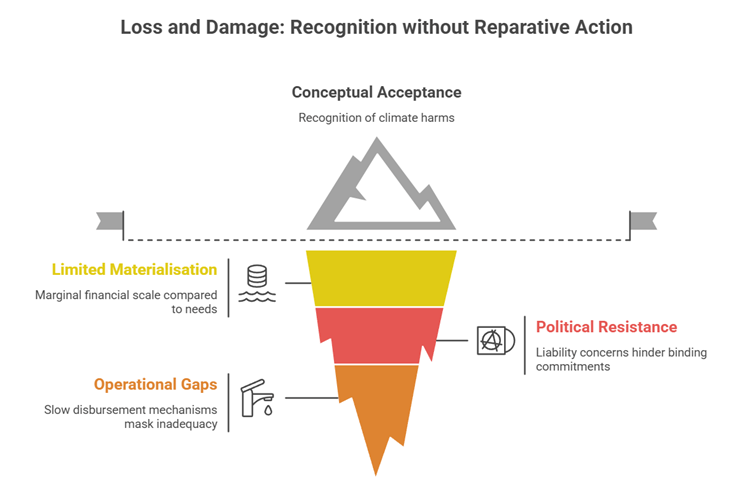
1. Conceptual acceptance but limited materialisation
Loss and damage addresses irreversible climate harms such as displacement, ecosystem loss, and cultural destruction that cannot be prevented through mitigation or adaptation alone.
Example / Case Study: Small island states facing permanent land loss due to sea-level rise have consistently highlighted non-economic losses such as identity and sovereignty.
While institutional mechanisms now exist, the financial scale remains marginal when compared to escalating climate disasters affecting vulnerable regions.
2. Political resistance rooted in liability concerns
Developed economies have historically resisted binding commitments on loss and damage due to fears of legal liability and compensation claims.
Example / Case Study: Prolonged opposition to formal recognition delayed progress for decades, resulting in symbolic breakthroughs without enforceable frameworks.
This resistance ensures that commitments remain voluntary, framed as solidarity rather than responsibility.
3. Operational gaps between funds and needs
Although funds have been established, capitalisation and disbursement mechanisms are slow and insufficient relative to projected disaster-related losses in developing regions.
Example / Case Study: Climate-vulnerable agrarian economies experiencing repeated floods and droughts often rely on emergency relief rather than predictable international support.
The result is a system where institutional presence masks functional inadequacy.
II. Technology Transfer: From Promises to Controlled Access
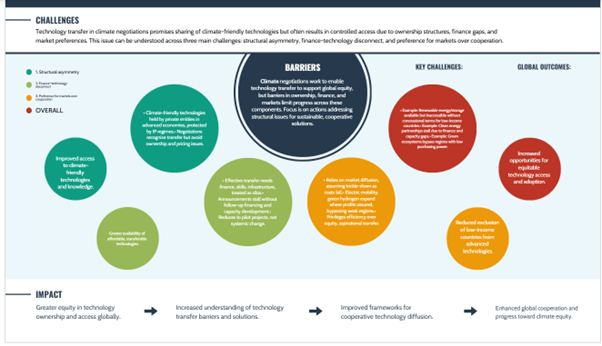
1. Structural asymmetry in technology ownership
Climate-friendly technologies are largely held by private entities in advanced economies, protected by intellectual property regimes.
Example / Case Study: Renewable energy and storage technologies are commercially available but financially inaccessible for many low-income countries without concessional terms.
Negotiations recognise transfer in principle but avoid confronting ownership and pricing structures.
2. Finance–technology disconnect
Effective technology transfer requires simultaneous access to finance, skills, and infrastructure, which negotiations often treat as separate silos.
Example / Case Study: Announcements of clean energy partnerships frequently stall due to lack of follow-up financing and local capacity development.
This disconnect reduces technology transfer to pilot projects rather than systemic transformation.
3. Preference for markets over cooperation
Negotiations increasingly rely on market-driven diffusion, assuming technologies will eventually trickle down as costs fall.
Example / Case Study: Electric mobility and green hydrogen ecosystems expand rapidly where profits are assured, bypassing regions with weaker purchasing power.
This approach privileges efficiency over equity, leaving transfer largely aspirational.
III. Just Transition: Normative Consensus without Redistributive Power
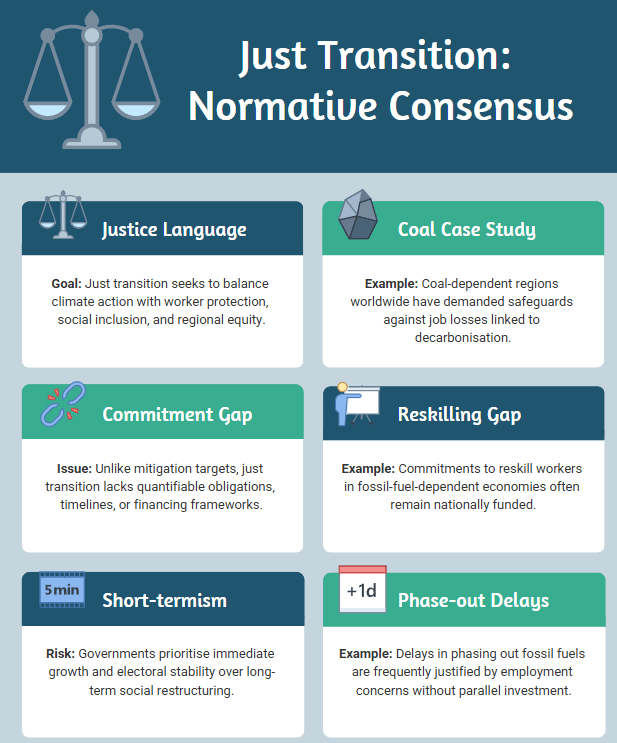
1. Broad acceptance of justice language
Just transition seeks to balance climate action with worker protection, social inclusion, and regional equity.
Example / Case Study: Coal-dependent regions worldwide have demanded safeguards against job losses linked to decarbonisation.
Negotiations acknowledge these concerns rhetorically, embedding them in declarations and principles.
2. Absence of binding social protection commitments
Unlike mitigation targets, just transition lacks quantifiable obligations, timelines, or financing frameworks.
Example / Case Study: Commitments to reskill workers in fossil-fuel-dependent economies often remain nationally funded, with limited international support.
Justice is recognised as desirable but treated as domestic responsibility, not a shared global task.
3. Economic short-termism and political risk aversion
Governments prioritise immediate growth and electoral stability over long-term social restructuring.
Example / Case Study: Delays in phasing out fossil fuels are frequently justified by employment concerns without parallel investment in alternative livelihoods.
This reinforces incrementalism, making just transition more aspirational than transformative.
Conclusion:
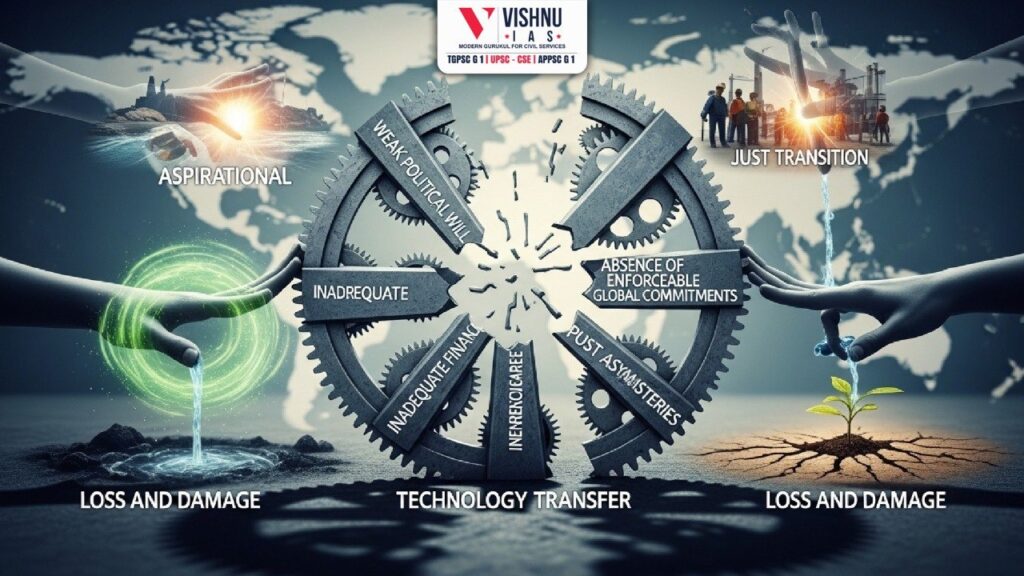
Loss and damage, technology transfer, and just transition persist as aspirational pillars because they challenge the core political economy of climate governance — raising questions of who pays, who benefits, and who bears risk.
While global climate finance flows remain well below the multi-trillion-dollar annual needs of developing economies, negotiations continue to rely on voluntary pledges and moral persuasion rather than enforceable commitments.
A meaningful way forward lies in predictable finance, rebalanced intellectual property regimes, and institutional mechanisms that integrate justice with action, supported by transparent metrics and timelines. Without aligning political incentives with planetary realities, climate governance will continue to drift — recognising destinations without mobilising the drivers needed to reach them.
Recap: