Judicial Delays in India: Court Inefficiency or Systemic Governance Failure?
Introduction
• Judicial delays refer to the lapse of time between filing of a case and its final disposal (or at least a substantive order), including delays in intermediate stages (e.g. adducing evidence, filing appeals), adjournments, procedural bottlenecks, etc.
• Court inefficiency generally implies ineffectiveness or inertia by courts or judges (slow scheduling, low productivity, vacation periods, etc.).
• Systemic governance failures include insufficiencies in lawmaking, executive function, administration (staffing, infrastructure, resources), litigant behaviour, policy design — i.e. problems beyond just what the courts do.
• As of early 2025, about 5.09 crore cases were pending in Indian courts – roughly 4.48 crore in subordinate courts, about 60.35 lakh in High Courts, and ~66,103 in the Supreme Court.
Body
1. Dimensions of Court Inefficiency
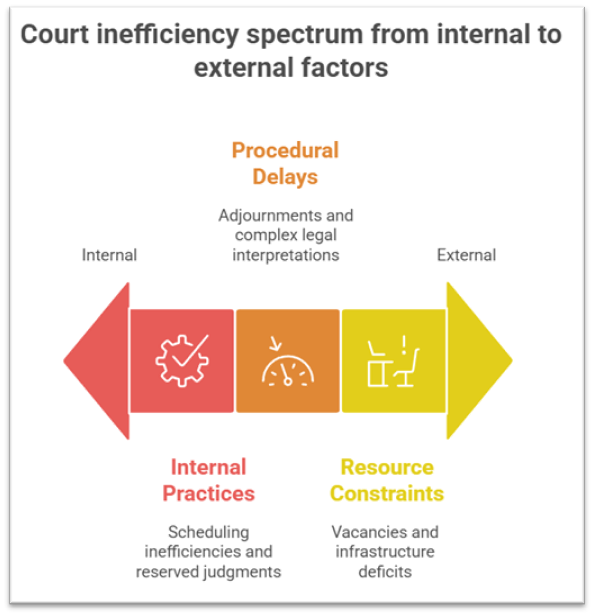
A. Resource Constraints within Judiciary
- Vacancies in judicial positions: High Courts ~33%, Subordinate Courts ~20%, Supreme Court minor but still unfilled posts. This means fewer judges to hear cases, more backlog per judge.
- Staff / Administrative vacancies: Court registries, clerks, technical staff are also under-staffed, delaying filing, service of summons, record-keeping etc.
- Infrastructure / technological deficits: Many district courts lack adequate court halls, video-conferencing facilities, electronic display etc. Some high courts and subordinate courts still lag in ICT enablement.
B. Procedural Delays & Adjudicatory Factors
- Frequent adjournments because of non-availability of counsel or parties, witnesses, or procedural non-compliance. Often, courts grant adjournments by default.
- Complex law / poorly drafted statutes that require extensive judicial interpretation, leading to delays in resolution. Multiple provisos, exceptions, ambiguities in law slow down adjudication.
- Interlocutory applications and appeals: Many preliminary/challenging issues are litigated before the final hearing, consuming time. Stay orders across courts/appellate layers contribute to prolonged periods before substantive adjudication begins.
C. Internal Court Practices & Scheduling Inefficiencies
- Causelists / docket management: Inefficient case scheduling, uneven distribution of cases among judges, delays in listing hearings.
- Bench strength imbalance & vacation periods: Periods when full benches are not operational; vacation benches are fewer; work during vacations still partly on reserved judgments etc but not all benches sit.
- Reserved judgments backlog: Even after hearing, delay in writing / issuing judgment, especially with high caseload; judges overloaded with pending writing tasks.
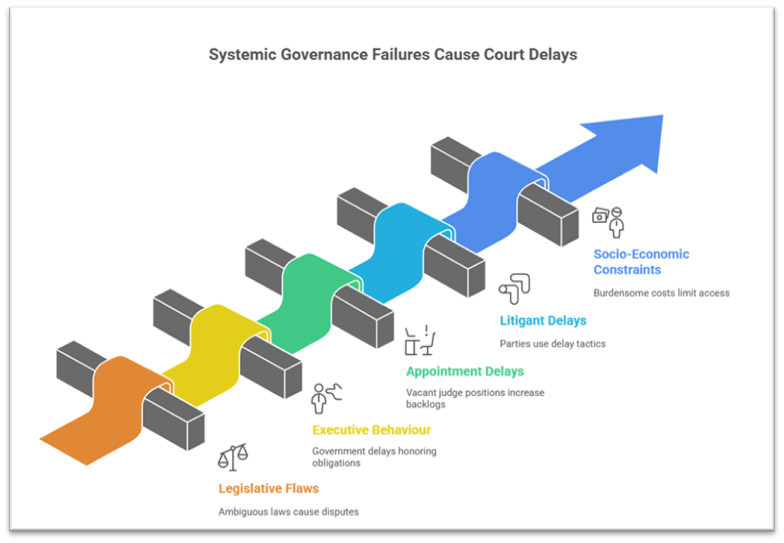
2. Systemic Governance Failures Contributing to Delays
A. Legislative and Policy Design Flaws
- Laws poorly framed: Ambiguous provisions, excessive exceptions/provisos lead to litigation. For example, reforms that rebrand old criminal codes without simplifying them meaningfully contribute to confusion and dispute.
- Mandates without implementation clarity: e.g. mandatory pre-suit mediation (under Commercial Courts Act) may be well-intentioned but without infrastructure, guidelines or enough mediators, many mediations fail; leads to additional waste of time.
B. Executive Behaviour
- Government as a litigant: The Union/State governments often initiate appeals or litigate routine contract disputes, sometimes delaying honouring obligations. This adds to load.
- Unwillingness to reduce litigation: Ministries filing routine appeals, using discretion poorly, leading cases into higher courts; failure to expedite simple cases involving government entities.
C. Appointment Process & Institutional Delay
- Slow judge appointment mechanisms: The process of selecting, approving, and appointing judges (Collegium, executive) is often delayed. Many positions lie vacant for long periods even when retirements are predictable.
- Inadequate monitoring & accountability of delays: No strong mechanism to ensure that intermediate delays (e.g. for service, affidavit filing) are minimized; lack of enforcement for parties causing avoidable delay.
D. Access, Litigant Behaviour & Socio-Economic Constraints
- Litigant-side delays: Absence of lawyers, failure to appear, missing witnesses, sometimes deliberate delay tactics.
- Cost & time burdens: Delay in physical infrastructure (e.g. remote areas), transport, travel costs influence attendance etc.
- Under-resourced legal aid: Marginalised litigants may not be able to engage lawyers well, leading to procedural delays (errors, adjournments) etc.
3. Interplay, Case Studies & Government Initiatives
A. Case Study: Pendency & Vacancies
- In Karnataka, lower/subordinate courts have ~20.2 lakh pending cases with ~16.4% vacancies in judicial officer posts; many cases pending for 10-20 years, some for over 20 years.
- Calcutta High Court has 2,185 cases pending over 50 years, ~94% of all such very‐long-pending high court cases in the country.
- These show that both inefficiencies (inside courts) and external governance failures (vacancies, legislative complexity, government litigation) contribute heavily to delay.
B. Government / Policy Initiatives Addressing Delays
- eCourts Phase III: Approved by Union Cabinet; aims at expanding e-filling, virtual hearings, smart scheduling, automated summons (NSTEP), data-driven registry support etc., to reduce pendency.
- Opening of new JMFC courts in Odisha: To address backlog of over 1.9 million pending cases in lower courts, 56 new courts will be opened, with staff, etc.
C. Legal Reform Efforts & Law Design Changes
- Proposed reforms of criminal law (renaming codes as “sanhitas”) intended to simplify; but critique is that many changes are cosmetic or rebranding without addressing deep precedent burden.
- Revisions to Income-Tax Act to simplify; yet insertion/removal/re-labelling of exceptions/provisos mean possibility of renewed litigation over interpretation.
D. Real-life Examples Showing Delays Owing to Non-Court Factors
- Cases where government departments delay honouring contracts or avoid compliance, leading to court cases dragging for years.
- Undertrial detention: many accused remain in jail for long periods due to slow process (police, lawyers, courts) — the delay is not only judicial inefficiency but failures in police investigation, prosecution, legal aid etc.
Conclusion:
• Judicial delays in India are a multifaceted issue: inefficiencies inside courts co-exist with systemic governance failures. To treat delays as solely court inefficiency gives an incomplete narrative; conversely, ignoring court performance issues risks under-serving litigants and undermining justice. A balanced, holistic approach is essential.
• judicial delays are as much a governance failure as a court performance issue, and better outcomes will require coordinated reforms across law-making, executive behaviour, judicial administration, and procedural norms.
Recap: