India’s Strategic Options in Afghanistan: Balancing Diplomacy, Development, and Security
India’s Strategic Options in Afghanistan represent a critical policy recalibration following the Taliban’s return to power in 2021. India’s strategic posture toward Afghanistan must be understood against the backdrop of decades of engagement, regional geostrategic contestation, and evolving security threats. With the fall of the republic in 2021 and the return of the Taliban to power, India confronted a difficult choice: whether to disengage, isolate, or recalibrate. Today, the recent visit of Afghanistan’s Acting Foreign Minister to New Delhi and the upgrade of India’s mission in Kabul reflect that recalibration.
India must now choose among a menu of strategic options — ranging from purely humanitarian engagement to deeper bilateral and regional diplomacy — while managing security imperatives and the sensitivities of neighbouring states. The goal must be twofold: stabilising a fragile Afghanistan, and projecting India credibly as a stabiliser in the region.
1. Political-Diplomatic Engagement: Cautious Normalization
(a) De facto engagement without full recognition
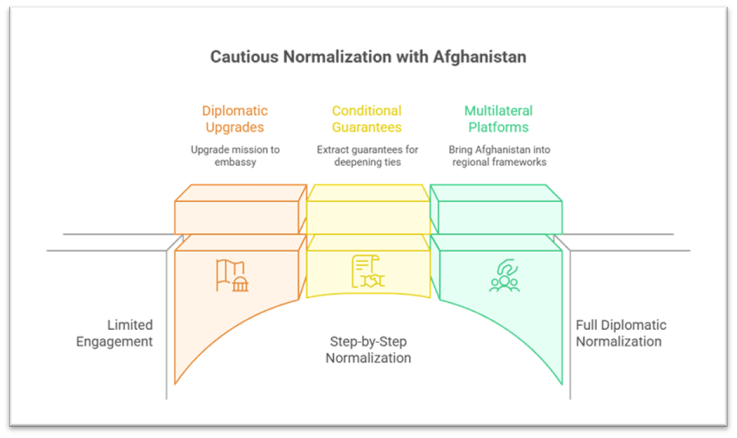
India’s current posture treats the Taliban as the factual authority in Kabul — coordinating humanitarian assistance and diplomatic exchanges — but stops short of de jure recognition. This principled ambiguity lets New Delhi retain flexibility. For example, India reopened a technical mission in Kabul in 2022 and has since signalled upgrading it to an embassy, while not formally endorsing Taliban legitimacy. This approach aligns with India’s broader “strategic hedging” — maintaining presence while assessing evolving conduct.
(b) Step-by-step diplomatic normalization
The visit of Afghanistan’s Acting Foreign Minister and the announcement to upgrade the technical mission to a full embassy signal India’s willingness to move slowly toward full diplomatic normalization. Subsequent engagements — humanitarian, development, and security dialogues — should be staged to ensure conditional progress. India can extract guarantees on counterterrorism assurances, women’s rights, and minority protections as preconditions for deepening ties.
(c) Leveraging multilateral and regional platforms
India should bring Afghanistan into regional frameworks such as SAARC (if revived), SCO, or Central Asian dialogues, allowing international legitimacy while diluting bilateral overexposure. Coordination through UN agencies, donor conferences, and regional mechanisms can strengthen stabilization. India and Central Asian NSAs have already begun plans to stabilize Afghanistan, learning from the gradual engagement models of countries like Qatar.
2. Socio-Economic, Developmental, and Humanitarian Tools
(a) Humanitarian assistance and reconstruction projects
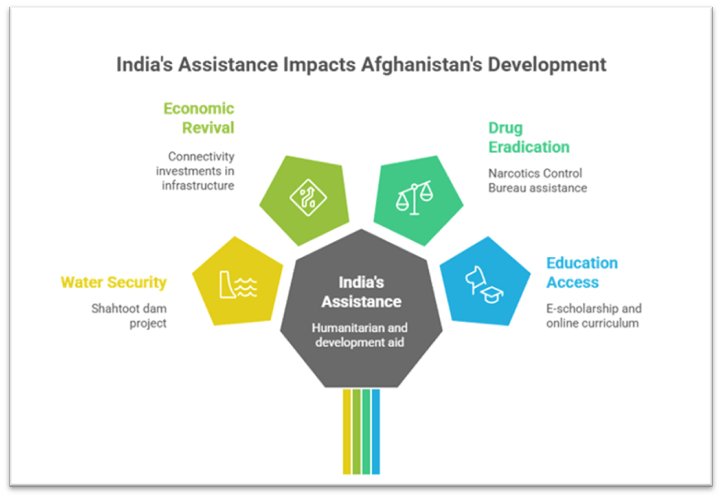
India’s strength in Afghanistan over 2001–2021 lay in visible infrastructure and people-to-people goodwill. Projects like the Shahtoot Dam and connectivity initiatives can revive Afghanistan’s local economies. In the current context, relief in food, healthcare, education, and welfare serves as the foundation for engagement.
(b) Crop substitution, counter-narcotics, and economic diversification
The Taliban’s mixed record on drug eradication calls for external support. India can assist via its Narcotics Control Bureau (NCB) in intelligence sharing and crop substitution programs. Ensuring market access for licit crops is crucial to prevent relapse into opium cultivation.
(c) Skills, education, and institutional capacity building
India must advocate for women’s education, offering online scholarship and training programs. The e-scholarship scheme (1,000 slots) should be scaled up. Capacity building in sectors such as mining and energy can foster local employment and reduce dependency on Indian personnel.
3. Security, Strategic, and Regional Balancing
(a) Counterterrorism and intelligence cooperation
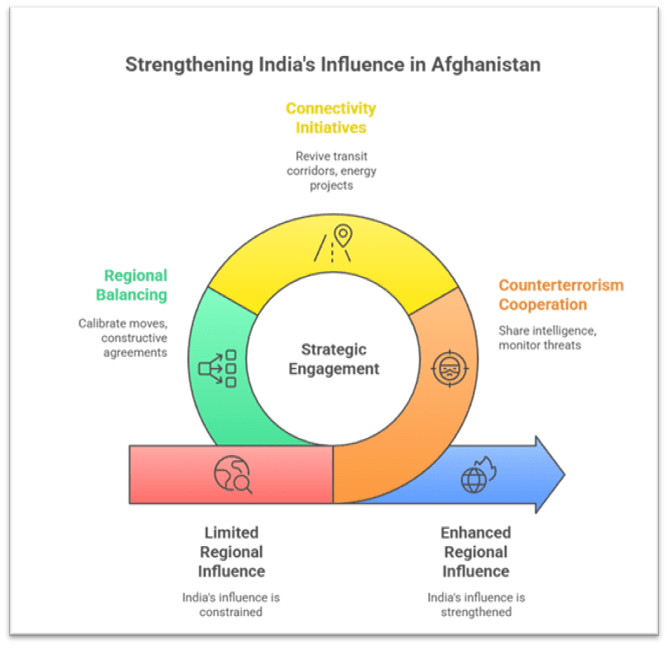
A key concern for India is ensuring that Afghan soil is not used for terrorism against India. Cooperation on monitoring IS-K, TTP, and al-Qaeda is vital. India can also enhance surveillance and intelligence-sharing networks with global partners.
(b) Connectivity and transit corridors
Reviving the Chabahar Port and linking Afghanistan with Central Asia and South Asia are vital for India’s geoeconomic strategy. Participation in projects like the TAPI pipeline can strengthen India’s strategic foothold, subject to adequate security guarantees.
(c) Balancing Pakistan, China, and regional stability
India must balance its engagement to avoid provoking Pakistan while leveraging current tensions between Islamabad and Kabul. Deeper engagement will also counter China’s growing influence through the Belt and Road Initiative (BRI) and mining investments.
Conclusion
India’s strategic options in Afghanistan are neither simple nor risk-free. A phased, calibrated approach — starting with humanitarian assistance and expanding toward full diplomatic and security engagement — remains India’s best path forward. The recent diplomatic outreach marks an important inflection point.
Executed wisely, this policy can help India prevent Afghanistan from becoming a militant base, reinforce regional stability, and re-establish India as a moral and humanitarian force in South-Central Asia. In doing so, India may reclaim its lost influence in Afghanistan while showcasing responsible global leadership.
Recap: