Evaluating India’s Food Subsidy Regime: Restructuring PDS for Nutrition & Inclusive Food Security
Introduction
India’s food subsidy regime is one of the largest social welfare interventions in the world, primarily delivered through the Public Distribution System (PDS) and backed by schemes such as the National Food Security Act (NFSA), 2013. Currently, about 800 million beneficiaries are entitled to free or highly subsidised cereals. According to recent consumption surveys and global poverty assessments, extreme poverty in India declined from 16.2% in 2011-12 to 2.3% in 2022-23, reflecting improved living standards. However, a deeper examination reveals that while cereal consumption has largely equalised across income groups, nutritional deprivation, especially protein and micronutrient gaps, persists. This raises questions on the effectiveness and inclusiveness of the current regime and calls for restructuring with a more diversified food basket.
1. Strengths of the Current Food Subsidy Regime
Reduction of Hunger and Poverty
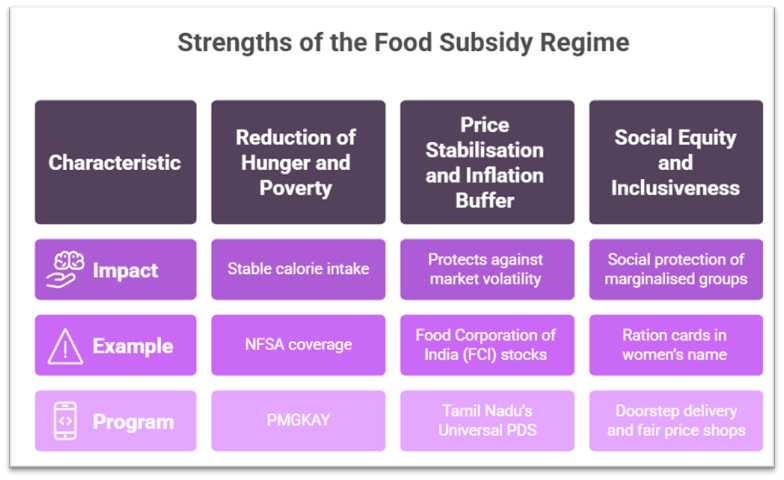
- The PDS has ensured near-universal access to cereals, leading to stable calorie intake across rural and urban areas.
- The NFSA covers 75% of the rural and 50% of the urban population, ensuring food security at scale.
- During the COVID-19 pandemic, PMGKAY distributed free foodgrains to over 80 crore people, preventing a potential hunger crisis.
Price Stabilisation and Inflation Buffer
- Subsidised cereals protect poor households against market volatility in food prices.
- Food Corporation of India (FCI) stocks stabilise open market supplies, preventing price spikes during poor harvest years.
- States like Tamil Nadu’s Universal PDS further shield consumers from regional price variations.
Social Equity and Inclusiveness
- The system reduces inter-state disparities in cereal availability and contributes to social protection of marginalised groups.
- Tribal communities in Chhattisgarh and Odisha benefit significantly from doorstep delivery and localised fair price shops.
- Ration cards in women’s names improve intra-household food access.
2. Limitations and Challenges in the Current Regime
Narrow Food Basket
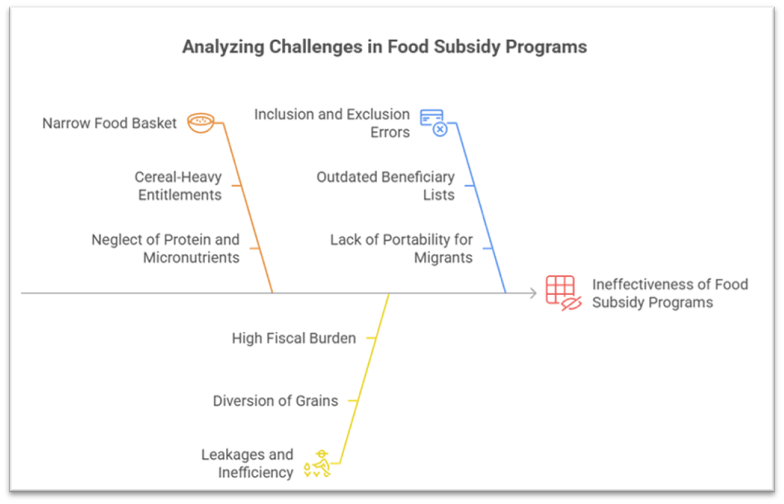
- Current entitlements are cereal-heavy, though cereals account for only about 10% of household expenditure.
- Protein (pulses, eggs), micronutrients, and fats remain outside the subsidy net, perpetuating hidden hunger.
- NFHS-5 highlights persistent child malnutrition (stunting ~35%) despite universal cereal access.
Leakages, Inefficiency and Fiscal Burden
- Despite Aadhaar seeding and DBT pilots, leakages remain significant in some states.
- Annual subsidy bills cross ₹2 lakh crore, straining fiscal resources.
- Shanta Kumar Committee (2015) estimated less than 40 paise per ₹1 reaches the poor.
Inclusion and Exclusion Errors
- Outdated 2011 Census lists wrongly exclude needy households.
- Migrant labourers face portability issues despite ONORC rollout.
- Some better-off households still access subsidies unnecessarily.
3. Restructuring PDS for Diversification and Progressiveness
Diversifying the Food Basket
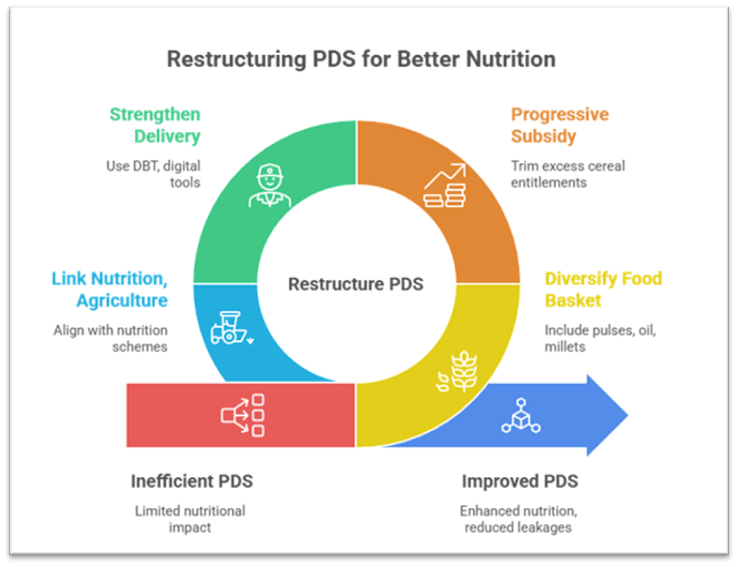
- Include pulses, oil, and millets to address protein and micronutrient deficiencies.
- International Year of Millets (2023) created policy momentum for nutri-cereals in PDS.
- The Tamil Nadu Amma Unavagam model shows how diverse meals can complement PDS.
Making Subsidy Progressive
- Rationalise entitlements for better-off households to save resources for nutrition-rich foods.
- States like Chhattisgarh and Odisha distributed fortified rice to tackle deficiencies.
- Adopt a graded subsidy approach for equity across income groups.
Strengthening Delivery and Monitoring
- Use DBT for better-off groups while maintaining in-kind distribution for vulnerable households.
- Leverage e-POS devices, GPS tracking, and biometric tools to reduce leakages.
- Andhra Pradesh’s doorstep delivery improved access and accountability.
Linkages with Nutrition and Agriculture
- Align PDS with ICDS, Mid-Day Meal, and POSHAN Abhiyaan for better outcomes.
- Procure locally grown pulses and millets under MSP to support farmers and diversification.
- Karnataka’s inclusion of ragi and jowar in PDS improved nutrition and farmer incomes.
Conclusion:
India’s food subsidy regime has effectively eliminated extreme hunger and stabilised cereal consumption, reducing extreme poverty to 2.3% by 2022-23. However, its cereal-heavy design limits its ability to fight hidden hunger, as child stunting and anaemia remain high. The way forward is to progressively restructure PDS by reducing excess cereals for better-off groups, adding pulses, oil, and millets, and strengthening delivery systems with technology. If redesigned, the PDS can evolve from a calorie-security scheme to a nutrition-security enabler—ensuring that India’s poorest households enjoy access to a balanced diet and setting a global model for inclusive food security.
Recap: