India’s Demographic Dividend at Risk? Key Factors & Policy Interventions
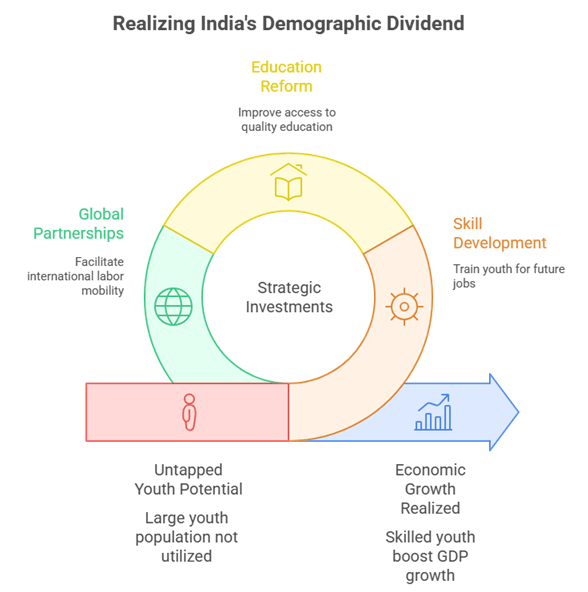
India’s Demographic Dividend refers to the potential economic growth from a favorable age structure, where the working-age population exceeds dependents. India, with over 800 million people below 35 (UNFPA, 2023), is often seen as being on the cusp of this dividend. However, concerns are rising that without proper skills, education, and employment opportunities, this youth bulge could turn into a demographic liability.
Factors Supporting the Demographic Dividend Potential
Large Youth Population
- India has the largest working-age population globally (World Bank, 2023), potentially adding nearly 2% to annual GDP growth if effectively utilized.
- Sectors like digital economy, renewable energy, and healthcare are already absorbing skilled youth; India’s IT exports reached $194 billion in 2023 (NASSCOM).
- Case Study: Bengaluru and Hyderabad as start-up hubs driving innovation.
Expanding Education Access
- Gross Enrollment Ratio in higher education increased to 28.4% in 2023 (AISHE Report).
- Government efforts like NEP 2020 focus on flexibility, multidisciplinary learning, and skill integration.
- Example: Skill India Mission has trained over 1.4 crore youth under PMKVY till 2023.
Global Labor Demand
- As developed nations face ageing populations, India can supply skilled manpower globally.
- Example: Indian nurses in Gulf and UK healthcare, IT professionals in Silicon Valley.
- The G20 New Delhi Declaration (2023) emphasized mobility partnerships for youth.
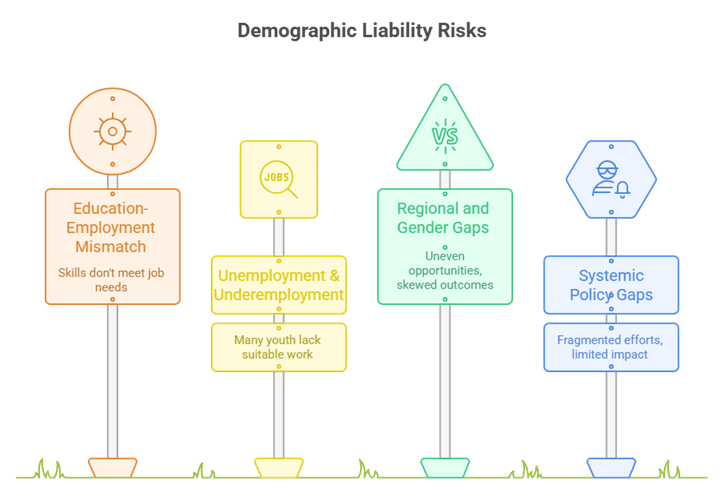
Factors Risking a Demographic Liability
Education-Employment Mismatch
- 70% of jobs in India at risk from automation by 2030 (McKinsey 2024).
- 40–50% of engineering graduates remain unemployed.
- Infosys and TCS spend billions retraining fresh recruits due to lack of job-ready skills.
Unemployment & Underemployment
- Youth unemployment rate at 17% in 2024 (CMIE data).
- Many educated youth in gig economy jobs, showing underemployment.
- Case Study: Bihar & UP graduates applying for low-skill jobs.
Regional and Gender Inequalities
- Female Labor Force Participation is just 24% (World Bank 2023).
- States like Kerala outperform in human capital indices, BIMARU states lag behind.
- Example: Kerala’s literacy and skilling drive vs distress migration in UP.
Systemic Policy Gaps
- Skill India Mission fell short due to fragmented implementation and poor industry linkages.
- Multiple schemes (PMKVY, PMYY, SANKALP, JSS) operate in silos.
- NEP 2020 reforms are in early rollout stages, limiting immediate impact on employability.
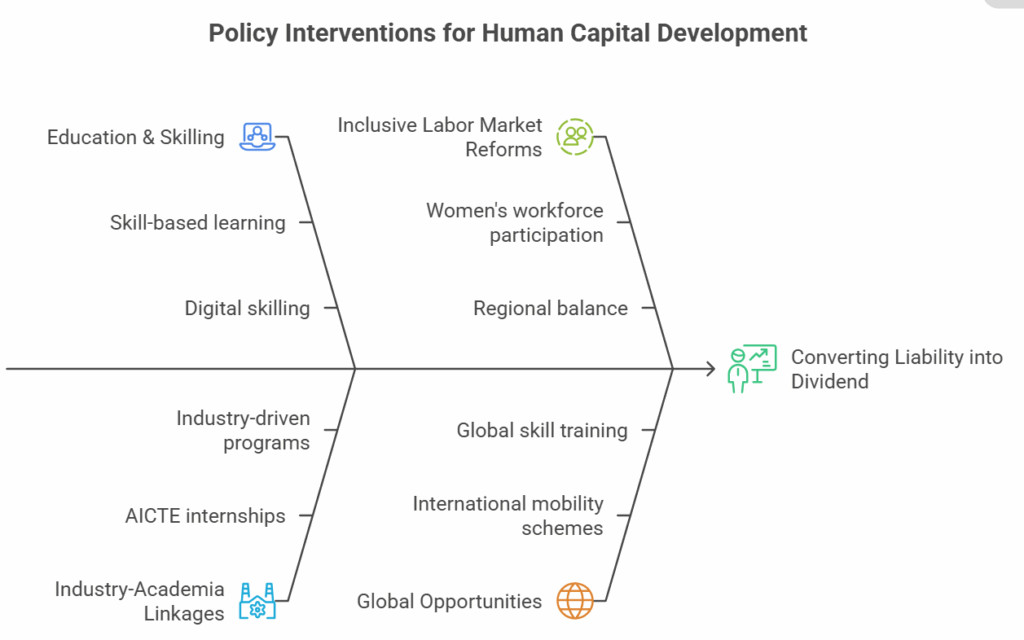
Policy Interventions Needed
Reforming Education & Skilling
- Shift from rote learning to skill-based, experiential learning with school-to-work pathways.
- Example: Finland’s career guidance model adapted to India.
- Digital skilling: PMKVY 4.0 focuses on AI, robotics, and green jobs.
Strengthening Industry-Academia Linkages
- Expand AICTE internships to ensure hands-on experience for every graduate.
- Scale collaborations like NITI Aayog–Intel’s AI for All program.
- Incentivize industry-driven skill programs via tax rebates and CSR mandates.
Inclusive Labor Market Reforms
- Encourage women’s workforce participation through childcare facilities and flexible work policies.
- Example: SEWA model for empowering informal workers.
- Regional balance via special economic zones in Bihar, Jharkhand, and UP.
Harnessing Global Opportunities
- Promote international mobility schemes under CEPA and similar pacts.
- Train youth in language, digital, and healthcare skills for global demand.
- Example: Philippines’ overseas labour model for remittance-driven stability.
Conclusion
India stands at a decisive crossroads: its youth bulge can either become the engine of global leadership or a burden on national stability. While opportunities from AI and emerging tech are immense, automation risks are real. Timely reforms in education, skilling, gender inclusion, and global labor alignment can convert the potential demographic liability into a powerful growth asset. The solution is within reach: prepare India’s youth for the careers of tomorrow.
Recap: