
India–U.S. Trade Deal: Tariff Reduction and Its Impact on Labour-Intensive Exports
The India–U.S. trade deal marks a significant development in India’s external trade policy by proposing a sharp reduction in U.S. tariff barriers on Indian goods. At a time of global trade uncertainty and supply-chain realignments, this understanding has important implications for export competitiveness, employment generation, and India’s labour-intensive manufacturing sectors.
Introduction:
- Trade agreements are negotiated arrangements between countries aimed at reducing barriers to cross-border exchange of goods and services, thereby enhancing market access, competitiveness, and economic growth.
- The recent India–United States trade understanding, which proposes a sharp reduction in U.S. tariffs on Indian imports from 50% to 18%, assumes particular importance because the U.S. remains India’s largest export destination, accounting for roughly one-fifth of India’s total merchandise exports, while labour-intensive sectors employ over 60 million workers directly and indirectly.
- Against a backdrop of global trade fragmentation, supply-chain realignments, and subdued world demand, this development signals both economic relief and strategic recalibration, with implications that extend beyond tariffs to employment, geopolitics, and industrial policy.
Body:
I. Significance of Tariff Reduction in the India–U.S. Trade Relationship
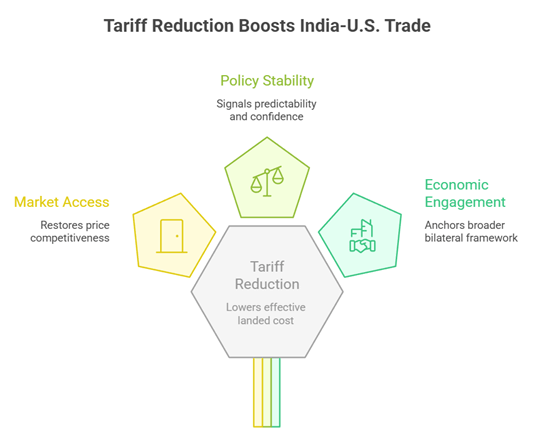
1. Restoring Market Access and Price Competitiveness
- The reduction of U.S. tariffs substantially lowers the effective landed cost of Indian goods, enabling exporters to regain price competitiveness that had eroded due to earlier tariff hikes.
- This is particularly relevant for sectors where margins are thin and demand is highly price-sensitive, such as garments and footwear.
- Example / Case Study: Indian apparel exporters had seen orders diverted to Vietnam and Bangladesh after higher tariffs made Indian products relatively expensive; the tariff rollback directly addresses this loss of market share.
2. Signalling Trade Policy Stability Amid Global Uncertainty
- At a time when protectionism and unilateral tariff actions have increased globally, the deal sends a signal of predictability and confidence to businesses and investors on both sides.
- Financial markets have already reflected this optimism through improved currency sentiment and equity valuations in export-oriented firms.
- Example / Case Study: Similar confidence effects were observed after India concluded preferential trade arrangements with the UAE.
3. Anchoring a Broader Bilateral Economic Engagement
- The agreement may act as a first tranche toward a more comprehensive bilateral trade framework covering goods, services, and investment.
- It reinforces the economic pillar of the broader strategic partnership.
- Example / Case Study: Earlier mini-deals globally have evolved into deeper agreements once trust and momentum were established.
II. Impact on India’s Labour-Intensive Export Sectors
1. Employment Security and Job Creation Potential
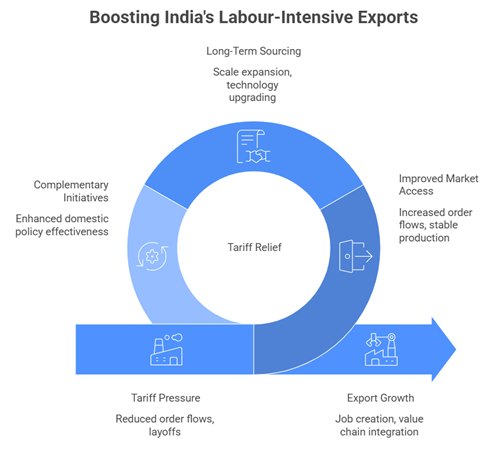
- Labour-intensive industries such as textiles, apparel, leather, footwear, and light engineering are major employers of semi-skilled and low-skilled workers.
- Lower tariffs improve order flows, stabilise production cycles, and reduce the risk of layoffs.
- Example / Case Study: Garment clusters in Tiruppur and Noida reported capacity underutilisation during the high-tariff phase.
2. Strengthening Value Chain Integration and Scale
- Improved access to the U.S. market encourages long-term sourcing contracts and scale expansion.
- This supports deeper integration into global value chains.
- Example / Case Study: Engineering goods exporters benefit from predictable tariff regimes.
3. Complementing Domestic Industrial and Export Promotion Initiatives
- The tariff relief works alongside domestic measures aimed at boosting competitiveness.
- It enhances the effectiveness of manufacturing and export facilitation policies.
- Example / Case Study: Production-linked support schemes become more impactful when market access improves.
III. Strategic and Structural Dimensions Beyond Immediate Gains
1. Managing Competitive Asymmetries
- Even after the reduction, Indian exports may still face marginally higher tariffs than some competitors.
- The narrowed gap significantly improves India’s relative position.
2. Navigating Trade-Offs and Policy Ambiguities
- Uncertainty remains regarding reciprocal commitments and procurement norms.
- Transparent sequencing is essential to avoid adjustment shocks.
3. Reinforcing India’s Position in a Fragmenting Global Trade Order
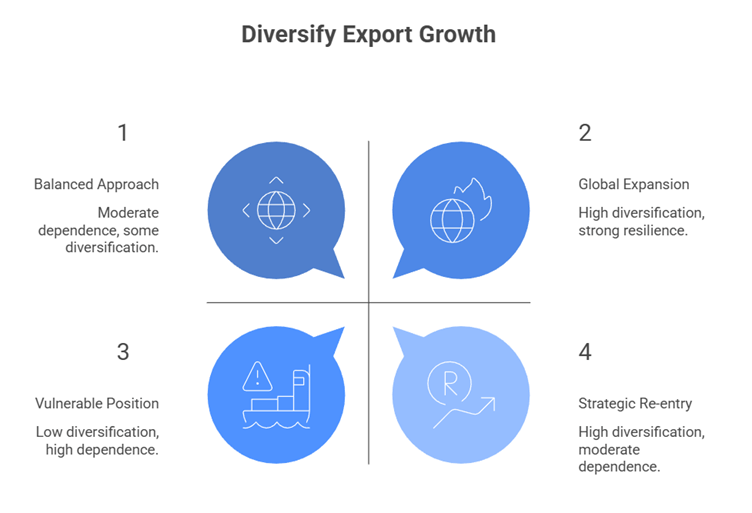
- Diversified trade partnerships reduce over-dependence on any single market.
- This strengthens resilience against external shocks.
Conclusion:
- The India–U.S. trade deal represents a meaningful economic and strategic development.
- By restoring competitiveness and stabilising employment, it provides timely relief.
- Clear commitments, domestic productivity improvements, and diversified market access will determine long-term gains.
Recap: