
Institutional Mechanisms Power India–U.S. Defence and Technology Partnerships
Institutional frameworks now play a decisive role in shaping India–U.S. defence and technology partnerships, ensuring strategic stability, defence innovation, and long-term cooperation beyond the optics of high-level political summits.
Introduction:
- India–United States relations illustrate a mature strategic partnership where institutional mechanisms increasingly outweigh summit-level diplomacy in sustaining momentum. While high-level summits such as the Quad Leaders’ Summit provide political signalling, the real continuity lies in defence, technology, and bureaucratic frameworks that operate irrespective of political headwinds.
- This is evident in the steady expansion of defence trade, which has crossed multi-billion-dollar levels over the past decade, the rise of joint military exercises from sporadic engagements to institutionalised annual formats, and the growing number of inter-governmental working groups on critical and emerging technologies. Together, these trends reflect a dual-track relationship where institutions ensure stability, predictability, and long-term strategic convergence even when political engagement appears strained.
1. Institutional Defence Frameworks as the Pillar of Strategic Stability
- Foundational defence agreements institutionalising cooperation
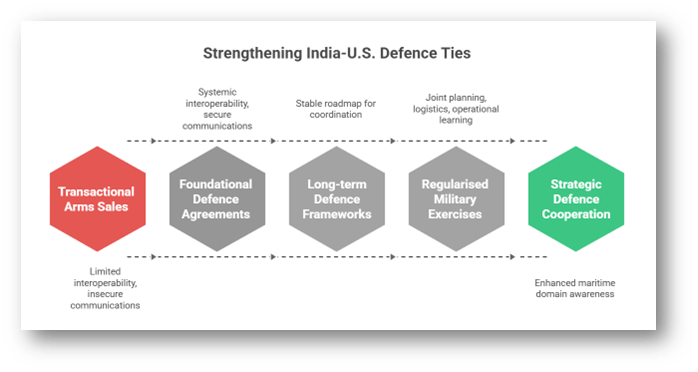
- The signing of LEMOA, COMCASA, and BECA has transformed India–U.S. defence ties from transactional arms sales into systemic interoperability, enabling secure communications, real-time geospatial intelligence sharing, and reciprocal logistical support.
- EXAMPLE: During joint maritime surveillance in the Indo-Pacific, BECA-enabled data sharing has enhanced India’s maritime domain awareness without requiring new political mandates.
- This aligns with India’s broader defence reforms aimed at jointness and integration, complementing initiatives such as the creation of the Chief of Defence Staff (CDS) and theatreisation efforts.
- Long-term defence frameworks ensuring continuity beyond political cycles
- The 10-year Defence Framework Agreement (2025) provides a stable roadmap for coordination, co-development, and deterrence planning, insulating defence cooperation from short-term diplomatic frictions.
- CASE STUDY: Even amid trade disputes and summit postponements, defence dialogues and service-level talks continued uninterrupted, demonstrating institutional resilience.
- Such frameworks mirror India’s preference for strategic autonomy with structured partnerships, rather than alliance dependency.
- Regularised military exercises building trust and interoperability
- Exercises like Yudh Abhyas, Malabar, and Tiger Claw have evolved into institutionalised platforms for joint planning, logistics, and operational learning.
- EXAMPLE: Malabar’s expansion from a bilateral naval drill to a Quad-level exercise reflects institutional depth rather than summit-driven symbolism.
- These exercises reinforce India’s Indo-Pacific vision of a free, open, and rules-based order, complementing regional security architectures.
2. Technology and Industrial Cooperation Driven by Bureaucratic Ecosystems
- Defence-industrial collaboration through structured mechanisms
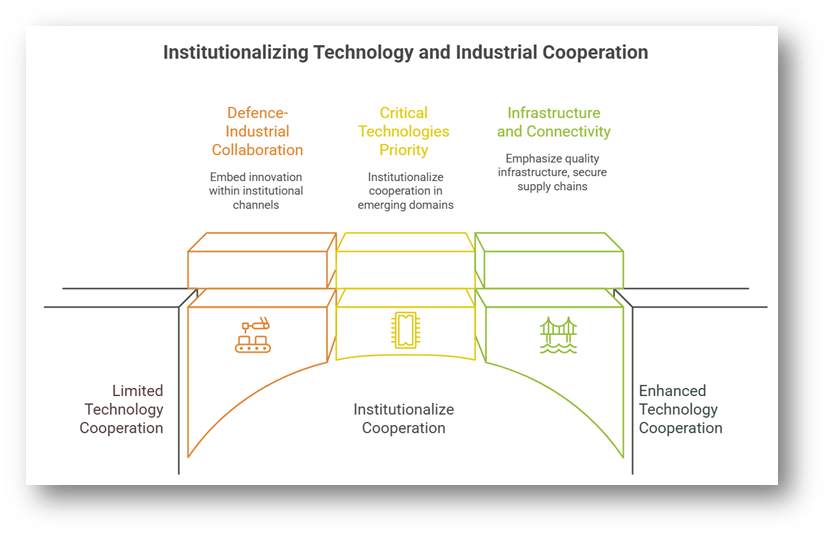
- Platforms such as INDUS-X and the Security of Supply Arrangement (SOSA) embed defence innovation within institutional channels linking governments, start-ups, and private industry.
- EXAMPLE: The HAL–General Electric fighter jet engine agreement illustrates how institutional trust enables high-end technology collaboration beyond buyer–seller dynamics.
- This dovetails with India’s Atmanirbhar Bharat and defence indigenisation goals, promoting co-production rather than dependence.
- Critical and emerging technologies as an institutional priority
- The Initiative on Critical and Emerging Technologies (iCET) institutionalises cooperation in AI, semiconductors, space, and cyber domains, areas less dependent on summit diplomacy.
- CASE STUDY: The joint NASA–ISRO NISAR satellite for disaster management and infrastructure planning shows how scientific institutions sustain collaboration despite geopolitical flux.
- Such cooperation supports India’s digital public infrastructure push and resilience-building objectives.
- Expanding cooperation into infrastructure and connectivity
- Institutional Quad initiatives, such as the Ports of the Future Conference, emphasise quality infrastructure, secure supply chains, and regional connectivity.
- EXAMPLE: Collaboration on resilient port development aligns with India’s Sagarmala Programme, integrating national priorities with regional partnerships.
- This demonstrates how institutional mechanisms translate strategic convergence into tangible regional outcomes.
3. Managing Political Volatility Through Institutional Continuity
- Buffering geopolitical and economic frictions
- While trade disputes, tariff issues, and differing approaches to third countries create political strain, institutional dialogues continue to function quietly and effectively.
- EXAMPLE: Defence cooperation expanded even as India’s exports to the U.S. fluctuated, highlighting sectoral insulation through institutions.
- This reflects Washington’s pragmatic balance-of-interest approach and India’s emphasis on issue-based engagement.
- Quad’s operational relevance beyond leader-level optics
- Ministerial meetings, working groups, and counterterrorism dialogues ensure the Quad remains active even when leader summits are delayed.
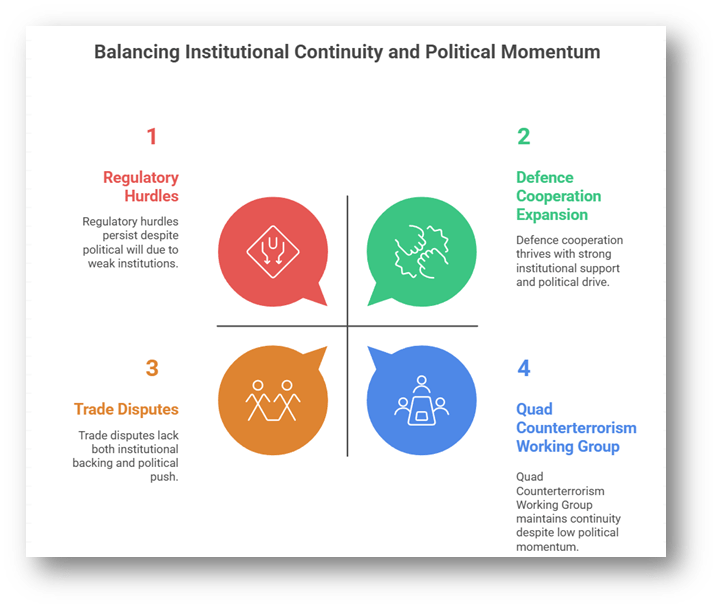
- CASE STUDY: The Quad Counterterrorism Working Group’s sustained engagement demonstrates functional cooperation independent of summit schedules.
- Such mechanisms align with India’s multilateral strategy of minilateralism for practical outcomes.
- Limits of institutionalism without political momentum
- Analysts caution that while institutions preserve continuity, transformational leaps often require political impetus, especially in trade and people-to-people domains.
- EXAMPLE: Regulatory hurdles and technology transfer concerns persist despite strong defence frameworks.
- This underscores the need for political leadership to complement, not replace, institutional depth.
Conclusion:
- The India–U.S. partnership demonstrates that institutional mechanisms—defence frameworks, technology initiatives, and bureaucratic ecosystems—form the backbone of cooperation, ensuring resilience amid political volatility. While high-level summits provide visibility and direction, it is institutions that sustain trust, enable interoperability, and translate strategic convergence into action.
- Looking ahead, deepening institutional understanding across defence, technology, trade, and infrastructure will be crucial. Expanding cooperation into emerging sectors and aligning regulatory frameworks can help convert continuity into momentum.
- In an evolving geopolitical landscape, the durability of India–U.S. ties will depend less on the frequency of summits and more on the strength of these parallel institutional tracks, which quietly but decisively uphold the partnership’s strategic relevance.
- The signing of LEMOA, COMCASA, and BECA has transformed India–U.S. defence ties from transactional arms sales into systemic interoperability, enabling secure communications, real-time geospatial intelligence sharing, and reciprocal logistical support.
- EXAMPLE: During joint maritime surveillance in the Indo-Pacific, BECA-enabled data sharing has enhanced India’s maritime domain awareness without requiring new political mandates.
- This aligns with India’s broader defence reforms aimed at jointness and integration, complementing initiatives such as the creation of the Chief of Defence Staff (CDS) and theatreisation efforts.
- The 10-year Defence Framework Agreement (2025) provides a stable roadmap for coordination, co-development, and deterrence planning, insulating defence cooperation from short-term diplomatic frictions.
- CASE STUDY: Even amid trade disputes and summit postponements, defence dialogues and service-level talks continued uninterrupted, demonstrating institutional resilience.
- Such frameworks mirror India’s preference for strategic autonomy with structured partnerships, rather than alliance dependency.
- Exercises like Yudh Abhyas, Malabar, and Tiger Claw have evolved into institutionalised platforms for joint planning, logistics, and operational learning.
- EXAMPLE: Malabar’s expansion from a bilateral naval drill to a Quad-level exercise reflects institutional depth rather than summit-driven symbolism.
- These exercises reinforce India’s Indo-Pacific vision of a free, open, and rules-based order, complementing regional security architectures.
- Platforms such as INDUS-X and the Security of Supply Arrangement (SOSA) embed defence innovation within institutional channels linking governments, start-ups, and private industry.
- EXAMPLE: The HAL–General Electric fighter jet engine agreement illustrates how institutional trust enables high-end technology collaboration beyond buyer–seller dynamics.
- This dovetails with India’s Atmanirbhar Bharat and defence indigenisation goals, promoting co-production rather than dependence.
- The Initiative on Critical and Emerging Technologies (iCET) institutionalises cooperation in AI, semiconductors, space, and cyber domains, areas less dependent on summit diplomacy.
- CASE STUDY: The joint NASA–ISRO NISAR satellite for disaster management and infrastructure planning shows how scientific institutions sustain collaboration despite geopolitical flux.
- Such cooperation supports India’s digital public infrastructure push and resilience-building objectives.
- Institutional Quad initiatives, such as the Ports of the Future Conference, emphasise quality infrastructure, secure supply chains, and regional connectivity.
- EXAMPLE: Collaboration on resilient port development aligns with India’s Sagarmala Programme, integrating national priorities with regional partnerships.
- This demonstrates how institutional mechanisms translate strategic convergence into tangible regional outcomes.
- While trade disputes, tariff issues, and differing approaches to third countries create political strain, institutional dialogues continue to function quietly and effectively.
- EXAMPLE: Defence cooperation expanded even as India’s exports to the U.S. fluctuated, highlighting sectoral insulation through institutions.
- This reflects Washington’s pragmatic balance-of-interest approach and India’s emphasis on issue-based engagement.
- Ministerial meetings, working groups, and counterterrorism dialogues ensure the Quad remains active even when leader summits are delayed.
- CASE STUDY: The Quad Counterterrorism Working Group’s sustained engagement demonstrates functional cooperation independent of summit schedules.
- Such mechanisms align with India’s multilateral strategy of minilateralism for practical outcomes.
- Analysts caution that while institutions preserve continuity, transformational leaps often require political impetus, especially in trade and people-to-people domains.
- EXAMPLE: Regulatory hurdles and technology transfer concerns persist despite strong defence frameworks.
- This underscores the need for political leadership to complement, not replace, institutional depth.
- The India–U.S. partnership demonstrates that institutional mechanisms—defence frameworks, technology initiatives, and bureaucratic ecosystems—form the backbone of cooperation, ensuring resilience amid political volatility. While high-level summits provide visibility and direction, it is institutions that sustain trust, enable interoperability, and translate strategic convergence into action.
- Looking ahead, deepening institutional understanding across defence, technology, trade, and infrastructure will be crucial. Expanding cooperation into emerging sectors and aligning regulatory frameworks can help convert continuity into momentum.
- In an evolving geopolitical landscape, the durability of India–U.S. ties will depend less on the frequency of summits and more on the strength of these parallel institutional tracks, which quietly but decisively uphold the partnership’s strategic relevance.
Recap: