India Potential Growth Rate: Role of Public & Private Investment, GFCFR & ICOR
India potential growth rate is shaped by the balance between investment quantity and capital efficiency — primarily public and private investments measured by Gross Fixed Capital Formation Rate (GFCFR) and Incremental Capital-Output Ratio (ICOR). This article evaluates how these two parameters determine India’s long-term economic potential and sustainable growth path.
Introduction
- Potential growth rate represents the maximum sustainable rate of GDP growth that an economy can achieve without triggering inflationary pressures. For India, this is presently estimated at around 6.5%, as inferred from trends in Gross Fixed Capital Formation Rate (GFCFR) and Incremental Capital-Output Ratio (ICOR).
- The GFCFR, averaging nearly 34–35% of GDP in recent years, reflects the share of total investment in fixed assets, while the ICOR, averaging 5.2, indicates how efficiently that capital translates into output. Together, they serve as fundamental metrics for assessing India’s long-term productive potential.
- The Economic Survey 2024–25 highlights that while India remains the fastest-growing major economy, the challenge is to sustain and elevate its potential growth by deepening private investment and improving capital efficiency.
I. Role of Public Investment in Sustaining Potential Growth
1. Infrastructure-Led Multiplier Effect
- Public investment in infrastructure — roads, railways, renewable energy, and digital infrastructure — has a strong multiplier effect on private investment and productivity.
- Programs like PM Gati Shakti, National Infrastructure Pipeline (NIP), and Bharatmala & Sagarmala enhance logistical efficiency, lowering ICOR in the long run.
- Example: National Infrastructure Pipeline (2019–25): Targeting investment of over ₹111 lakh crore, it has catalysed private sector participation and improved inter-sectoral linkages, particularly in logistics and energy.
2. Counter-Cyclical Stabilization Role
- During economic slowdowns, public investment sustains demand when private investment weakens.
- Capital expenditure by the Central Government grew by over 30% annually during FY22–FY24, cushioning the post-pandemic slowdown.
- Case Study: Post-COVID Fiscal Push – The government’s increased capital outlay (rising to 3.4% of GDP in FY25) stabilized GFCFR and prevented a fall in aggregate investment levels.
3. Structural Transformation and Human Capital Creation
- Public sector investments in health, education, and skilling enhance long-term productivity, reducing ICOR over time.
- Initiatives like PM-Ayushman Bharat Health Infrastructure Mission, Skill India Mission, and PM Vishwakarma Yojana are improving human capital quality and technological adaptation capacity.
- Empirical evidence from Asian Development Bank studies shows economies with stronger public investment in education and R&D have lower ICORs and higher potential growth.
4. Challenges and Limitations
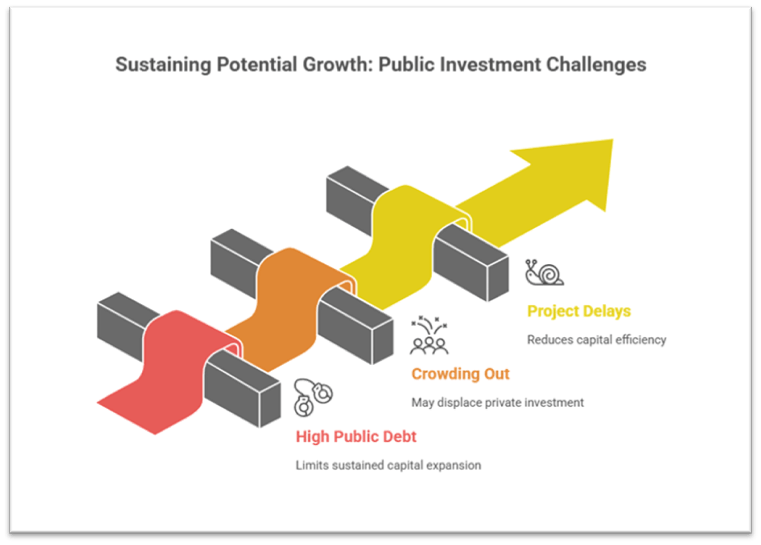
- High public debt (around 82% of GDP) limits fiscal space for sustained capital expansion.
- Rising share of public sector GFCF (from 21.6% in 2021–22 to 25.1% in 2023–24) may crowd out private investment if not complemented by ease-of-doing-business reforms.
- Additionally, infrastructure projects often face delays and cost overruns, reducing capital efficiency and raising ICORs in the short term.
II. Role of Private Investment in Enhancing Potential Growth
1. Engine of Productive Capacity and Innovation
- Private investment drives technological innovation, operational efficiency, and productivity gains, thereby lowering ICOR.
- India’s private corporate investment rate, however, fell from 37% to 34.4% of total GFCF between FY22 and FY24, constraining potential growth.
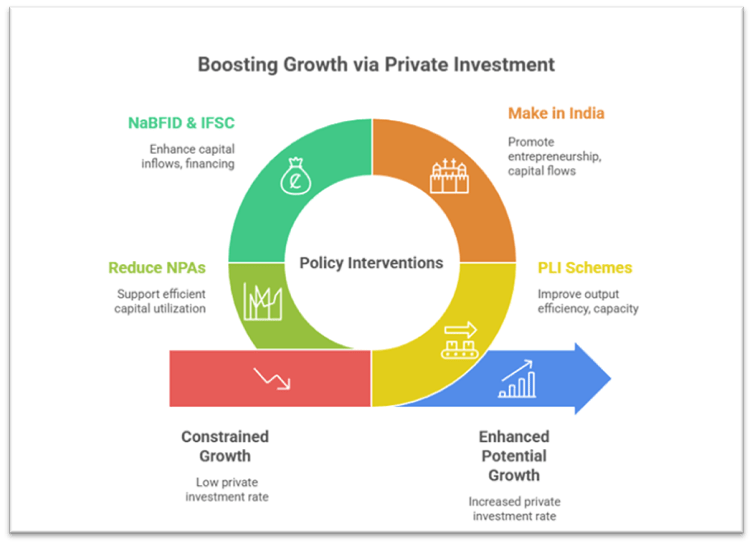
- Example: Automotive & Electronics Sectors – Investments under PLI Schemes have led to improved output efficiency and higher capacity utilization, boosting growth in manufacturing.
2. Role in Employment and Sectoral Diversification
- Private investment stimulates job creation, especially in labour-intensive sectors such as manufacturing, logistics, and construction.
- Programs like Make in India, Startup India, and National Logistics Policy promote entrepreneurship and private capital flows into emerging industries.
- Case Study: Semiconductor Mission (2021) – Catalyzed private participation in high-tech manufacturing, reducing import dependence and improving ICOR in advanced industries.
3. Financial Sector Depth and Ease of Credit
- Access to credit and capital markets enables private firms to expand capacity efficiently.
- The NaBFID and IFSC GIFT City initiatives aim to enhance private capital inflows and project financing.
- A healthy corporate bond market and reduced NPAs (now below 3%) further support efficient private capital utilization.
4. Constraints on Private Investment
- Regulatory uncertainty, slow judicial resolution, and infrastructure bottlenecks deter private investors.
- Weak global demand and geopolitical risks have dampened export-linked sectors, constraining profitability and reinvestment.
- The private sector’s risk aversion post-pandemic underscores the need for policy credibility and institutional stability to revive investor sentiment.
III. Interlinkages Between GFCFR, ICOR, and Potential Growth
1. GFCFR as a Key Determinant of Long-Term Growth
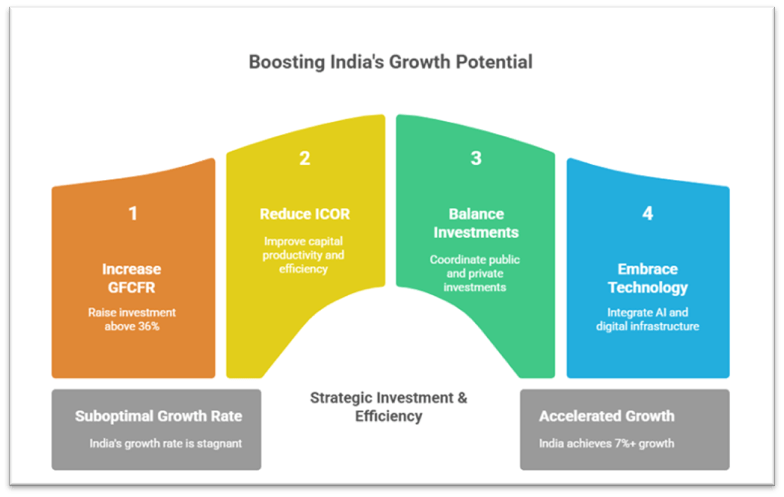
- Sustained GFCFR above 36% of GDP is typically associated with 7%+ potential growth.
- India’s GFCFR has remained steady at around 34.5% since FY23, suggesting a stable but not accelerating growth potential.
- Example: East Asian Economies (1980s–2000s) – Maintained GFCFR above 40%, achieving double-digit growth, underscoring the importance of high investment rates for capital deepening.
2. ICOR as a Measure of Capital Efficiency
- ICOR represents how effectively investments translate into output; a lower ICOR indicates higher capital productivity.
- India’s ICOR currently averages around 5.2, higher than China (~4) or Vietnam (~3.8), suggesting room for efficiency gains.
- Reducing ICOR through technology adoption, regulatory simplification, and infrastructure quality improvements can lift India’s potential growth to 7% or above.
3. Balancing Public and Private Investment for Optimal Growth
- While public investment builds foundational infrastructure, private investment ensures productivity and innovation.
- Coordinated policy efforts—such as PPP and PLI—can jointly raise GFCFR and lower ICOR.
- Example: Delhi-Mumbai Industrial Corridor (DMIC) – A successful PPP model demonstrating how synergistic investments can yield higher capital efficiency and productivity spillovers.
4. Emerging Technological and Global Dimensions
- The integration of AI, Gen AI, and digital infrastructure can reduce ICOR by automating processes and improving precision in manufacturing and logistics.
- However, global trade headwinds and supply chain realignments pose challenges to export-led investment expansion.
- Balanced diversification of trade partners and innovation-driven domestic production will be crucial to maintaining GFCFR and achieving efficiency-driven growth.
Conclusion:
- India’s potential growth rate of around 6.5% reflects a delicate balance between investment quantity (GFCFR) and efficiency (ICOR). While public investment has anchored infrastructure and stabilized growth post-pandemic, private investment remains the decisive engine for sustained expansion and job creation.
- To push the potential growth beyond 6.5%, India must raise GFCFR by 2 percentage points and reduce ICOR below 5, achievable through deeper private sector participation, productivity-enhancing reforms, and digital innovation.
- Going forward, strengthening the investment climate, accelerating structural reforms, and improving governance efficiency can enable India to achieve a sustainable 7%+ potential growth trajectory, ensuring inclusive development consistent with the goals of Amrit Kaal and Viksit Bharat 2047.
Recap: