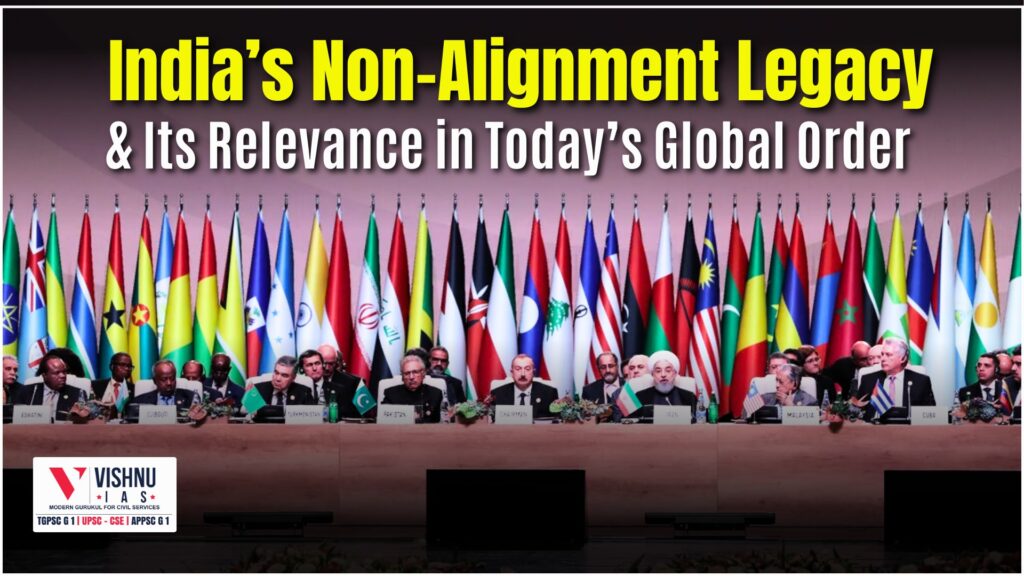
India’s Non-Alignment Legacy and Its Relevance in Contemporary Global Engagements
Introduction
India’s Non-Alignment legacy emerged as an independent foreign policy doctrine in the early years of independence, seeking to maintain strategic autonomy amidst Cold War bipolarity. India, under Jawaharlal Nehru and later leaders, helped found the Non-Aligned Movement (NAM) in 1961, which gave newly decolonized nations a platform to resist alignment with either the U.S. or the USSR.
Today, India is the world’s fourth-largest economy (IMF 2025 estimates, ~$4.5 trillion GDP), a leading digital hub, and a critical player in multilateral institutions. However, debates persist on whether non-alignment remains relevant in a world increasingly marked by U.S.-China strategic competition, multipolarity, and technological rivalries. Examining this legacy helps assess how India balances continuity with adaptation in its global engagements.
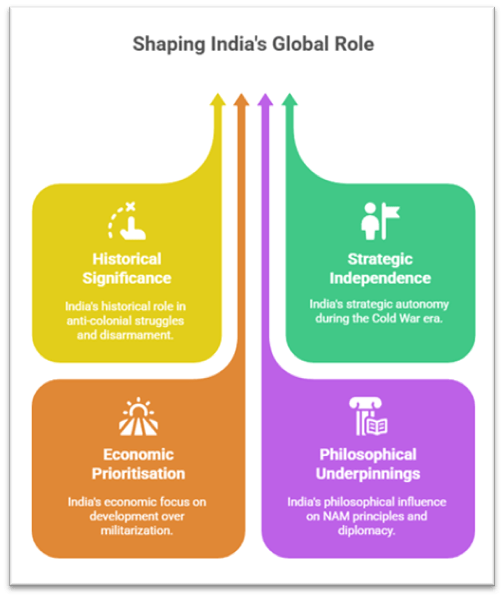
Historical Significance and Strategic Autonomy
Moral and Political Leadership
- NAM positioned India as the voice of the Global South, providing credibility in championing anti-colonial struggles and disarmament.
- Example: India’s mediation in the Korean War (1950s) enhanced its image as a peace broker.
- This legacy continues in India’s role in United Nations Peacekeeping, where India remains among the largest troop contributors.
Strategic Independence during the Cold War
- Non-alignment allowed India to access both U.S. and Soviet resources while safeguarding sovereignty.
- Example: Indo-Soviet Treaty of 1971 balanced against U.S. tilt towards Pakistan, showing pragmatic flexibility.
- This ethos underpins India’s current stance of “multi-alignment,” engaging with QUAD, BRICS, and SCO simultaneously.
Economic Prioritisation
- Policy of “Butter before Guns” emphasized development over militarization, aligning with NAM’s principles of peace and cooperation.
- Green Revolution transformed India into a net food exporter.
- Today, India uses its G20 presidency outcomes (2023) to advocate for debt relief and climate finance, echoing NAM’s focus on development justice.
Philosophical Underpinnings
- India’s civilisational ethos shaped NAM: non-violence, Panchsheel, and Vasudhaiva Kutumbakam.
- This legacy informs India’s climate diplomacy (e.g., International Solar Alliance).
- The philosophy sustains India’s credibility among Global South nations in UN reforms advocacy.
Contemporary Relevance in Global Engagements
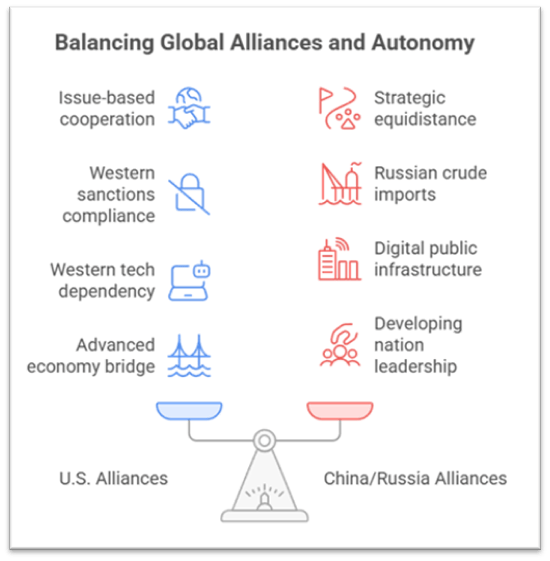
Balancing Major Power Rivalries
- India refuses to be drawn fully into U.S.-China confrontation, preserving issue-based cooperation.
- Example: Membership in QUAD coexists with engagement in BRICS and SCO.
- This is reminiscent of NAM’s strategic equidistance, recalibrated as “issue-based alignment.”
Energy and Defence Security
- India’s pragmatic energy sourcing and defence partnerships reflect NAM’s ethos.
- Example: Importing discounted Russian crude oil despite sanctions, while expanding U.S. defence ties (COMCASA, BECA).
- This echoes NAM’s principle of safeguarding sovereignty.
Technological Sovereignty
- India emphasizes autonomy in the digital economy and AI geopolitics.
- Example: Digital Public Infrastructure (UPI, Aadhaar, ONDC) models for the Global South.
- This reflects NAM’s resistance to dependency, adapted for the cyber era.
South-South Cooperation
- India sustains leadership among developing nations through NAM-style solidarity.
- Example: Voice of Global South Summit (2023) amplified climate finance and trade justice issues.
- This reinforces India’s identity as a bridge between advanced and developing economies.
Critiques, Limitations, and Adaptations
- Constraints of Multipolarity: Critics argue pure non-alignment is outdated in today’s world. Example: dependence on U.S. tech ecosystems limits autonomy.
- Security Pressures: Border tensions with China and instability in South Asia narrow India’s neutrality. Example: Galwan clash (2020) deepened convergence with the U.S. and Quad.
- Economic Dependence: Global market integration increases vulnerability. Example: WTO disputes with the U.S. over agricultural subsidies.
- Institutional Relevance of NAM: NAM today lacks leadership compared to BRICS or G20. India now uses NAM more symbolically than substantively.
Conclusion:
India’s Non-Alignment legacy remains deeply relevant, not as rigid neutrality but as a guiding principle of strategic autonomy, South-South solidarity, and issue-based cooperation. While the original Cold War context has changed, the ethos of resisting dependency and maintaining sovereignty continues to shape India’s global engagements.
India’s current multi-alignment strategy, technological sovereignty push, and leadership of the Global South reflect adaptations of this legacy. Moving forward, blending historical non-alignment values with pragmatic engagement in emerging domains like AI governance, climate change, and supply chain security will ensure India not only safeguards autonomy but also contributes constructively to a multipolar global order.
Recap: