
Evaluating India’s Carbon Credit Trading Scheme: Decarbonisation Pathway to Net-Zero Targets
India’s Carbon Credit Trading Scheme (CCTS) represents a key market-based mechanism to accelerate industrial decarbonisation and help achieve the nation’s net-zero carbon emissions goal by 2070. With high-emission sectors in focus, the scheme aligns climate policy with economic growth, but its effectiveness requires evaluation and strategic refinement.
Introduction
- Climate change mitigation is a central tenet of India’s development strategy, with the country committing to reach net-zero carbon emissions by 2070, as announced at COP26.
- A vital component of this effort is market-based mechanisms that drive emissions reductions while supporting economic growth.
- One such instrument is the Carbon Credit Trading Scheme (CCTS), notified under the Energy Conservation (Amendment) Act, 2022, and operationalised in 2023-24.
- The CCTS is designed to create a domestic compliance carbon market, initially covering eight key heavy industries — aluminium, cement, iron and steel, paper and pulp, chlor-alkali, textiles, petrochemicals, and petroleum refineries — to regulate and reduce their emissions intensity of production.
Conceptual Foundations and Design of CCTS
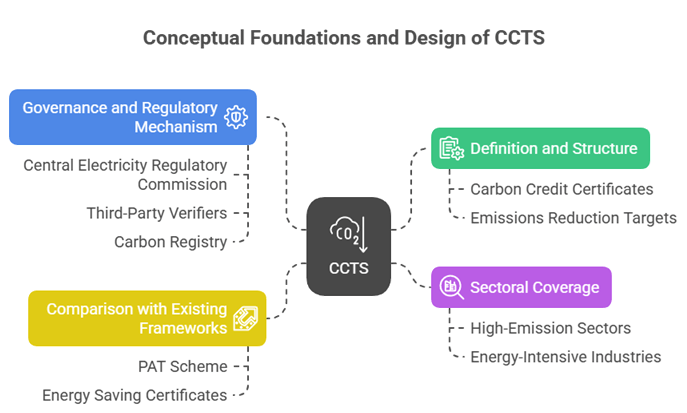
- Definition and Structure: CCTS is a market-based compliance mechanism where carbon credits are issued to industries reducing emissions below targets and traded with those exceeding them.
- It focuses on direct CO₂e emissions reduction per production unit, unlike the PAT Scheme’s focus on energy efficiency.
- Regulated under the Ministry of Power with BEE oversight, supported by Measurement, Reporting, and Verification (MRV) frameworks.
Sectoral Coverage and Industrial Focus
- Targets eight high-emission, energy-intensive sectors accounting for over 60% of industrial CO₂ emissions.
- Fertilizer sector excluded temporarily due to insufficient baseline data but expected to be added later.
Comparison with Existing Frameworks
- Builds on lessons from the PAT scheme that offered Energy Saving Certificates (ESCerts); CCTS introduces carbon credit trading aligning with global markets.
- PAT Cycle I achieved 26 Mtoe energy savings but lacked uniform emissions reduction outcomes.
Governance and Regulatory Mechanism
- Central Electricity Regulatory Commission (CERC) to regulate market design.
- Third-party verifiers ensure MRV integrity and a central Carbon Registry maintains credit transparency.
Assessment of Effectiveness in Driving Decarbonisation
Economy-Wide vs. Entity-Level Impact
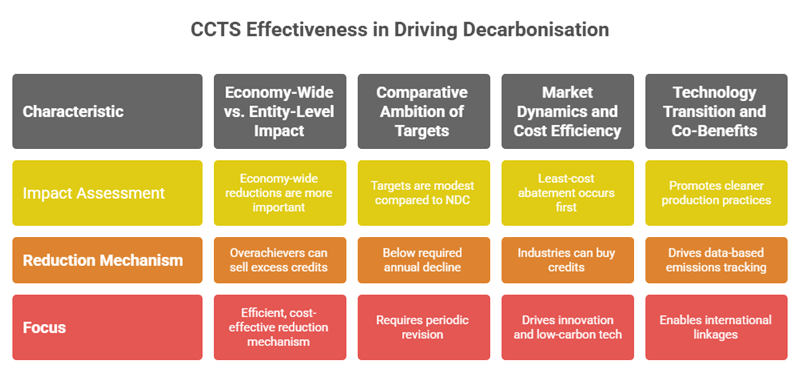
- Emphasizes overall sector-level performance over uniform reductions by each entity.
- Industries exceeding targets can sell excess credits, promoting system-wide efficiency.
Comparative Ambition of Targets
- Current emissions intensity reduction target: ~1.68% annually (2023–2027), below the ~2.5–3.5% required for India's net-zero path.
- Targets may need to be revised upwards for alignment with India’s NDCs.
Market Dynamics and Cost Efficiency
- Ensures least-cost abatement through trading, helping avoid abrupt industrial disruption.
- Market-based price signals encourage adoption of low-carbon technologies.
Technology Transition and Co-Benefits
- Promotes clean tech like CCS, green hydrogen, and electrification.
- Supports global carbon reporting obligations and future Article 6 market linkages under the Paris Agreement.
- Example: Reliance and IndianOil’s green hydrogen investments demonstrate future-readiness.
Challenges and Recommendations for Strengthening CCTS
Data Integrity and MRV Infrastructure
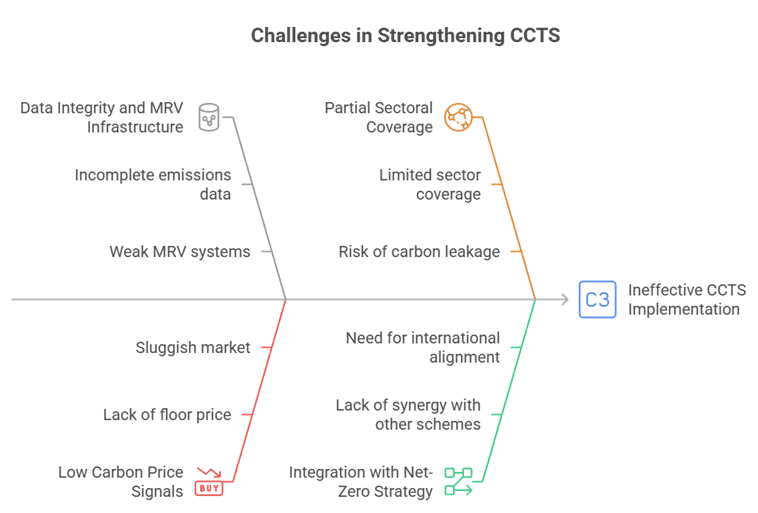
- Data gaps among MSMEs and lack of robust MRV threaten credibility.
- National MRV Framework (2023) introduced to streamline and standardize emissions data collection.
Low Carbon Price Signals
- Absence of floor price or cap may cause undervaluation of credits, weakening decarbonisation incentives.
- Need to build a robust secondary market and ensure trading transparency.
Partial Sectoral Coverage and Carbon Leakage
- Only eight sectors covered; fertilizers, MSMEs, and transport remain excluded.
- Risk of emissions shift to unregulated sectors if comprehensive coverage isn't ensured.
Integration with Net-Zero Strategy
- Requires alignment with complementary schemes: Renewable Energy Targets, National Green Hydrogen Mission, Battery PLI.
- Inter-ministerial coordination between MoEFCC, MNRE, MoP, and others is crucial.
- Example: EU’s CBAM could impact Indian exporters — domestic policies must adapt quickly.
- Suggestion: Introduce export incentives for carbon-compliant industries.
Conclusion
India’s Carbon Credit Trading Scheme is a promising beginning in its decarbonisation journey, especially for hard-to-abate industries. While its current targets may appear moderate, the CCTS framework offers a scalable, cost-effective, and flexible tool that can evolve with India’s economic and climate ambitions.
According to IEA (2024), India must reduce emissions intensity by ~3% annually to remain on the net-zero path. CCTS must align accordingly and act as a central pillar in India’s green transition strategy.
If implemented with rigorous oversight and evolving ambition, India’s CCTS can serve as a model for emerging economies seeking to balance development with climate responsibility. The next few years will be pivotal in determining whether this instrument becomes transformative or merely transitional.
RECAP