
Exclusionary Immigration Frameworks: Unmasking Racial and Cultural Bias in Modern Democracies
Introduction:
Exclusionary immigration frameworks refer to legal, administrative or policy mechanisms adopted by states to restrict, regulate or deny the entry, residence or rights of non-citizens (migrants, refugees, asylum seekers) on the basis of prescribed criteria. These frameworks often manifest through visa restrictions, deportation regimes, asylum metering, family‐separation policies, or pathways to citizenship that are onerous or inaccessible. Globally, migration is substantial: according to the Organisation for Economic Co‑operation and Development (OECD), many member states are grappling with rising migrant flows and have introduced both integration and exclusion measures. :contentReference[oaicite:1]{index=1} Numerous analyses show that what might appear as “neutral” immigration policy often correlates with disparities by race, ethnicity, national origin or religion. For example, the United Nations Human Rights Council in its 2021 report noted that although immigration laws appear race-neutral, they frequently produce discriminatory outcomes based on origin, ethnicity or race.
Body:
1. Structural and Institutional Dimensions of Exclusion
1.1 Historical legacies and nation-state identity
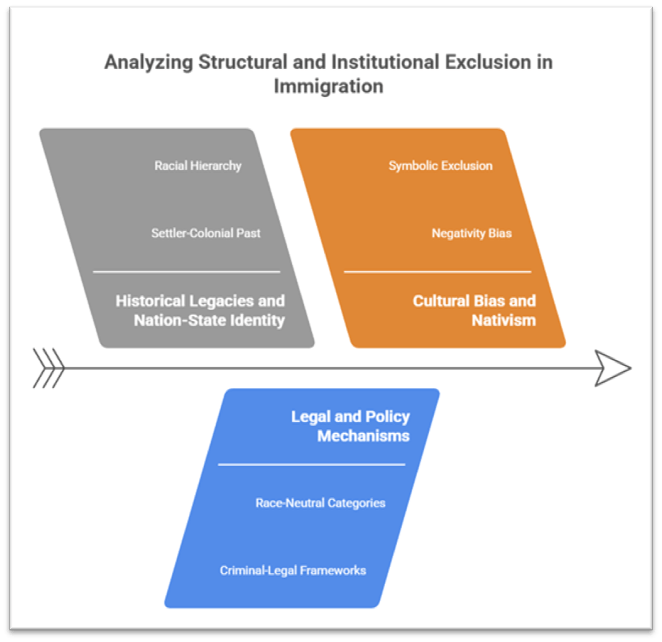
Many modern immigration frameworks are rooted in the settler-colonial and imperial past of Western states, where migration, displacement and exclusion were embedded in the creation of the nation-state. Scholars argue that migration law continues to carry the logic of racial hierarchy: the migrant is constructed as “other”, external to the normative citizen-subject. For example, the immigration policy of the White Australia policy in Australia explicitly sought to exclude non-white migrants and demonstrates how racialised criteria were institutionalised. The structural bias is also present in how nation-states privilege certain origins: Research in the U.S. indicates that undocumented immigrants from Latin America face harsher enforcement compared to prior European migrants who entered under similar conditions.
1.2 Legal and policy mechanisms that reproduce bias
Exclusionary immigration frameworks often use ostensibly race-neutral categories (national origin, visa type, modality of entry) to generate disparate impact along racial, ethnic or cultural lines. The UN Special Rapporteur on racism notes that such policies “in effect … single out specific racial, ethnic, national and religious groups”. In the U.S., for example, a machine-learning analysis of nearly 6 million asylum court cases found that 58.5 % of the variability in decision outcomes was explained by political climate and judge cohort rather than case merits. :contentReference[oaicite:4]{index=4} The reliance on criminal-legal frameworks within immigration enforcement (e.g., prosecution of “unauthorised entry” leading to mass detention) disproportionately affects migrants of colour, linking immigration status with punitive processes.
1.3 Cultural bias, nativism and symbolic exclusion
Attitudinal research shows that public perceptions of immigration are marked by a “negativity bias” where cultural threat, economic threat and security threat dominate narratives. This bias tends to map onto perceptions of migrants from non-white or non-Western origins. The concept of nativism captures how exclusionary frameworks are embedded in ideology: where indigenous (or established) populations are privileged over newcomer groups, often on cultural or symbolic grounds. In many democracies, even legal acceptance of migrants does not translate into “symbolic acceptance” within communities—white respondents in the U.S. may favour legal pathways but stop short of full inclusion of non-white migrants in shared social spaces.
2. Case Studies: Modern Democracies and Immigrant Exclusion
2.1 United States: Race, asylum and enforcement
In the U.S., studies show that Black non-citizens face disparate treatment in immigration detention, screening, and removal systems: higher rates of detention, higher bonds, and lower approval rates for asylum/credible fear tests for those from Black-majority countries. A commentary observed that U.S. immigration policy functions as structural racism: undocumented immigrants of colour face harsher consequences than earlier European migrants for similar actions (e.g., undocumented entry).
2.2 United Kingdom (and Europe): The “Hostile Environment” and narrative framing
In the U.K., the Hostile Environment Policy (announced 2012) aimed to make life difficult for undocumented migrants, but has been criticised for producing a “shadow” excluded population primarily affecting racialised minorities. Research on U.K. parliamentary discourse indicates a shift towards securitised narratives of “illegal immigration” and away from integrative frames—reflecting how policy culture reinforces exclusion and othering. European integration policies (e.g., in Belgium, Germany, Spain) now include civic-integration tests and language proficiency requirements—but critics argue these may implicitly filter cultural-minority migrants or reinforce assimilation-oriented benchmarks for belonging. :contentReference[oaicite:6]{index=6}
2.3 Technological and algorithmic bias in migration governance
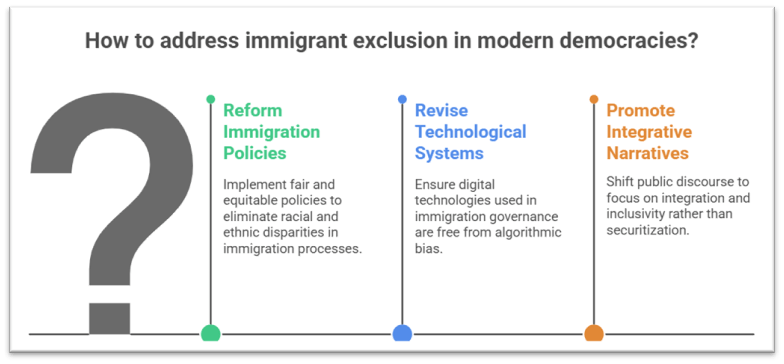
Digital border technologies, biometric-screening systems and automated decision-making in immigration governance pose risks of embedding racialised and ethnic profiling: the UN report highlights how digital technologies in immigration enforcement exacerbate racial inequalities. For example, algorithmic systems assessing risk in migration may carry embedded assumptions about certain nationalities or ethnicities as “risky” or “undesirable”, reinforcing exclusionary logics rather than neutral adjudication. Such practices underscore how modern democracies’ immigration frameworks can reflect not only overt cultural or racial bias, but structural computational bias that perpetuates exclusion under the guise of efficiency or objectivity.
3. Consequences, Ethical Implications and Policy Responses
3.1 Consequences for migrants, society and democracy
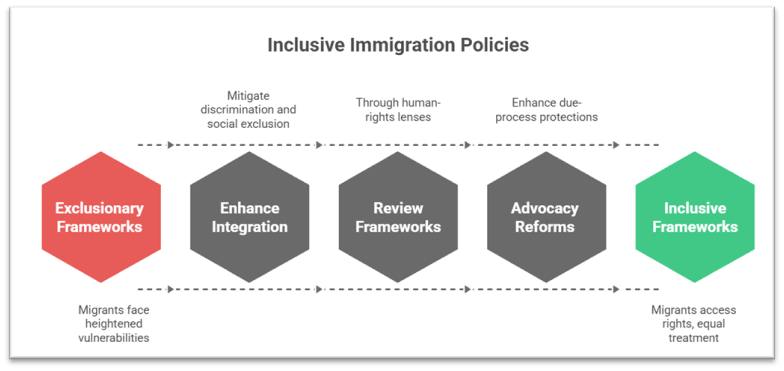
Migrants subject to exclusionary frameworks face heightened vulnerabilities: restricted access to rights (employment, health, justice), more precarious legal status, and social marginalisation. Recognition gaps (e.g., in Sweden, where immigrants were racialised and stigmatized during COVID-19) illustrate cultural dimensions of exclusion. For host societies, exclusionary frameworks undermine democratic values: the denial of equal treatment and due process for non-citizens or racialised migrants challenges the universalist foundations of democracy and human rights. Ethically, when states deploy immigration policy in ways that correlate with race, ethnicity or culture, they violate principles of equality, non-discrimination and dignity. The ethics of immigration field itself has been critiqued for methodological nationalism and for neglecting equal opportunity and reparation as normative principles.
3.2 Policy responses and government initiatives
Many OECD states are now enhancing integration policies to mitigate discrimination and social exclusion: e.g., language and civic orientation requirements in Belgium, Norway’s “Action Plan Against Racism and Discrimination (2024-27)”, Germany’s anti-racism programmes. Some states are reviewing immigration frameworks through human-rights lenses: the UN Committee on the Elimination of Racial Discrimination emphasises that differential treatment based on immigration status constitutes racial discrimination if not justified legitimately and proportionately. Advocacy organisations call for reforms: in the U.S., recommendations include ending mass migration-related prosecutions, revising asylum adjudication systems to reduce extraneous decision-influences, and enhancing due-process protections for racialised migrant groups.
3.3 Strategic considerations for modern democracies (especially in UPSC context)
For aspirants of civil services, it is important to contextualise immigration frameworks within broader themes of social justice, international human rights law, globalisation and domestic democracy. Immigration policy is not only about border control or economics but intersects with race, culture, national identity, citizenship theory and historical legacies of empire/colonialism. Balanced policy requires states to reconcile sovereign rights to regulate entry with universal human rights and non-discrimination norms. Recognition of implicit bias and cultural exclusion is crucial for designing inclusive frameworks.
Conclusion:
Exclusionary immigration frameworks in modern democracies often mirror and reproduce racial and cultural biases through structural, institutional and cultural dimensions. These frameworks are not merely border-management tools but are embedded in historical legacies of exclusion, nation-state identity formation, and power hierarchies of race and culture. Empirical evidence—from racial disparities in asylum adjudication in the U.S. to nativist public attitudes and digital biases—demonstrates how exclusion is operationalised. For democracy to uphold its ideals of equality, dignity, and inclusion, it must critically examine and reform immigration frameworks that implicitly or explicitly discriminate. Going forward, states should enhance transparency in immigration decision-making, strengthen safeguards against racial or cultural profiling, invest in integration and recognition of migrants as full social actors, and align domestic policy with international human rights norms.
Recap: