Community-Level Diplomacy in Indo-Sri Lankan Maritime Disputes: Joint Conservation for Palk Bay Fisheries
Introduction
Maritime disputes between India and Sri Lanka in the Palk Bay region represent one of South Asia’s most sensitive livelihood-security challenges. These disputes are shaped by cross-border fishing practices, the Katchatheevu sovereignty debate, and ecological pressures on marine resources. According to the FAO’s State of World Fisheries Report 2024, nearly 35% of global fish stocks are overexploited, with South Asia witnessing some of the sharpest declines. In this context, community-level diplomacy in Indo-Sri Lankan maritime disputes and joint conservation models offer potential frameworks to transform recurring disputes into cooperation mechanisms. The issue demands not only state-led negotiations but also grassroots engagement, given that over 200,000 fisher families in Tamil Nadu and Northern Sri Lanka directly depend on these waters for survival.
I. Understanding the Nature of Indo-Sri Lankan Maritime Disputes
1. Historical and Legal Dimensions
- The 1974 and 1976 India-Sri Lanka Maritime Boundary Treaties settled sovereignty issues such as Katchatheevu, which international law now recognises as final (pacta sunt servanda).
- However, perceptions persist in India that the islet was “ceded,” generating political rhetoric that complicates technical negotiations.
- Case studies such as the Rann of Kutch Arbitration (1968) and the ICJ’s Minquiers and Ecrehos case (1953) illustrate how administrative jurisdiction historically outweighs rhetorical claims, underscoring why Katchatheevu remains legally settled.
2. Ecological Pressures in the Palk Straits
- Mechanised bottom trawling by Indian vessels has degraded coral beds, shrimp habitats, and reduced near-shore stocks, affecting both Indian and Sri Lankan small-scale fishers.
- Sri Lanka banned bottom trawling in 2017, but enforcement challenges persist.
- Similar ecological degradation has been observed in the Bay of Bengal Large Marine Ecosystem, where unregulated fishing led to severe biodiversity loss, highlighting the need for cooperative monitoring.
3. Livelihood Conflicts Within Communities
- Disputes are not only bilateral but intra-community, as artisanal fishers in Tamil Nadu lose out to trawler operators who dominate with capital-intensive methods.
- Traditional fishing communities in Sri Lanka’s Northern Province, who were restricted during the civil war (1983–2009), continue to rebuild fragile livelihoods.
- The issue parallels Indonesia’s community-fisheries conflicts, where artisanal fishers demanded quotas distinct from industrial operators.
4. Misconceptions and Public Perceptions
- Media discourse often links the fisheries crisis with sovereignty over Katchatheevu, while in reality, fishing rights are distinct from territorial control.
- Community sensitisation, including highlighting Tamil Nadu’s historic support for Sri Lankan Tamil refugees, can foster empathy over confrontation.
II. Exploring Community-Level Diplomacy as a Solution
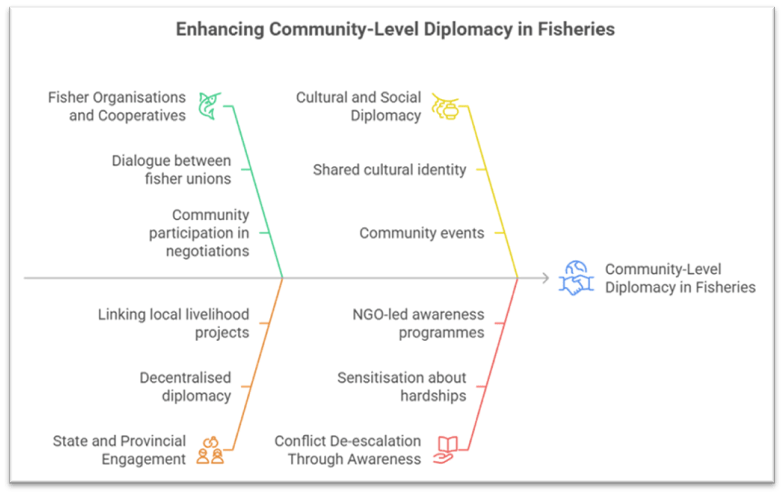
1. Role of Fisher Organisations and Cooperatives
- Dialogue between Indian and Sri Lankan fisher unions can help negotiate regulated access, seasonal fishing rights, or shared quotas.
- The India-Sri Lanka Joint Working Group on Fisheries (2016) has already facilitated limited dialogues, but decentralised bodies could ensure direct community participation.
- Lessons can be drawn from the Philippines-Indonesia tuna fisheries agreements, where fisher cooperatives co-managed catch limits.
2. State and Provincial Engagement
- Involving Tamil Nadu government and Sri Lanka’s Northern Provincial Council can decentralise diplomacy, reflecting community concerns better than central negotiations alone.
- State-level initiatives like Tamil Nadu’s Deep Sea Fishing Scheme (2017) could be linked with Sri Lanka’s local livelihood projects.
- Example: Kerala’s community-based fisheries management councils, which integrate local fisher voices into policy, provide a replicable model.
3. Cultural and Social Diplomacy
- Shared Tamil identity and kinship ties across the Palk Straits offer a platform for soft diplomacy.
- Community events such as the St. Anthony’s Church festival on Katchatheevu, attended by fishers from both sides, can be expanded into cultural diplomacy initiatives.
- Similar models exist in Indo-Nepal border fairs, which promote fraternity even amidst disputes.
4. Conflict De-escalation Through Awareness
- Sri Lankan Tamil MPs and media could sensitise Tamil Nadu about the hardships faced by Northern Province fishers during decades of war.
- NGO-led programmes such as South Asia Cooperative Environment Programme (SACEP) have demonstrated how awareness-building reduces hostility in environmental disputes.
- Such efforts can prevent framing Sri Lankan fishers as “aggressors,” preserving regional harmony.
III. Joint Conservation Models and Future Cooperation
1. Semi-Enclosed Sea Cooperation Frameworks
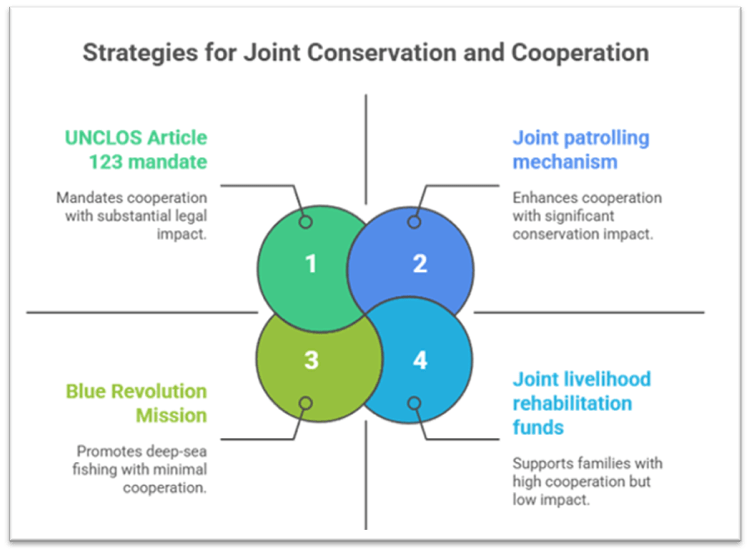
- UNCLOS Article 123 mandates cooperation in semi-enclosed seas like the Palk Bay and Gulf of Mannar.
- Joint conservation bodies could emulate the Baltic Sea Fisheries Convention, where multiple states share quotas and data.
- A bilateral Marine Resources Research Centre on Katchatheevu could generate scientific evidence for sustainable practices.
2. Promotion of Deep-Sea Alternatives
- India’s Blue Revolution Mission and Pradhan Mantri Matsya Sampada Yojana (PMMSY, 2020) promote deep-sea fishing, which can reduce pressure on contested near-shore zones.
- Incentivising artisanal fishers with modern gear for offshore waters mirrors Japan’s small-boat fisheries diversification programme, which successfully shifted pressure offshore.
- This strategy aligns with India’s 200-nautical-mile EEZ exploitation potential.
3. Joint Enforcement and Technology Sharing
- Satellite-based vessel monitoring systems, already trialled by India’s Directorate of Fisheries, can be expanded bilaterally.
- A joint patrolling mechanism could be piloted in specific hotspots, similar to India-Bangladesh coordinated patrols in the Sundarbans.
- Introducing blockchain-based traceability in fish trade, as done in Norway’s seafood exports, can ensure only legal, sustainable catches enter the market.
4. Economic and Humanitarian Cooperation
- Joint India-Sri Lanka livelihood rehabilitation funds could support families penalised for cross-border violations.
- Cross-investment in cold storage and fish processing units in Northern Sri Lanka could create economic interdependence.
- This mirrors the Indo-Myanmar Kaladan project, where infrastructure was leveraged for both connectivity and community development.
Conclusion:
Exploring community-level diplomacy and joint conservation models reveals that Indo-Sri Lankan maritime disputes are less about sovereignty and more about sustainability and livelihoods. Surveys such as the 2024 Pew Global Attitudes Report indicate that over 70% of South Asians favour cooperative neighbourhood policies over confrontational nationalism, reinforcing the need for pragmatic engagement.
Moving forward, blending government-to-government dialogue, provincial participation, fisher-level negotiations, and joint conservation regimes can transform the Palk Straits from a zone of contestation into a model of South Asian cooperation. By prioritising artisanal fishers, fostering ecological balance, and depoliticising sovereignty myths, both nations can advance towards the broader vision of peace, prosperity, and mutual respect in South Asia.
Recap: