
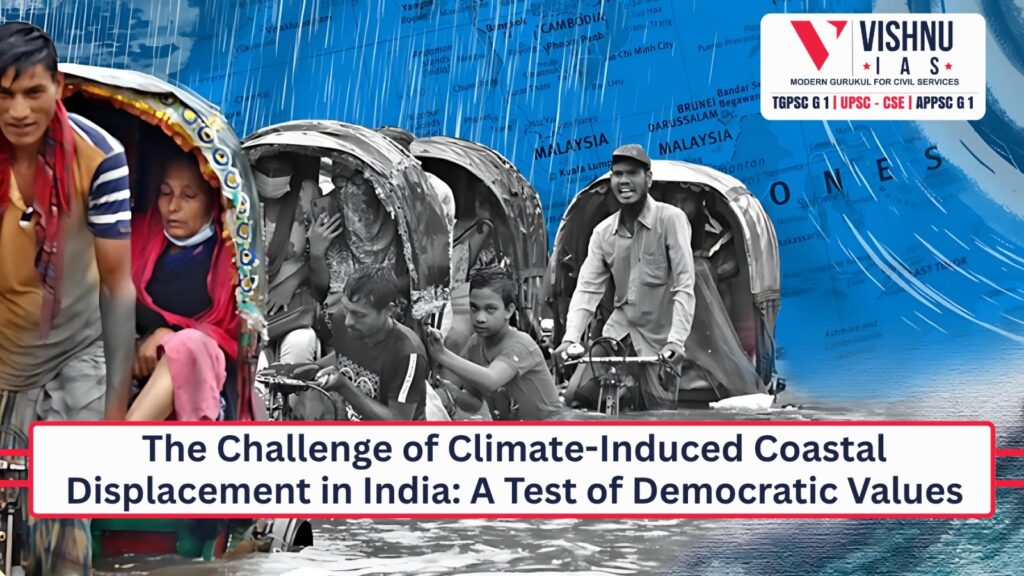
The Challenge of Climate-Induced Coastal Displacement in India – A Test of Democratic Values
Context:
India’s extensive coastline, measuring 7,500 km, faces significant threats from rising sea levels, saline intrusion, and unregulated development, displacing millions of individuals residing in coastal areas. The traditional livelihoods based on fishing, agriculture, and forestry are deteriorating, resulting in a large-scale movement of people into informal urban labor markets.
Current disaster management, environmental, and labor regulations do not adequately address the issue of climate-induced displacement, thereby exposing migrants to potential exploitation.
1. Socio-Environmental Consequences
- Coastal erosion and the intrusion of saltwater are submerging villages, leading to the degradation of cultivable land and freshwater resources.
- Example: Satabhaya (Odisha) has now succumbed to the sea, forcing its inhabitants to relocate to inadequately equipped resettlement areas.
2. Economic Disruption and Loss of Livelihoods
- Communities that have been displaced are compelled to engage in unstable construction, brick-kiln, and domestic work, lacking social security protections.
- Example: Migrants from Nagapattinam and Kutch are integrating into Mumbai’s informal labor market under exploitative debt-bondage conditions.
3. Social Vulnerabilities and Exploitation
- The lack of legal recognition renders climate migrants vulnerable to wage theft, hazardous working conditions, and gender-based violence.
- Example: Displaced women employed in domestic work encounter underpayment, mistreatment, and the threat of trafficking.
4. Legal and Policy Deficiencies
- Article 21 guarantees the right to life and dignity; however, there is no legislation that specifically addresses the issue of slow-onset climate migration.
- The Disaster Management Act (2005), the Environment Protection Act (1986), and the CRZ Notifications primarily concentrate on response measures or conservation efforts, neglecting rehabilitation needs.
- The relaxations in CRZ 2019 have favored tourism and port development at the expense of the rights of fishing communities.
5. Institutional Shortcomings
- The National Action Plan on Climate Change (NAPCC) and State Action Plans acknowledge the vulnerability of coastal areas but do not provide specific programs for populations that have been displaced.
- The Labour Codes fail to include clear protections for climate migrants working in the construction and domestic sectors.
6. Grass-roots Resistance and Environmental Justice
- Unions of fisherfolk and indigenous communities have effectively opposed harmful projects through protests and legal actions.
- Notable instances include the opposition to Ennore Creek in Tamil Nadu, the defense of mangroves in Pattuvam, Kerala, and the Save Satabhaya campaign in Odisha.
- Nevertheless, activists encounter threats, surveillance, and legal repercussions.
7. Pathways for Reform
- It is essential to acknowledge "climate migrants" within national migration and urban policies, ensuring access to decent employment, housing, and essential services.
- Labour laws should be revised to provide social security and minimum wage protections for informal sectors primarily occupied by displaced individuals.
- The Coastal Regulation Zone (CRZ) regulations need to be reinforced to promote participatory zoning and ensure the free, prior, and informed consent of coastal communities.
- Climate displacement should be integrated into both state and national adaptation strategies, accompanied by specific programs for rehabilitation, skill development, and livelihood support.
Conclusion:
Protecting coastal communities from climate-related displacement is not only an environmental imperative but also a challenge to India’s constitutional pledge to uphold dignity and equality. A rights-oriented, multi-faceted approach—incorporating legal reforms, community engagement, and specific welfare initiatives—has the potential to empower climate migrants, transforming them from highly vulnerable individuals into resilient citizens with protected rights.