Chinese Economy Structural Shift: From Investment-Led Growth to New Productive Forces and Lessons for India
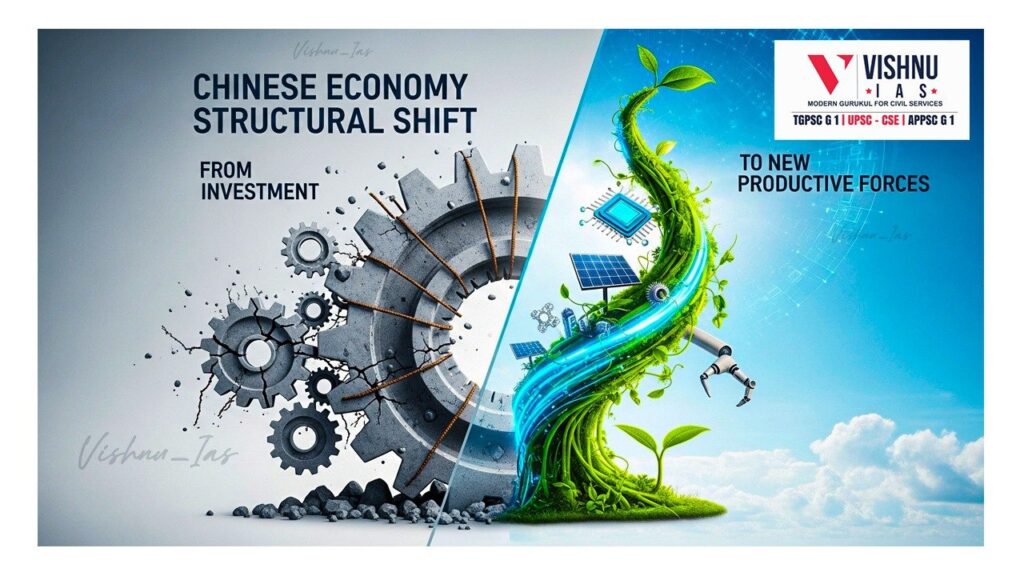
The Chinese economy structural shift represents a long-term transformation in the composition of growth drivers, sectoral output, and sources of productivity. China’s recent economic trajectory illustrates such a shift—from a high-investment, export-heavy model to one increasingly driven by domestic consumption and new productive forces such as advanced manufacturing, digital technologies, and green industries.
By 2025, China’s GDP crossed 140 trillion yuan, with consumption contributing over half of incremental growth, while high-tech manufacturing and clean energy emerged as core growth anchors. This transition is occurring amid global trade fragmentation, technological rivalry, and slowing traditional capital accumulation, making China’s experience relevant for other large developing economies seeking sustainable industrialisation.
I. From Investment-Led Growth to Consumption-Centric Expansion
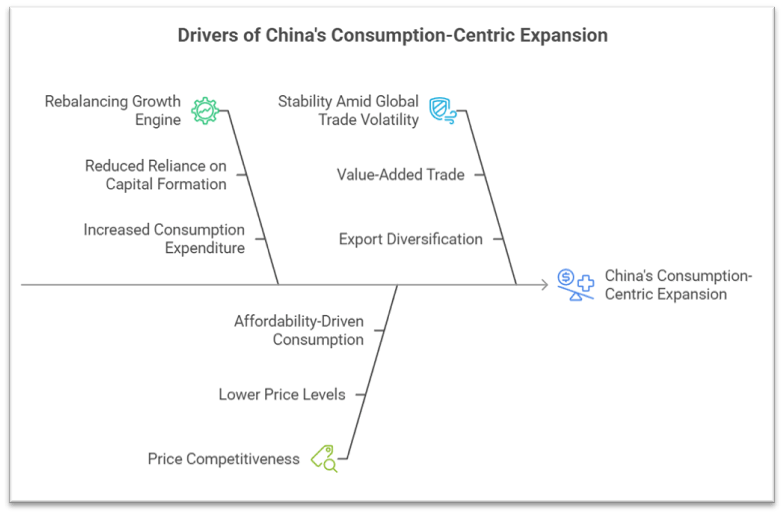
1. Rebalancing the Growth Engine
- China has consciously reduced its reliance on gross capital formation, which once dominated growth through infrastructure and real estate, and repositioned final consumption expenditure as the primary driver, reflecting a maturing economy where household demand sustains momentum.
- Rising urbanisation, expansion of the middle-income population exceeding 400 million, and improvements in social security coverage have supported higher discretionary spending.
- Example – Consumption Upgrade: Rapid growth in services such as digital payments, online retail, and health-related consumption demonstrates how internal demand can offset external shocks.
2. Price Competitiveness vs. Real Consumption
- Lower price levels in China often mask the depth of consumption when viewed through nominal expenditure, but physical consumption indicators—from food protein intake to digital device penetration—show mass-scale demand.
- This highlights the importance of affordability-driven consumption, rather than luxury-led growth, in sustaining large-population economies.
- Case Study – Digital Platforms: E-commerce ecosystems linking rural producers to urban consumers expanded domestic markets while compressing transaction costs.
3. Stability Amid Global Trade Volatility
- While exports remain important, their role has shifted from volume-driven to value-added, technology-intensive trade, allowing domestic demand to absorb global downturns.
- Export diversification towards regional partners reduced vulnerability to protectionism.
- Example – Regional Trade Integration: Stable trade with East and Southeast Asian economies helped balance fluctuations in traditional Western markets.
II. ‘New Productive Forces’ as the Core of Structural Transformation
1. Technological Upgradation of Manufacturing
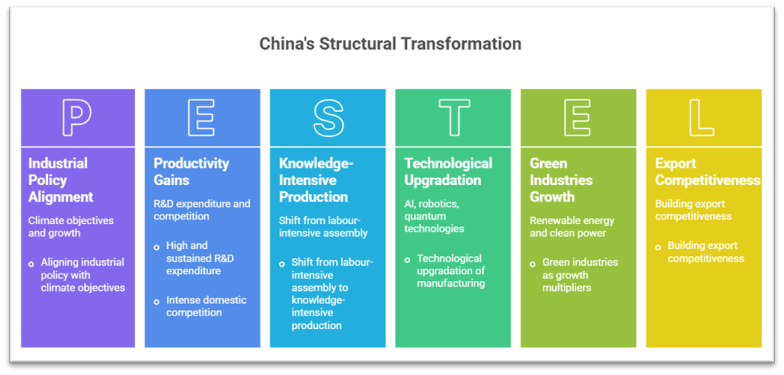
- China’s growth narrative now centres on AI, industrial robotics, quantum technologies, and advanced electronics, reflecting a shift from labour-intensive assembly to knowledge-intensive production.
- High and sustained R&D expenditure and intense domestic competition have underpinned productivity gains rather than reliance on price undercutting.
- Case Study – Industrial Automation: Rapid adoption of industrial robots improved efficiency in electronics and automobile manufacturing clusters.
2. Green Industries as Growth Multipliers
- Renewable energy, electric mobility, and clean power equipment have become strategic sectors, aligning industrial policy with climate objectives.
- Green manufacturing has created forward and backward linkages across metals, electronics, and software services.
- Example – Clean Energy Manufacturing: Large-scale deployment of renewable power equipment has lowered energy costs while building export competitiveness.
3. Exporting Capability, Not Excess
- Capacity utilisation rates comparable to advanced economies indicate that exports largely respond to external demand, not surplus dumping.
- Developing countries increasingly source Chinese machinery and technology for infrastructure and industrialisation needs.
- Real-Life Application – Infrastructure Modernisation: Adoption of cost-effective Chinese equipment in power and transport projects across Asia and Africa accelerated development timelines.
III. Lessons for India’s Manufacturing Sector
1. Align Manufacturing with Domestic Demand
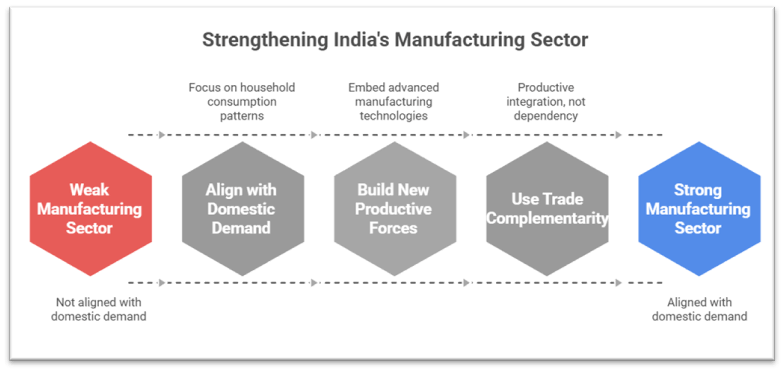
- India’s large population offers a scale advantage similar to China’s, but manufacturing must be closely tied to household consumption patterns, not just export incentives.
- Strengthening purchasing power through employment-intensive sectors can create a virtuous cycle between demand and production.
- Example – Consumer Electronics Assembly: Expansion of domestic electronics production shows how internal markets can anchor industrial capacity.
2. Build ‘New Productive Forces’ Early
- India can avoid late-stage industrial stagnation by embedding advanced manufacturing, digitalisation, and green technologies into its growth strategy from the outset.
- Strategic support for R&D, skill development, and technology diffusion is critical.
- Case Study – Semiconductor Ecosystem Development: Emerging fabrication and design initiatives illustrate the potential of technology-led industrial upgrading.
3. Use Trade Complementarity Strategically
- Importing intermediate goods that enhance domestic manufacturing capability should be viewed as productive integration, not dependency.
- Simultaneously, market access diplomacy can expand exports of pharmaceuticals, agri-products, and services.
- Example – Regional Value Chains: Participation in Asian supply chains can help Indian firms scale up while gradually moving into higher value segments.
Conclusion:
- China’s structural transition underscores that sustainable growth in large economies depends on consumption-led demand, technology-driven productivity, and green industrialisation, rather than perpetual investment expansion.
- Its experience shows that manufacturing competitiveness is built over time through innovation ecosystems, affordability, and scale, not short-term protectionism.
- For India, the central lesson lies in synchronising manufacturing growth with domestic demand expansion, accelerating the adoption of new productive forces, and leveraging trade as a tool for capability building.
- With Asia projected to contribute the majority of incremental global growth in the coming decade, a calibrated approach blending internal markets with advanced manufacturing can position India as a resilient and inclusive industrial power.
Recap: