Child Trafficking in Bihar: Causes, Challenges & Effective Policy Measures
(GS Paper II – Governance, Social Justice and Social Welfare)
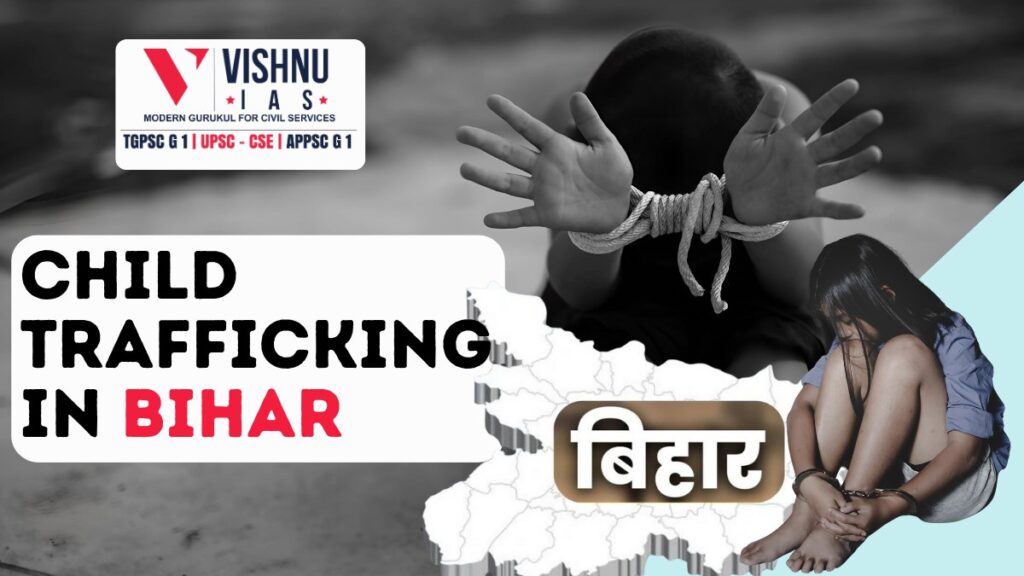
Child trafficking in Bihar is one of the gravest violations of human rights, inflicting physical, psychological and economic harm on its victims. In Bihar, this crime has surged, with thousands of girls coerced into “dance troupes” or the flesh trade every year. Despite robust legal frameworks like POCSO, the Immoral Traffic (Prevention) Act and the Juvenile Justice Act, gaps in enforcement, socio-economic vulnerabilities and institutional weaknesses perpetuate the cycle of exploitation.
Factors Contributing to Child Trafficking in Bihar
- Socio-economic vulnerability: Decades of poverty compel parents to pursue any opportunity to improve their families' circumstances—traffickers take advantage of this desperation by offering false promises of training, employment, or marriage.
- Geographic and transport linkages: A porous border with Nepal, along with extensive railway connections and inter-State bus networks, facilitates the movement of children across various regions.
- Cultural aspirations turned predatory: In states such as West Bengal, dance and music are held in high esteem; traffickers entice girls with deceptive promises of fame and lucrative earnings.
- Regulatory and social acceptance gaps: Local communities frequently perceive "dance troupes" as legitimate enterprises. The absence of village-level oversight permits exploitation to thrive without restraint.
Challenges in the Existing Anti-Trafficking Framework
- Under-resourced AHTUs: Anti-Human Trafficking Units suffer from a shortage of trained full-time officers, resulting in jurisdictional confusion and delays in investigations.
- Low conviction rates: Many cases are categorized as kidnappings or missing persons; intricate multi-State investigations seldom achieve timely trial resolutions.
- Family complicity and stigma: The fear of social ostracism or financial repercussions deters families from reporting trafficking incidents or collaborating with authorities.
- Lack of sufficient rehabilitation: Rescued children are frequently returned to the very environments that enabled their exploitation, often without adequate counseling or skills development.
Comprehensive Strategy to Combat Child Trafficking
Prevention
- Monitor school attendance and trigger alerts for prolonged absences.
- Introduce migratory registers in Panchayats to log seasonal family movements.
- Enhance community awareness involving parents, teachers and local leaders.
Transport Vigilance
- Expand Railway Protection Force (RPF) model to bus stands and private carriers.
- Train transport staff to detect signs of trafficking, such as multiple minors with unfamiliar adults or forged IDs.
Institutional Strengthening
- Empower AHTUs with multi-disciplinary teams and multi-State coordination protocols.
- Ban minors in orchestras and map premises where under-age performers are exploited.
- Enforce labour inspections through unannounced checks and penalties.
Prosecution and Legal Reform
- Fast-track courts for trafficking with clear investigation and trial timelines.
- Mandate asset seizure and strict punishment for organisers, landlords, and intermediaries.
- Strengthen witness protection and ensure child-friendly procedures under POCSO.
Rehabilitation and Reintegration
- State-run long-term recovery homes offering psycho-social counseling and skill training.
- Ensure district-level implementation of victim compensation schemes.
- Use survivor-led feedback to adapt and improve rehabilitation programs.
Policy Convergence – The “PICKET” Framework
- Policy: Clear, child-centric guidelines across ministries.
- Institutions: Well-resourced agencies for monitoring, prosecution, and rehabilitation.
- Convergence: Unified digital platform linking police, child welfare, labour and transport.
- Knowledge: Utilize community intelligence, survivor insights, and analytics.
- Economically: Make trafficking financially unviable by increasing risks and reducing profits.
- Technology: Use real-time databases, heat maps, and AI to monitor trafficking routes.
Conclusion
Child trafficking in Bihar is a symptom of intersecting governance gaps, poverty and social acceptance of exploitative “dance troupes.” While India’s legal architecture is comprehensive, without political will, institutional coordination and community ownership, prevention remains elusive. A strategy rooted in prevention, swift prosecution and survivor-centred rehabilitation can transform Bihar from a trafficking hub into a model of child protection. The tools and laws exist—what is needed now is unwavering collective will.