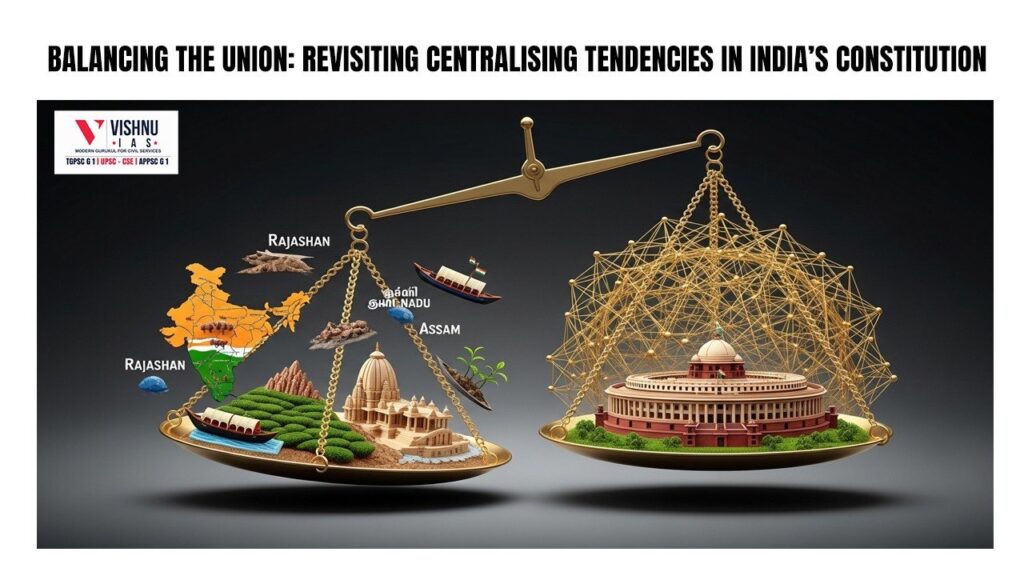
Centralising Tendencies in India's Constitution: Need for Federal Recalibration and National Dialogue
Centralising Tendencies in India's Constitution have significantly shaped Centre-State relations since independence. Federalism refers to a constitutional arrangement in which powers are divided between a central authority and constituent units (States), each having autonomy in defined spheres. In India, federalism is constitutionally enshrined through the Seventh Schedule, which distributes legislative subjects into the Union List (97 subjects), State List (66 subjects), and Concurrent List (52 subjects), reflecting a “federal system with unitary bias”.
The Constitution also created institutions such as the Finance Commission and Inter-State Council to balance fiscal and administrative powers. However, historical imperatives like Partition, integration of over 560 princely States, and national unity concerns, coupled with constitutional provisions such as Article 356 (President’s Rule) and Article 249 (Parliament’s power over State subjects), have strengthened central authority.
Recent analyses, including the committee chaired by Kurian Joseph and constituted by the Government of Tamil Nadu, highlight growing concerns about centralisation, arguing that India’s federal framework requires recalibration to sustain democratic governance and developmental effectiveness.
I. Historical Context Behind Centralising Tendencies in India’s Constitutional Design
1. Legacy of Partition, Integration, and National Consolidation
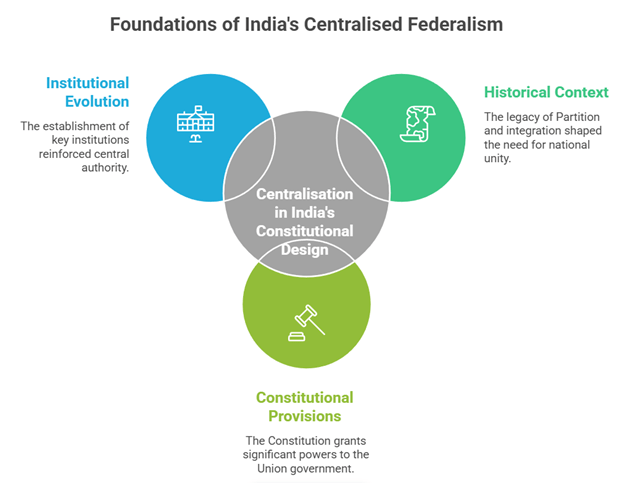
- The Constitution emerged in the aftermath of Partition (1947) and integration of princely States, creating urgent priorities of national unity and territorial integrity, leading the Constituent Assembly of India to design a stronger Centre to prevent fragmentation.
- Example – Integration of Hyderabad and Junagadh: The Union intervened politically and militarily to ensure integration, reinforcing the need for central authority to maintain sovereignty.
- Case Study – Linguistic Reorganisation of States (1956): Though states were reorganised to accommodate linguistic diversity, Parliament retained decisive powers under Articles 3 and 4, allowing unilateral reorganisation, demonstrating asymmetry favouring the Union.
2. Constitutional Provisions Structurally Favouring the Union
- The Constitution grants residuary powers to the Union (Article 248), unlike classical federations such as the United States where States retain residual authority, reflecting intentional centralisation.
- Article 356 (President’s Rule) has been imposed over 100 times since independence, especially during political instability in the 1970s–1990s, enabling the Centre to dismiss State governments, although judicial safeguards were later strengthened.
- Example – National Emergency (1975–77): The Union assumed extensive powers over States, suspending democratic freedoms and centralising governance, highlighting structural provisions enabling temporary unitary transformation.
3. Institutional and Administrative Evolution Reinforcing Central Authority
- The establishment of the Planning Commission (1950) centralised development planning, with States dependent on discretionary Union grants, limiting fiscal autonomy until its replacement by NITI Aayog in 2015, which aimed to promote cooperative federalism.
- All India Services (IAS, IPS, IFoS) ensure administrative uniformity but remain jointly controlled, with disciplinary and cadre management powers tilted toward the Centre.
- Example – Expansion of Concurrent List subjects: Areas like education, forests, and labour were shifted or increasingly regulated centrally, reducing State-exclusive policy space over time.
II. Contemporary Manifestations and Implications of Centralising Tendencies
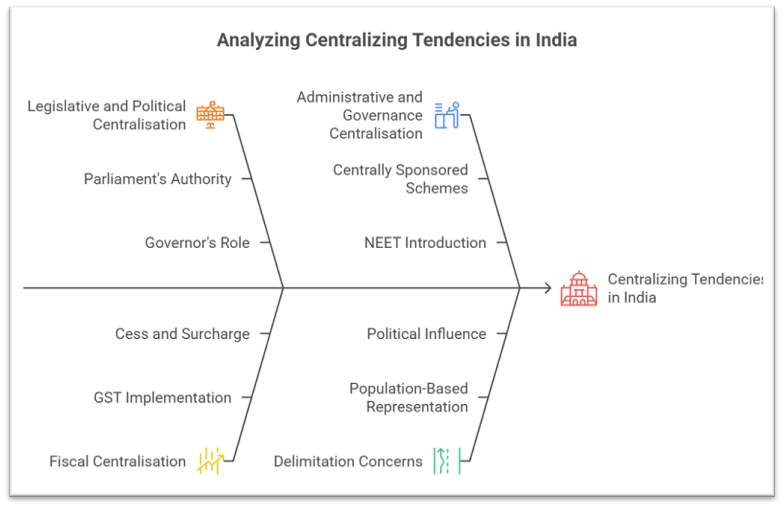
1. Legislative and Political Centralisation Affecting State Autonomy
- Parliament retains unilateral authority to alter State boundaries, illustrated by the Jammu and Kashmir Reorganisation Act, 2019, which downgraded a State into two Union Territories, raising federalism concerns.
- The increasing role of Governors, appointed by the Centre, has triggered disputes in States such as Tamil Nadu, Kerala, and Punjab over delays in approving legislation, raising questions about political neutrality.
- Case Study – S.R. Bommai (1994): The Supreme Court restricted misuse of Article 356, reinforcing federal principles while recognising constitutional balance.
2. Fiscal Centralisation Through Taxation and Resource Distribution
- The Goods and Services Tax (GST), introduced in 2017, subsumed major State taxation powers, shifting fiscal authority toward the Union and the GST Council, though it operates on consensus.
- The Union increasingly relies on cess and surcharge, which accounted for nearly 18–20% of gross tax revenue in recent years, and these are not shareable with States, effectively reducing their fiscal share despite the Finance Commission recommending 41% tax devolution.
- Example – GST Compensation Issue: During the COVID-19 pandemic, States like Punjab and Kerala faced delayed compensation, affecting their fiscal capacity and highlighting dependence on Union transfers.
3. Administrative and Governance Centralisation in Key Sectors
- Centrally Sponsored Schemes such as PM-JANMAN, Ayushman Bharat, and PM-KISAN are designed and largely controlled by the Union, with States having limited flexibility despite bearing implementation responsibilities.
- Example – NEET: The introduction of NEET standardised medical admissions nationally, reducing States’ autonomy over education policy and raising debates on regional equity.
- Delimitation Concerns: The upcoming delimitation exercise based on population could increase parliamentary representation of northern States, raising apprehensions among southern States about declining political influence despite better demographic performance.
III. Case for Federal Recalibration and Need for a New National Conversation
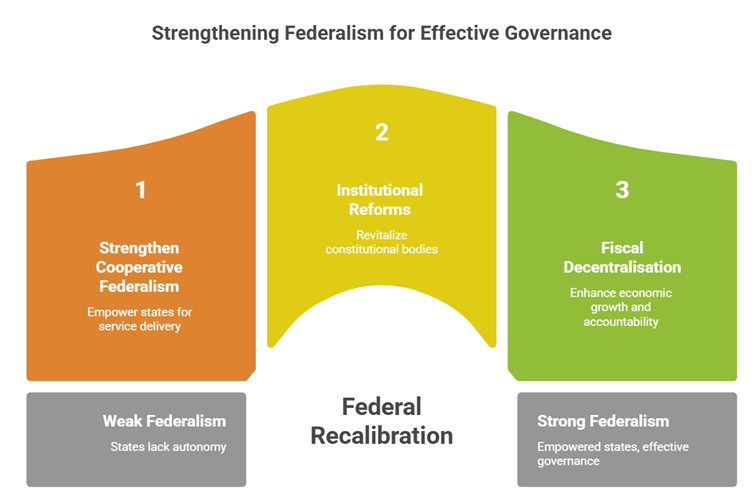
1. Strengthening Cooperative and Competitive Federalism
- States account for nearly 60% of total public expenditure in India, making them primary actors in delivering health, education, and welfare services.
- Example – Aspirational Districts Programme: Encourages collaboration between Centre and States using performance-based rankings.
- Case Study – Kerala’s Decentralised Planning Model: Demonstrates benefits of decentralised decision-making in improving human development indicators.
2. Institutional and Constitutional Reforms
- Revitalising the Inter-State Council (Article 263) can facilitate dialogue and dispute resolution.
- Strengthening judicial safeguards and clarifying the role of Governors can prevent political misuse.
- Example – Fifteenth Finance Commission: Allocated over ₹4.36 lakh crore to local bodies, strengthening grassroots federalism.
3. Fiscal and Policy Decentralisation
- Greater fiscal autonomy enables States to tailor policies based on local needs.
- Competitive federalism has driven reforms such as ease of doing business rankings.
- Example – Direct Benefit Transfer (DBT): Improved welfare delivery efficiency, saving over ₹3 lakh crore by reducing leakages.
Conclusion
India’s constitutional design reflected historical imperatives of unity and stability, but evolving democratic maturity and developmental complexity require recalibration of Centre-State relations. With 28 States, 8 Union Territories, and over 1.4 billion people representing immense linguistic, cultural, and economic diversity, federalism remains essential for inclusive governance.
Recent fiscal reforms increasing States’ tax devolution to 41% and expanding grants to local governments demonstrate recognition of decentralisation’s importance. A renewed national conversation grounded in cooperative federalism, institutional respect, and balanced constitutional interpretation can strengthen democratic resilience, promote innovation, and ensure sustainable development, reinforcing federalism as a pillar of India’s democratic progress.
Recap: