

Vishnu Vardhan

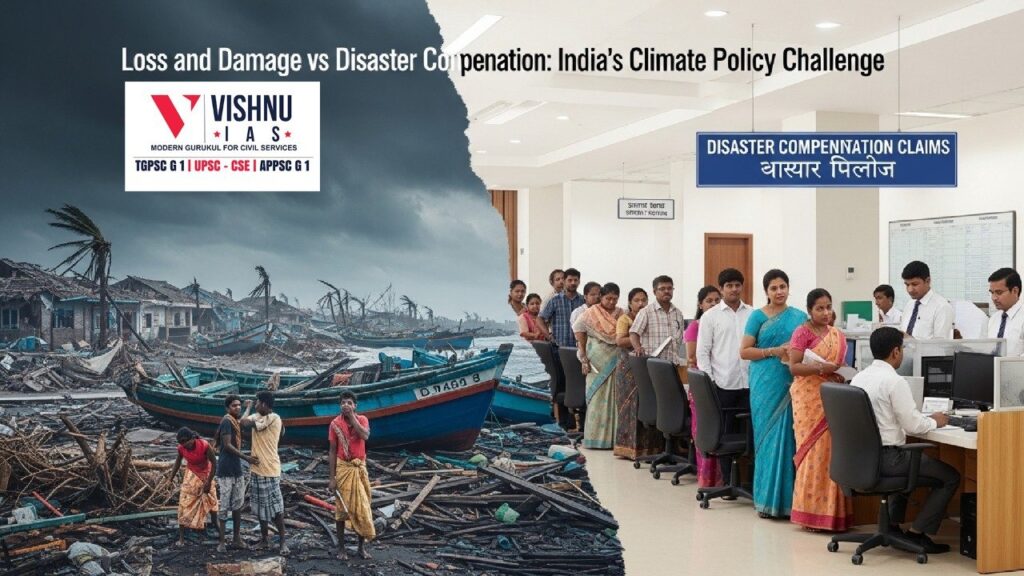
Loss and Damage, Technology Transfer and Just Transition in Climate Negotiations are central to equitable climate action, yet they remain largely aspirational due to political, financial and structural constraints. This blog analyses their role, limitations and the reasons behind weak implementation in global climate governance.

Loss and Damage, Technology Transfer and Just Transition in Climate Negotiations: Why They Remain Aspirational

Loss and Damage, Technology Transfer and Just Transition in Climate Negotiations: Why They Remain Aspirational Loss and Damage, Technology Transfer and Just Transition in Climate Negotiations have increasingly emerged as central pillars of equitable global climate action. These concepts were introduced to address the uneven distribution of climate impacts, technological capacities, and historical responsibilities between […]

Loss and Damage, Technology Transfer and Just Transition in Climate Negotiations: Why They Remain Aspirational Read More »

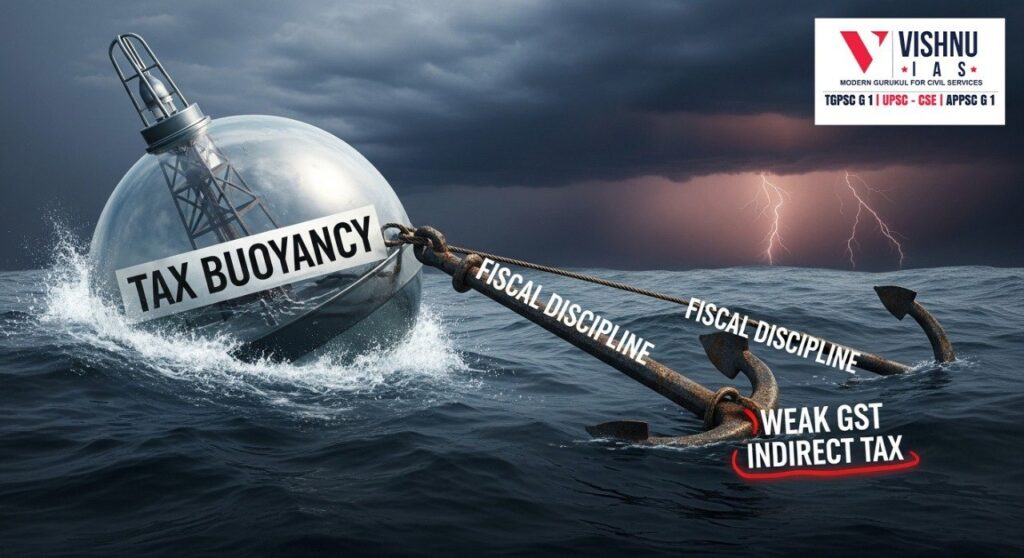
Tax Buoyancy and Fiscal Discipline: Why Indirect Tax Buoyancy Remains Weak Under GST

Tax Buoyancy and Fiscal Discipline: Why Indirect Tax Buoyancy Remains Weak Under GST Tax buoyancy plays a critical role in maintaining fiscal discipline by ensuring that government revenues grow in tandem with economic expansion. In India, while direct taxes have shown strong responsiveness to GDP growth, the persistently low indirect tax buoyancy—despite the maturation of

Tax Buoyancy and Fiscal Discipline: Why Indirect Tax Buoyancy Remains Weak Under GST Read More »

The India–U.S. trade deal aims to reduce tariff barriers and boost labour-intensive exports, improving competitiveness, employment and market access.

India–U.S. Trade Deal: Tariff Reduction and Its Impact on Labour-Intensive Exports

India–U.S. Trade Deal: Tariff Reduction and Its Impact on Labour-Intensive Exports The India–U.S. trade deal marks a significant development in India’s external trade policy by proposing a sharp reduction in U.S. tariff barriers on Indian goods. At a time of global trade uncertainty and supply-chain realignments, this understanding has important implications for export competitiveness, employment

India–U.S. Trade Deal: Tariff Reduction and Its Impact on Labour-Intensive Exports Read More »

A critical analysis of hydrological connectivity of Indian wetlands, examining urbanization, administrative lapses, and the role of GIS and remote sensing in restoration.

Hydrological Connectivity of Indian Wetlands: Impact of Urbanization and Role of GIS & Remote Sensing

Hydrological Connectivity of Indian Wetlands: Impact of Urbanization and Role of GIS & Remote Sensing The hydrological connectivity of Indian wetlands is increasingly under stress due to rapid urbanization and persistent administrative lapses. Disruptions in natural water flows between wetlands, their catchments and downstream systems have intensified urban floods, groundwater decline and ecological degradation. In

Hydrological Connectivity of Indian Wetlands: Impact of Urbanization and Role of GIS & Remote Sensing Read More »

An in-depth analysis of the public-led Capex model in India, examining budgeted vs actual capital expenditure and its impact on industrial growth and long-term domestic demand.

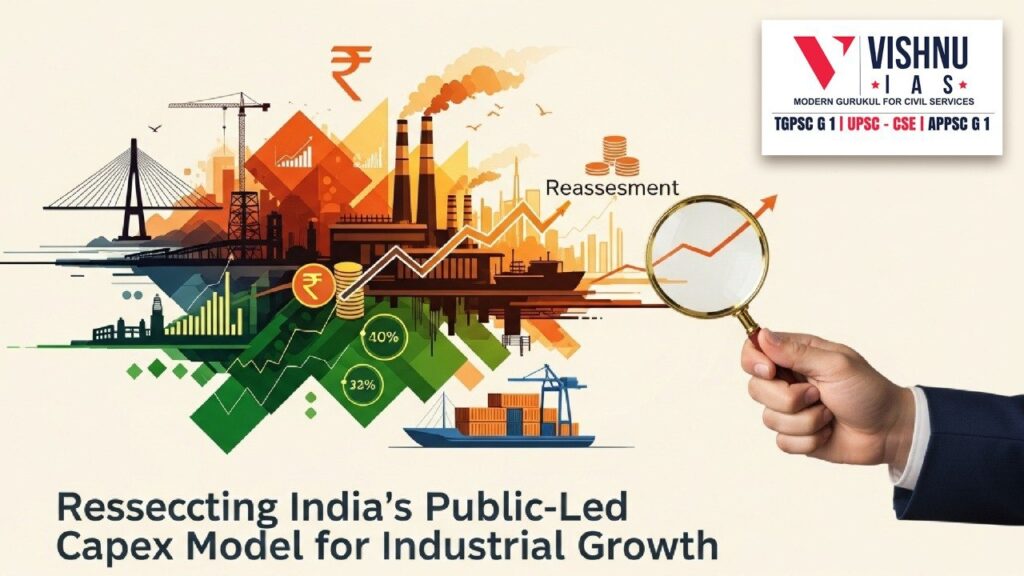
Public-Led Capex Model in India: Implications for Industrial Growth and Domestic Demand

Public-Led Capex Model in India: Implications for Industrial Growth and Domestic Demand Introduction: Public-led capital expenditure refers to the State using budgetary resources to drive economic growth by investing directly in infrastructure, industrial capacity and strategic sectors, with the expectation that such spending crowds in private investment and stimulates demand through multiplier effects. Over the

Public-Led Capex Model in India: Implications for Industrial Growth and Domestic Demand Read More »

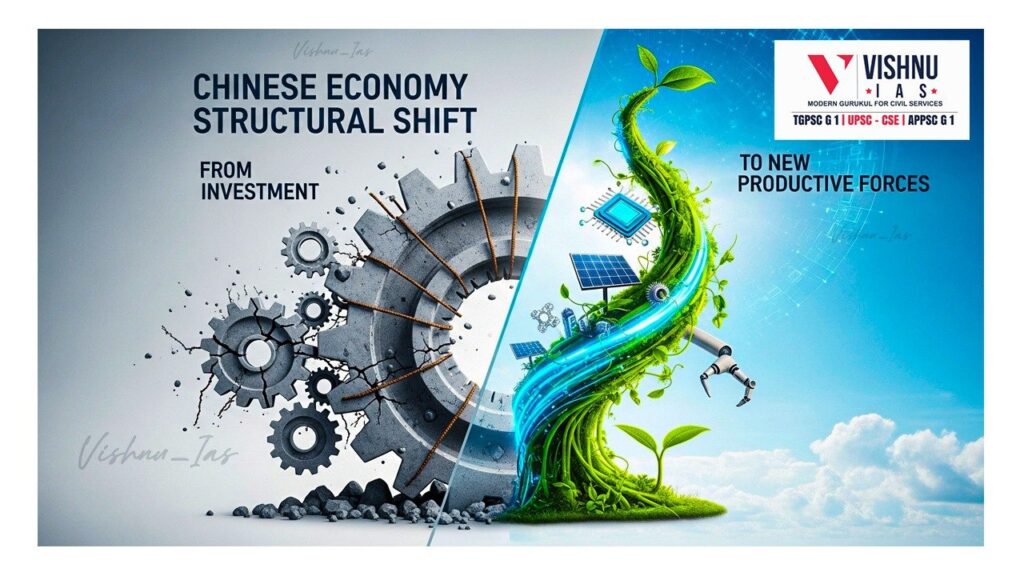
Chinese Economy Structural Shift: From Investment-Led Growth to New Productive Forces and Lessons for India

Chinese Economy Structural Shift: From Investment-Led Growth to New Productive Forces and Lessons for India

Chinese Economy Structural Shift: From Investment-Led Growth to New Productive Forces and Lessons for India The Chinese economy structural shift represents a long-term transformation in the composition of growth drivers, sectoral output, and sources of productivity. China’s recent economic trajectory illustrates such a shift—from a high-investment, export-heavy model to one increasingly driven by domestic consumption

Chinese Economy Structural Shift: From Investment-Led Growth to New Productive Forces and Lessons for India Read More »

Currency Devaluation in India is ineffective when inflation is low and trade barriers are geopolitical. Explore risks to exports, inflation, capital flows & policy.

Currency Devaluation in India: Why It Fails When Inflation Is Low and Trade Barriers Are Non-Economic

Currency Devaluation in India: Why It Fails When Inflation Is Low and Trade Barriers Are Non-Economic Currency devaluation in India refers to a deliberate or market-driven decline in the value of a country’s currency against foreign currencies, often expected to boost exports and correct external imbalances. In India’s current economic scenario, however, this traditional adjustment

Currency Devaluation in India: Why It Fails When Inflation Is Low and Trade Barriers Are Non-Economic Read More »

The revival of Spheres of Influence in contemporary geopolitics is reshaping power politics in the Western Hemisphere and Southeast Asia. This article evaluates how this trend challenges the authority, legitimacy, and enforcement capacity of the United Nations.

Revival of Spheres of Influence in Contemporary Geopolitics and the United Nations Crisis

Introduction The concept of Spheres of Influence refers to an informal geopolitical arrangement in which a powerful state claims predominant strategic, political, or security interests over a defined region, limiting the autonomy of other states and discouraging external intervention. Though never codified in international law, this practice shaped 19th- and early 20th-century imperial politics and

Revival of Spheres of Influence in Contemporary Geopolitics and the United Nations Crisis Read More »

India–EU Free Trade Agreement marks a strategic shift in India’s engagement with the EU, shaping trade diversification, regulatory standards, and strategic autonomy.

India–EU Free Trade Agreement: Significance for Trade, Standards and Strategic Autonomy

India–EU Free Trade Agreement: Significance for Trade, Standards and Strategic Autonomy Introduction India’s engagement with the European Union (EU) in 2026 marks a qualitative shift from traditional bilateralism to bloc-level diplomacy, reflecting the EU’s character as a 27-member regulatory and economic union rather than a single national actor. With the India–EU Free Trade Agreement emerging

India–EU Free Trade Agreement: Significance for Trade, Standards and Strategic Autonomy Read More »

Scroll to Top