

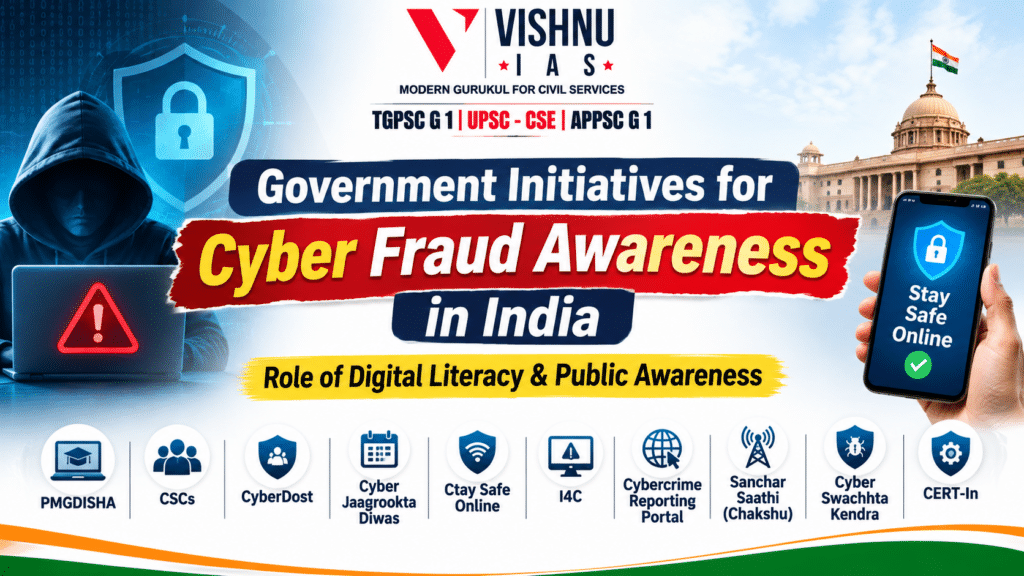
Government Initiatives for Cyber Fraud Awareness in India | Digital Literacy
Introduction
The rapid expansion of digital payments, online banking, e-commerce and digital governance has increased citizens' exposure to cyber fraud, making cyber fraud awareness in India increasingly important. Cyber frauds such as phishing, identity theft, UPI scams, OTP fraud, impersonation and digital arrest scams exploit the lack of digital awareness among users.
I. Government Initiatives to Promote Cyber Awareness
1. Pradhan Mantri Gramin Digital Saksharta Abhiyan (PMGDISHA) 2017
It aims to impart digital literacy to rural households by training at least one person per household. It enables citizens to use digital devices, access government services and undertake digital transactions safely.
2. Common Services Centres (CSCs)
These centres provide digital services and assistance to rural populations through Village Level Entrepreneurs (VLEs). They help bridge the digital divide and improve citizens' ability to access online services and conduct digital transactions.
3. CyberDost Initiative
Launched by the Indian Cyber Crime Coordination Centre (I4C), Ministry of Home Affairs, it disseminates cyber safety information through social media platforms. It educates citizens about phishing, online financial fraud, fake job offers, identity theft and safe digital practices.
4. Cyber Jaagrookta Diwas
Observed by CERT-In every month to sensitise internet users about cyberattacks, cyber frauds and preventive measures. It promotes cyber hygiene and responsible digital behaviour among citizens.
5. Stay Safe Online Campaign
The Ministry of Electronics and Information Technology (MeitY) conducts awareness programmes through handbooks, videos, posters and advisories to educate citizens about cybersecurity, data protection, online safety and emerging threats such as deepfakes.
II. Government Mechanisms to Prevent and Report Cyber Fraud
1. Indian Cyber Crime Coordination Centre (I4C)
Established by the Ministry of Home Affairs, it coordinates efforts among law enforcement agencies to tackle cybercrime. It also undertakes public awareness campaigns and strengthens the capacity of police personnel to investigate cyber offences.
2. National Cyber Crime Reporting Portal
The portal (cybercrime.gov.in) enables citizens to report cybercrime incidents, particularly financial fraud and crimes against women and children. The associated helpline 1930 facilitates immediate reporting of financial cyber fraud to help prevent further loss of money.
3. Sanchar Saathi Portal – Chakshu Facility
Launched by the Department of Telecommunications, it enables citizens to report suspected fraudulent communications received through calls, SMS and WhatsApp. It helps identify and prevent the misuse of telecom resources for cybercrime.
4. Cyber Swachhta Kendra
Established by CERT-In, it provides free tools to detect and remove malware and malicious programmes from digital devices. It also disseminates cybersecurity advisories and promotes safe online practices.
5. CERT-In Awareness Programmes
The Indian Computer Emergency Response Team issues cybersecurity alerts, advisories and guidelines to educate citizens and organisations about emerging cyber threats and preventive measures.
III. Way Forward
- Cybersecurity education should be integrated into school and higher education curricula.
- Special emphasis should be on elderly people, rural populations and first-time internet users.
- Cyber safety campaigns shall be conducted in regional languages through community radio, television, local bodies and social media to improve their reach.
- Police personnel should be trained in cyber forensics, digital evidence collection and investigation of cross-border cyber fraud.
Conclusion
Digital literacy is not merely the ability to use technology but also the ability to use it safely and responsibly. Government initiatives must move beyond expanding digital access towards building a cyber-aware citizenry. A combination of digital education, institutional preparedness, technological safeguards and citizen participation is essential for achieving a secure and inclusive Digital India.