
Introduction
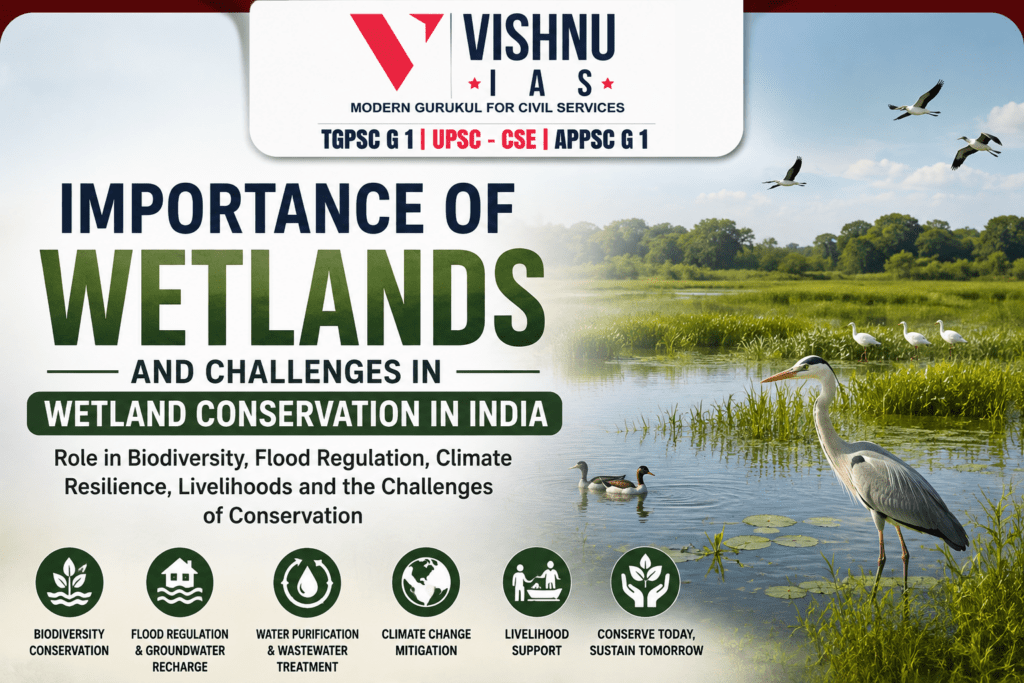
Wetlands are ecosystems where water is the primary factor controlling the environment and associated plant and animal life. India’s wetlands include lakes, marshes, mangroves, estuaries, floodplains and man-made wetlands. They act as “natural infrastructure” by supporting biodiversity, water security, livelihoods and climate resilience.
Importance of Wetlands
-
Biodiversity conservation:
Wetlands provide breeding, feeding and nesting habitats for a wide range of aquatic and terrestrial species, particularly migratory birds and threatened species. For example, Keoladeo National Park in Rajasthan provides an important habitat for migratory waterbirds, while Asan Wetland Conservation Reserve in Uttarakhand supports several migratory bird species.
-
Flood regulation and groundwater recharge:
Wetlands act as natural sponges by storing excess rainwater and releasing it gradually, thereby reducing flood intensity. They also facilitate groundwater recharge and help maintain water availability during dry periods. For example, Deepor Beel in Assam acts as a natural floodwater reservoir for the Guwahati region.
-
Water purification and wastewater treatment:
Wetlands can naturally remove sediments, nutrients and certain pollutants from water through biological and physical processes. The East Kolkata Wetlands are a notable example, where Kolkata’s wastewater is channelled through a network of ponds. Aquatic organisms and sunlight help treat the wastewater, while the nutrient-rich water supports fish cultivation and agriculture, creating a circular system of wastewater treatment and livelihood generation.
-
Climate-change mitigation:
Wetlands store carbon in their vegetation and soils and therefore act as important carbon sinks. Coastal wetlands such as mangroves in the Sundarbans also reduce the impact of cyclones, storm surges and coastal erosion, thereby strengthening climate resilience.
-
Livelihood support:
Wetlands support fishing, agriculture, livestock rearing, tourism and collection of aquatic resources. For example, Chilika Lake in Odisha supports large fishing communities and provides livelihoods through fisheries, while also supporting rich aquatic biodiversity.
-
Coastal protection:
Mangrove wetlands act as natural barriers against cyclones, storm surges and coastal erosion. The Sundarbans mangrove ecosystem is particularly important for protecting vulnerable coastal communities of West Bengal from extreme weather events.
-
Water and food security:
Wetlands provide water for agriculture, livestock and domestic purposes and support fisheries and other food resources. Their ability to store water also improves resilience during periods of drought and irregular rainfall.
-
Cultural, educational and recreational value:
Several wetlands have cultural, religious and tourism significance and support ecotourism. Wetlands such as Loktak Lake in Manipur, with its unique floating phumdis, are important both ecologically and culturally.
Challenges in Wetland Conservation
-
Encroachment and land-use change:
Urbanisation, agricultural expansion, infrastructure development and illegal occupation have resulted in the conversion and fragmentation of wetlands. Encroachment reduces wetland area and disrupts natural drainage and ecological functions.
-
Pollution and eutrophication:
Untreated sewage, industrial effluents, agricultural runoff, plastics and solid waste degrade wetland ecosystems. Excess nutrients from sewage and fertilisers can cause eutrophication, resulting in excessive algal growth, oxygen depletion and fish mortality.
-
Mining and developmental pressures:
Mining, construction and infrastructure projects can alter drainage patterns, increase sedimentation and disturb wetland habitats. The Supreme Court’s intervention in the Asan Wetland case is significant in this context, as it directed that mining within a 10-km radius of the wetland conservation reserve requires prior approval from the competent wildlife/environmental authorities.
-
Weak implementation and fragmented governance:
Wetland management involves multiple institutions at the Union, State and local levels, often resulting in fragmented responsibilities. Although the Wetlands (Conservation and Management) Rules, 2017 established State Wetland Authorities and provided a decentralised framework, variations in identification, monitoring and enforcement remain challenges.
-
Lack of statutory buffer for Ramsar sites:
A Ramsar designation does not itself create a statutory buffer zone under Indian law. Neither the Ramsar Convention nor the Wetlands Rules, 2017 prescribes a uniform distance-based buffer around Ramsar sites. Therefore, additional legal and judicial safeguards may be necessary in ecologically sensitive cases.
-
Climate change:
Changes in rainfall patterns, rising temperatures, prolonged droughts, floods and sea-level rise are altering wetland hydrology and biodiversity. Coastal wetlands additionally face salinity intrusion and coastal erosion.
-
Invasive species:
Invasive species such as water hyacinth can spread rapidly, obstruct waterways, reduce dissolved oxygen and adversely affect native biodiversity and fisheries.
-
Overexploitation of resources:
Unsustainable fishing, excessive groundwater extraction, fuelwood collection and other resource pressures can degrade wetland ecosystems and reduce their carrying capacity.
-
Lack of scientific monitoring and reliable data:
Many wetlands remain inadequately mapped and monitored. Absence of updated information on wetland boundaries, hydrology, biodiversity and pollution levels can weaken conservation planning and enforcement.
Way Forward
- Strengthen scientific identification and mapping: Wetland boundaries, catchment areas and zones of ecological influence should be scientifically mapped using GIS, remote sensing and periodic ground surveys.
- Adopt integrated wetland management: Wetlands should be managed at the level of their entire catchment and hydrological system, rather than as isolated water bodies. Urban planning should recognise wetlands as natural infrastructure for flood control and water purification.
- Strengthen pollution control: Sewage treatment, industrial effluent regulation, solid-waste management and control of agricultural runoff should be strengthened to prevent nutrient loading and eutrophication.
- Ensure community participation: Local communities, fisher groups, farmers and traditional users should participate in wetland management. The success of the East Kolkata Wetlands demonstrates how ecological functions can be integrated with local livelihood systems.
- Strengthen enforcement and governance: State Wetland Authorities should be adequately staffed and funded, while coordination between environmental, forest, urban development and local-government institutions should be improved.
- Balance development with ecological security: Projects such as mining, roads and industries near wetlands should undergo rigorous ecological assessment. The Asan Wetland judgment demonstrates how judicial safeguards can supplement existing regulatory mechanisms where ecological risks are significant.
Conclusion
Wetlands are not “wastelands” but productive ecosystems that provide biodiversity, flood regulation, water purification, carbon storage, livelihoods and climate resilience. India’s approach should therefore move from merely protecting individual wetlands towards integrated, landscape-level and community-based wetland governance. Protecting wetlands is ultimately an investment in India’s ecological security, water security and sustainable development.