
Introduction
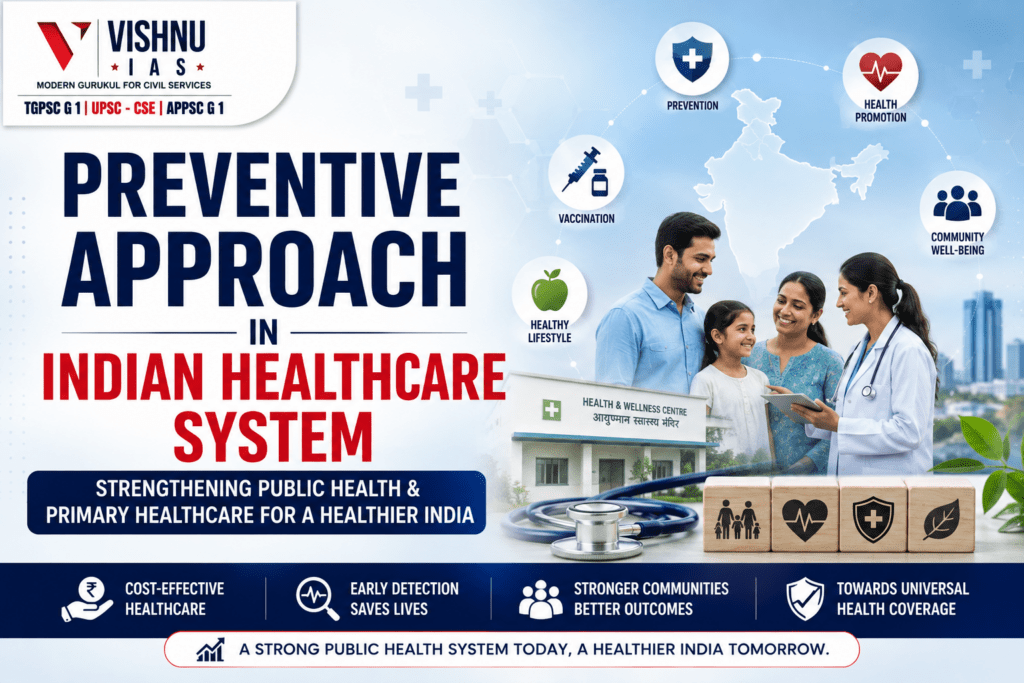
Public health focuses on population-level disease prevention, health promotion, surveillance and creation of healthy living conditions, whereas healthcare primarily focuses on diagnosis and treatment of individuals.
- Public health focuses on population-level disease prevention, health promotion, surveillance and creation of healthy living conditions, whereas healthcare primarily focuses on diagnosis and treatment of individuals.
- The constitutional vision under Article 47 directs the State to raise the level of nutrition, standard of living and improve public health, while the Supreme Court has interpreted the Right to Health as part of Article 21’s Right to Life.
- India has expanded its healthcare infrastructure and financial protection mechanisms, yet its health system continues to exhibit a curative-care, with substantial emphasis on secondary and tertiary treatment compared with preventive and primary healthcare.
- With the rising burden of non-communicable diseases (NCDs), persistent communicable diseases, environmental risks, ageing population and healthcare costs, a shift towards prevention and primary healthcare is essential for achieving Universal Health Coverage (UHC) and equitable health outcomes.
I. Need for Stronger Preventive and Primary Healthcare Orientation
1. Prevention is More Cost-Effective Than Treatment
- Preventive interventions such as vaccination, sanitation, nutrition, health education, screening and disease surveillance can prevent illnesses before they require expensive treatment.
- Early detection through primary healthcare reduces disease progression and the need for costly hospitalisation.
Example
- India's Universal Immunisation Programme prevents vaccine-preventable diseases and reduces the future burden on hospitals.
- The recent HPV vaccination drive aims to prevent cervical cancers.
2. India's Changing Disease Burden Requires Prevention
- India faces a dual burden of communicable and non-communicable diseases, making a purely curative approach inadequate.
- NCDs such as cardiovascular diseases, diabetes, cancer and chronic respiratory diseases require risk-factor reduction, screening, early diagnosis and long-term management.
- Addressing tobacco consumption, unhealthy diets, physical inactivity, alcohol use and air pollution requires population-level preventive interventions rather than hospital-based treatment alone.
Example
- The National Programme for Prevention and Control of Non-Communicable Diseases (NP-NCD) promotes screening and early detection of common NCDs at primary healthcare facilities.
3. Preventive Healthcare Addresses Social Determinants of Health
- Health outcomes are determined not merely by medical facilities but also by income, nutrition, education, housing, sanitation, drinking water and environmental quality.
- Therefore, public health requires an inter-sectoral approach in which healthcare is integrated with sanitation, nutrition, education, environment and urban development.
Example
- The Swachh Bharat Mission demonstrates how sanitation and behavioural change can contribute to disease prevention beyond conventional healthcare delivery.
4. Primary Healthcare Improves Financial Protection
- Out-of-pocket expenditure (OOPE) refers to direct payments made by individuals and households for healthcare services at the point of use.
- High OOPE can result in catastrophic health expenditure, particularly when patients require prolonged hospitalisation or expensive medicines and diagnostics.
- Strong primary healthcare can provide affordable first-contact care, preventive services, screening and early treatment, reducing dependence on expensive private or tertiary healthcare.
Example
- Ayushman Bharat Health and Wellness Centres, now referred to as Ayushman Arogya Mandirs, seek to provide comprehensive primary healthcare closer to communities.
II. Primary Healthcare for Preventive Actions
- The Alma-Ata Declaration (1978) recognised primary healthcare as central to achieving “Health for All”, while the Astana Declaration (2018) reaffirmed primary healthcare as the foundation of sustainable health systems.
- Weak primary healthcare often results in patients bypassing local facilities and directly approaching district hospitals or tertiary institutions. This leads to overcrowding, longer waiting periods, inefficient use of specialists and higher treatment costs.
- A strong primary-care system can function as the first point of contact and referral gateway, ensuring that specialised services are utilised by those who actually require them.
- Primary healthcare enables periodic screening, counselling, lifestyle modification, early diagnosis and continuous follow-up.
Example
- Screening for hypertension and diabetes at primary healthcare facilities can prevent or delay complications such as stroke, cardiovascular disease and kidney failure.
III. India's Curative-Care Focus and Its Consequences
1. Disproportionate Emphasis on Secondary and Tertiary Care
- India's health system has historically placed considerable emphasis on hospitals, specialised treatment and curative services, while preventive and promotive interventions have received comparatively less attention.
- Patients frequently seek treatment only after diseases have progressed, increasing both healthcare costs and mortality risks.
2. Weak Primary Care Increases the Burden on Hospitals
- When primary facilities lack adequate human resources, diagnostics, medicines and referral mechanisms, patients tend to bypass them. Consequently, tertiary hospitals face excessive patient loads even for conditions that could have been prevented or treated at the primary level.
3. Curative Orientation Can Perpetuate Health Inequalities
- Wealthier households can access private hospitals and specialised treatment more easily, while poorer households may delay treatment because of cost and geographical barriers. Preventive and primary healthcare, when universally available, can reduce such inequalities by providing basic health services closer to vulnerable populations.
IV. Government Initiatives Towards a Preventive-Primary Healthcare Model
1. Ayushman Bharat
- Ayushman Bharat seeks to address both ends of the healthcare spectrum.
- Ayushman Arogya Mandirs: Focus on comprehensive primary healthcare, prevention, screening and health promotion.
- Pradhan Mantri Jan Arogya Yojana (PM-JAY): Provides financial protection for eligible beneficiaries requiring secondary and tertiary hospitalisation.
2. National Health Mission
- The National Health Mission (NHM) provides an institutional framework for strengthening public health delivery, particularly through primary and community-level systems. It supports maternal and child health, immunisation, disease control, health infrastructure and community health workers.
3. National Health Policy, 2017
- The National Health Policy, 2017 envisages increasing government health expenditure to 2.5% of GDP and emphasises strengthening primary healthcare. Its approach seeks to move the health system towards preventive and promotive healthcare, while ensuring access to affordable treatment.
4. Digital Health and Early Detection
- The Ayushman Bharat Digital Mission (ABDM) can strengthen continuity of care, digital health records, referrals and interoperability. Digital tools can also support disease surveillance, telemedicine and early detection, particularly in geographically underserved regions.
V. Way Forward
1. Rebalance Public Health Expenditure
- India needs greater emphasis on primary care, prevention, sanitation, vaccination, screening and health promotion, while maintaining adequate investment in secondary and tertiary services. The objective should be “the right care at the right level at the right time.”
- Higher allocations alone are insufficient; But a check on budget execution, procurement efficiency and outcome-oriented spending must also improve.
2. Strengthen Primary Healthcare Infrastructure
- Sub-Centres, Primary Health Centres and Ayushman Arogya Mandirs require adequate doctors, nurses, ASHAs, medicines, diagnostics, equipment and digital connectivity. Primary healthcare should become a genuine first point of contact, rather than merely an administrative or referral institution.
3. Focus on Social Determinants
- Health policy should address nutrition, sanitation, drinking water, housing, education, air pollution and occupational safety. This requires convergence between the Ministries and institutions dealing with health, women and child development, environment, education, housing and rural development.
4. Strengthen Decentralised Health Governance
- Public health needs vary across districts and communities. Greater participation of Panchayati Raj Institutions, Urban Local Bodies, ASHAs, ANMs, community organisations and local health committees can improve disease surveillance, health awareness and accountability.
- Article 243G provides a constitutional basis for decentralisation of functions to Panchayats, including areas connected with health and sanitation through the Eleventh Schedule.
- Panchayat Advancement Index by NITI Aayog provisions has Healthy Panchayat as a theme.
5. Move from Expenditure-Based to Outcome-Based Governance
- Health programmes should not be assessed merely by how much money is spent, but by whether expenditure produces better outcomes. Indicators such as maternal and infant mortality, immunisation coverage, NCD screening, disease-control rates, OOPE and catastrophic health expenditure should guide performance assessment.
- NITI Aayog's Health Index evaluates States and Union Territories using indicators such as health outcomes, governance and key inputs, demonstrating a shift from merely tracking expenditure towards assessing actual health-system performance.
6. Strengthen Public Health as a Component of National Security
- Preventive healthcare is also a form of health security.
- Strong disease surveillance, laboratory networks, vaccination systems, community health workers and early-warning mechanisms can enable India to respond rapidly to pandemics and emerging infectious diseases.
- The COVID-19 pandemic demonstrated that hospital capacity is essential during a crisis, but surveillance, prevention, primary healthcare and community-level preparedness are crucial for containing the crisis in the first place.
Conclusion
A strong public health system should place prevention and primary healthcare at the foundation of an integrated continuum of care. India's constitutional commitment under Article 47, the judicial recognition of health under Article 21, and the goal of Universal Health Coverage provide a strong normative basis for this transition.
With India's disease burden increasingly shaped by NCDs, ageing, environmental risks and emerging infections, prevention, early detection and health promotion are becoming as important as hospital-based treatment.