Introduction:
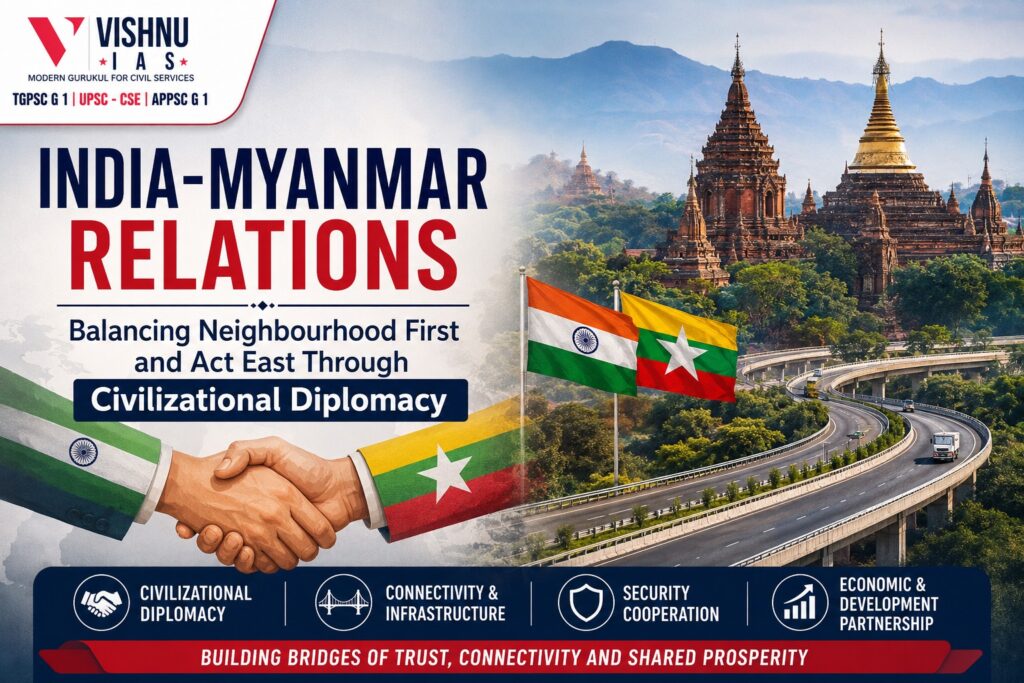
- Civilizational diplomacy refers to the use of shared historical, cultural, religious and people-to-people linkages to strengthen contemporary foreign relations, while structural engagement involves sustained cooperation through connectivity, trade, security, development partnerships and institutional mechanisms.
- India’s engagement with Myanmar exemplifies the convergence of these two approaches, enabling New Delhi to simultaneously advance its Neighbourhood First Policy and Act East Policy despite Myanmar’s prolonged political instability and international isolation.
- As India’s only land bridge to Southeast Asia, sharing a 1,643-km border with four northeastern states and occupying a strategic position between South and Southeast Asia, Myanmar remains central to India’s regional connectivity, security architecture and Indo-Pacific aspirations.
Body:
I. Myanmar as the Strategic Convergence Point of ‘Neighbourhood First’ and ‘Act East’
1. Geostrategic Bridge Between South and Southeast Asia
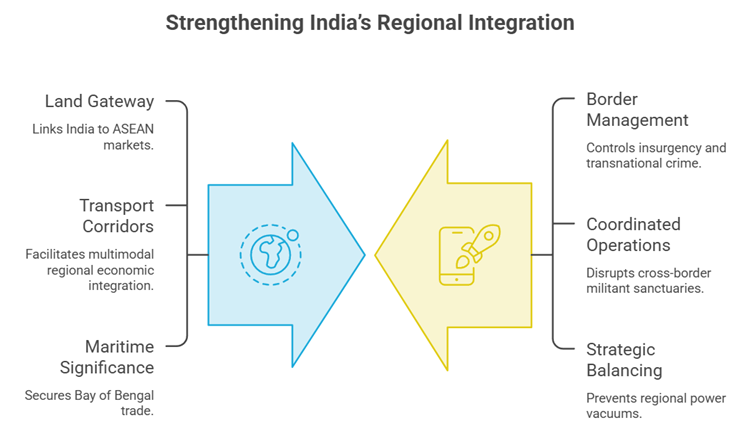
- Myanmar serves as India’s only land gateway connecting the Indian subcontinent with the ASEAN region, making it indispensable for translating eastern outreach into tangible connectivity.
- The country links India’s northeastern region with Southeast Asian markets, reducing geographical isolation and facilitating economic integration through multimodal transport corridors.
- Myanmar’s location at the intersection of the Bay of Bengal, Andaman Sea and Southeast Asia gives it significance in maritime security, regional trade and Indo-Pacific geopolitics.
- Example: The India-Myanmar-Thailand Trilateral Highway seeks to connect Moreh in Manipur with Mae Sot in Thailand, creating a vital overland economic corridor.
2. Security Imperatives Along the Shared Border
- Instability in Myanmar directly affects border management, insurgency control, arms trafficking and transnational organized crime in India’s Northeast.
- Cooperation with Myanmar has enabled coordinated operations against insurgent groups that historically used cross-border sanctuaries.
- The growing threat of cybercrime and online scam networks operating in Myanmar’s border regions has necessitated deeper security collaboration.
- Case Study: Joint India-Myanmar security operations in border regions have significantly disrupted insurgent camps operating near the frontier.
3. Strategic Balancing in an Evolving Regional Order
- Continued engagement prevents strategic vacuums that could be exploited by external powers, particularly China.
- Myanmar occupies a critical position in regional connectivity projects associated with competing geopolitical visions across the Indo-Pacific.
- India’s approach reflects strategic autonomy, prioritizing national interests while maintaining engagement with all stakeholders.
- Example: China’s expanding footprint through infrastructure projects under the China-Myanmar Economic Corridor has reinforced the importance of sustained Indian engagement.
II. Role of Civilizational Diplomacy in Sustaining Bilateral Relations
1. Shared Buddhist Heritage as a Soft-Power Asset
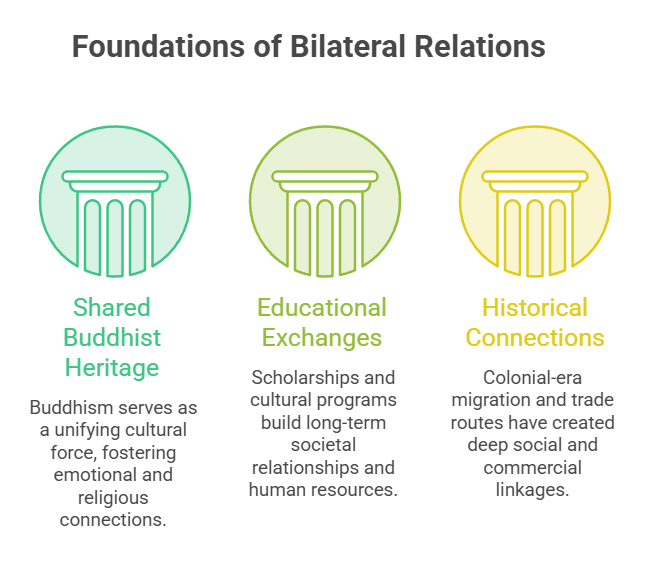
- Buddhism forms a powerful civilizational bond linking India and Myanmar through centuries of cultural interaction.
- Sacred sites associated with the life of the Buddha create enduring emotional and religious connections between the peoples of both countries.
- Such cultural linkages provide a politically neutral platform for engagement even during periods of diplomatic complexity.
- Example: The Mahabodhi Temple at Mahabodhi Temple remains a major pilgrimage destination for Myanmar’s Buddhist community.
2. Educational and Cultural Exchanges
- Academic scholarships, cultural exchanges and capacity-building initiatives strengthen long-term societal relationships.
- India’s educational diplomacy contributes to human resource development while nurturing goodwill among future leaders and professionals.
- Cultural institutions facilitate exchanges in language, heritage conservation and Buddhist studies.
- Example: Expansion of Mekong-Ganga Cooperation scholarships has enhanced educational opportunities for Myanmar students in India.
3. Historical and People-to-People Connections
- Colonial-era migration patterns created deep social and commercial linkages between communities across the Bay of Bengal.
- Indian-origin communities in Myanmar continue to contribute to economic and cultural interactions.
- Religious tourism, diaspora networks and traditional trade routes strengthen grassroots engagement beyond governmental relations.
- Case Study: Long-standing commercial networks between communities in Myanmar and eastern India have supported bilateral trade despite political disruptions.
III. Structural Engagement Despite International Isolation: Opportunities and Challenges
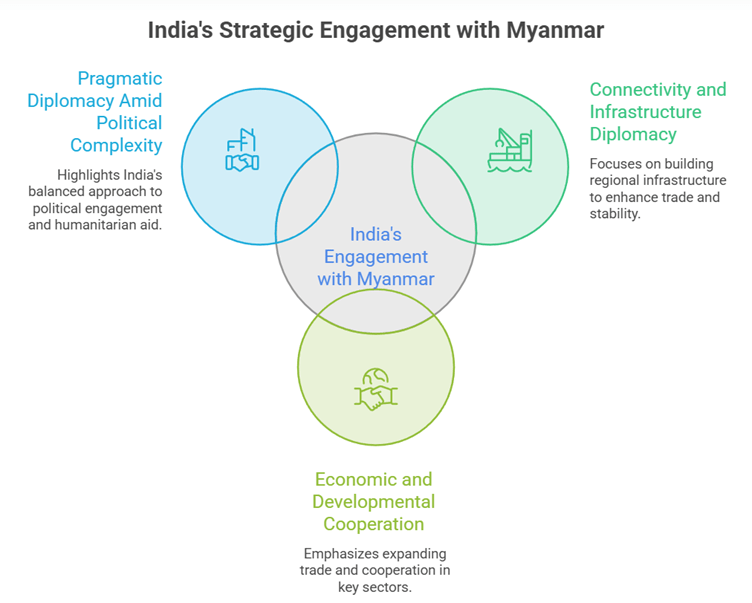
1. Connectivity and Infrastructure Diplomacy
- India has prioritized infrastructure-led engagement to strengthen regional integration and promote economic development.
- Connectivity projects support market access, logistics efficiency and strategic mobility while contributing to regional stability.
- Infrastructure cooperation demonstrates India’s commitment to long-term developmental partnerships rather than transactional diplomacy.
- Example: The Kaladan Multi-Modal Transit Transport Project links Kolkata to Sittwe Port, onward through inland waterways and roads to Mizoram, providing an alternative route to the Northeast.
- Case Study: Operationalization of the Sittwe Port component has enhanced maritime connectivity and reduced dependence on the Siliguri Corridor for certain logistical movements.
2. Economic and Developmental Cooperation
- Bilateral trade, border commerce and local currency settlement mechanisms are expanding economic engagement.
- Cooperation in critical minerals, energy resources and agriculture reflects emerging areas of mutual interest.
- Development partnerships focus on capacity building, healthcare, infrastructure and community-level welfare initiatives.
- Example: Efforts toward rupee-kyat trade settlement mechanisms seek to reduce transaction costs and improve resilience in bilateral commerce.
3. Pragmatic Diplomacy Amid Political Complexity
- India follows a policy of constructive engagement, recognizing that geographic realities necessitate continued dialogue with Myanmar’s governing authorities.
- Engagement allows India to safeguard connectivity projects, border security interests and humanitarian objectives.
- Simultaneously, India supports democratic aspirations, humanitarian assistance and inclusive political reconciliation through multilateral and bilateral channels.
- Example: India has consistently provided humanitarian assistance, including disaster relief, medical aid and development support during periods of political uncertainty.
- Case Study: Following natural disasters and humanitarian crises in Myanmar, India implemented assistance initiatives under regional cooperation frameworks, demonstrating a people-centric approach alongside strategic engagement.
Conclusion:
- India’s engagement with Myanmar reflects a calibrated blend of civilizational affinity and strategic pragmatism, where Buddhist heritage, cultural ties and people-to-people connections complement infrastructure development, security cooperation and economic partnerships.
- By integrating the objectives of Neighbourhood First and Act East, India seeks to transform Myanmar from a geopolitical buffer into a bridge of regional connectivity and shared prosperity.
- With ASEAN projected to remain one of the world’s fastest-growing economic regions and India’s northeastern states increasingly integrated into transnational value chains, sustained engagement with Myanmar will remain essential for regional stability, connectivity and an inclusive Indo-Pacific future.