
Introduction:
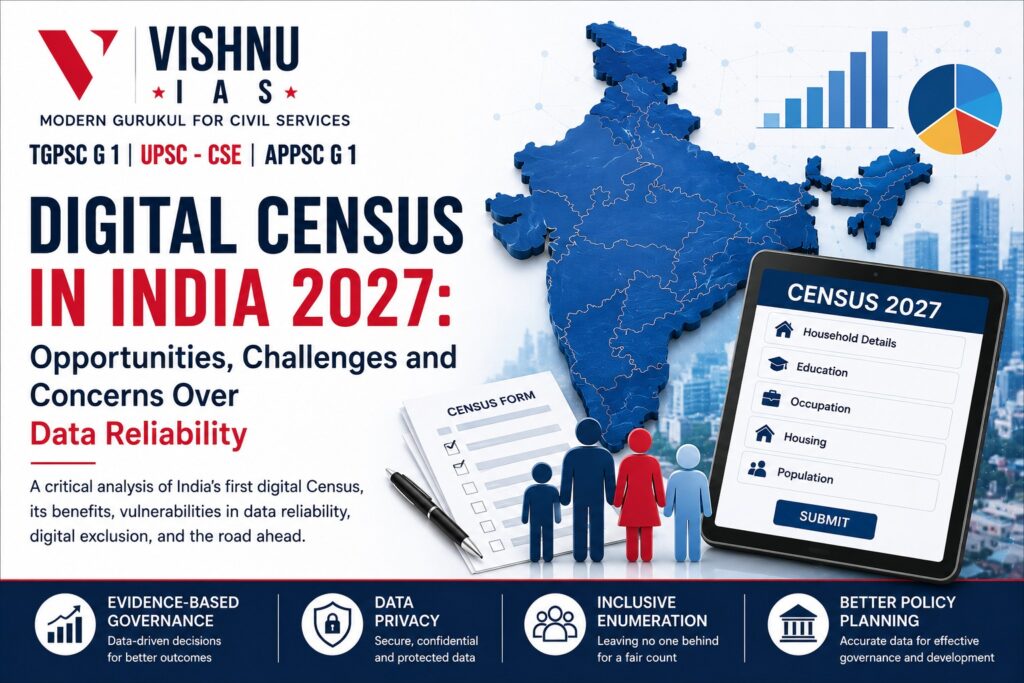
- A Census is the complete enumeration of a population, collecting demographic, social and economic information for governance, planning and democratic representation. India’s 2027 Census, the 16th Census and the first fully digital Census, marks a historic transition from paper-based enumeration to mobile-based digital data capture with self-enumeration options, backed by an outlay exceeding ₹11,700 crore and involving over 3 million enumerators.
- With over 44 crore households already using self-enumeration in Phase I, the reform promises faster and more efficient data generation; however, in a country where nearly one-third of the population still faces digital capability or connectivity limitations, the shift raises serious concerns regarding data reliability, exclusion errors, privacy, and representational justice.
Body:
1. Administrative efficiency and transformative potential of a digital Census
(a) Faster, real-time and more efficient data processing
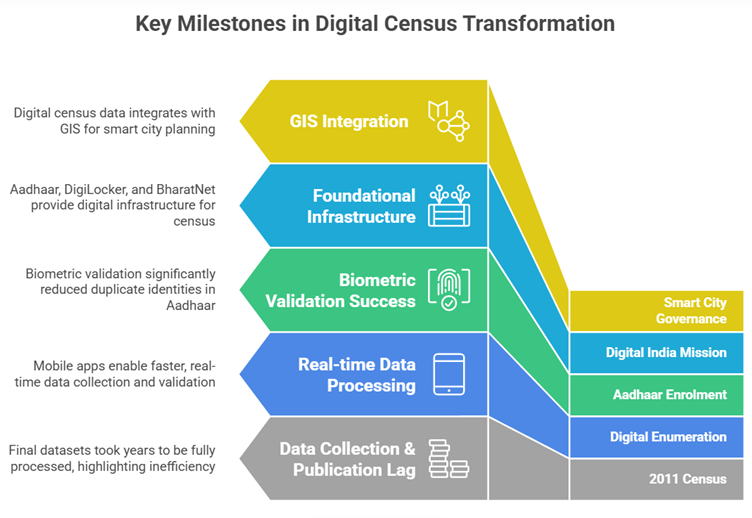
- Digital enumeration eliminates the long lag between data collection and publication, a major weakness visible after the 2011 Census, where final datasets took years to be fully processed.
- Real-time syncing, automated validation, and instant error flags improve administrative responsiveness.
- This enables faster policy design in areas such as urban planning, health provisioning and welfare targeting.
- Example: Rapid updating of household-level infrastructure data can improve Jal Jeevan Mission and PM Awas Yojana
(b) Improved operational transparency and reduced manual errors
- Mobile applications can embed mandatory fields, logic checks and GPS tagging, reducing handwriting errors and duplication.
- Automated audit trails improve enumerator accountability and reduce scope for fraudulent reporting.
- Digital dashboards permit better supervision by district and state authorities.
- Case Study: In Aadhaar enrolment, biometric validation significantly reduced duplicate identities, demonstrating technology’s error-reduction potential.
(c) Better integration with evidence-based governance
- Census data supports fiscal devolution, reservation policies, delimitation, and welfare delivery.
- Digital architecture allows interoperability with GIS-based planning, strengthening smart city governance and disaster planning.
- It aligns with the broader Digital India and National Data Governance
- Government Initiative: Digital India Mission has already created foundational infrastructure through Aadhaar, DigiLocker and BharatNet, easing digital census transition.
2. Vulnerabilities in data reliability and enumeration quality
(a) Digital tools do not automatically ensure accurate data
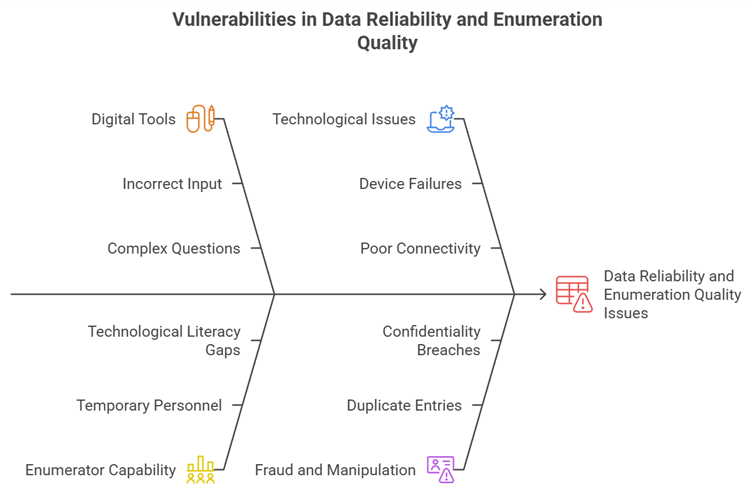
- Incorrect input through dropdown menus or misunderstanding of definitions can create systematic data distortions.
- Complex questions—such as those on occupation, disability, migration and caste—require human interpretation that digital forms cannot easily substitute.
- Errors become scalable: one flawed digital design can replicate mistakes nationwide.
- Example: Misclassification of informal workers can distort labour-force estimates and social-security planning.
(b) Enumerator capability and technological literacy gaps
- A large share of enumerators are temporary personnel, often teachers or local officials, with uneven digital skills.
- Device failures, poor connectivity, battery issues and software glitches can affect field quality.
- Pressure to meet targets may encourage data copying or proxy entry.
- Case Study: Karnataka’s recent Socio-Economic and Caste Survey reported difficulties among field staff in handling digital tools, affecting confidence in outputs.
(c) Risks of fraud, manipulation and confidentiality breaches
- Self-enumeration opens space for duplicate or strategic entries, especially where political incentives exist.
- Sensitive datasets involving caste, migration and disability increase risks of misuse.
- Although protected under the Census Act, 1948, digital storage raises cybersecurity concerns.
- Example: Large-scale global breaches such as the US Equifax data leak illustrate how centralised digital repositories can become vulnerable targets.
3. Digital exclusion and implications for representational equity
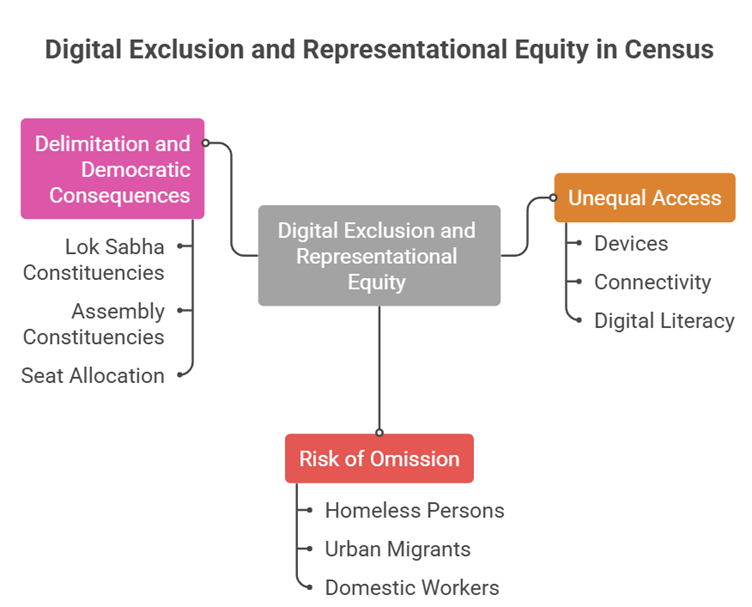
(a) Unequal access to devices, connectivity and digital literacy
- Rural populations, elderly citizens, women, tribal communities and migrant labourers remain disproportionately digitally excluded.
- Despite rising internet penetration, quality access remains highly unequal.
- This can create coverage bias, where digitally visible populations become overrepresented.
- Example: Remote habitations in Northeast India and tribal belts continue to face unstable network coverage.
(b) Risk of omission of invisible and mobile populations
- Homeless persons, urban migrants, domestic workers, hostel residents and temporary tenants are historically undercounted.
- Self-enumeration may worsen these omissions because households may ignore non-family residents.
- Such exclusions directly affect resource allocation and political representation.
- Case Study: Post-enumeration studies after earlier censuses repeatedly showed higher omission among domestic workers and distant relatives.
(c) Delimitation and democratic consequences
- Census figures determine Lok Sabha and Assembly constituency delimitation.
- Under-enumeration of migrant-heavy or NRI-heavy states can distort seat allocation.
- States such as Kerala, Punjab, Gujarat and Telangana, with significant overseas populations, may face representational distortions if non-resident linkages are inadequately captured.
- Example: Estimates indicate that Kerala’s large emigrant population could materially affect future seat calculations if excluded from demographic understanding.
- Critical Analysis
- The digital Census is not merely a technological reform; it is a constitutional governance exercise affecting representation, welfare and federal balance.
- Efficiency gains are undeniable, but technology cannot substitute institutional trust, human training and inclusive design.
- The core challenge is not whether to digitise, but how to digitise without excluding citizens or compromising reliability.
Conclusion:
- India’s digital Census marks a major leap toward modern, data-driven governance, capable of reducing delays and improving administrative precision. Yet the legitimacy of a Census rests not on technological sophistication but on universality, accuracy and public trust.
- With more than 44 crore households already participating digitally, the transition has begun well; its long-term success, however, depends on a hybrid model combining digital tools with strong field verification, intensive enumerator training, multilingual interfaces, robust post-enumeration surveys, and a clear “leave no person uncounted” principle. Only then can digital enumeration strengthen both state capacity and democratic inclusion.