
Introduction:
- Human-Wildlife Conflict (HWC) refers to situations where interactions between humans and wild animals lead to negative impacts on human life, livelihoods, property, or ecosystems, and simultaneously threaten wildlife survival. It is increasingly understood not merely as a wildlife protection issue, but as a multi-dimensional socio-ecological challenge arising from the interaction of ecological degradation, land-use change, governance gaps, and livelihood vulnerabilities.
- India, which hosts nearly 8% of global biodiversity while supporting around 18% of the world’s human population on only 4% of global land area, exemplifies this tension. Annual records indicate hundreds of human deaths in elephant encounters, thousands of livestock losses due to carnivore attacks, and rising crop depredation by species such as wild boar, nilgai, monkeys, and elephants, revealing that conflict is deeply linked to habitat fragmentation and shrinking ecological connectivity rather than isolated animal aggression.
Body:
· 1. Why Human-Wildlife Conflict is fundamentally a socio-ecological challenge
(a) Land-use change and habitat fragmentation as primary drivers
- Rapid urbanisation, infrastructure expansion, mining, railways, highways, and agricultural encroachment have fragmented forests into isolated patches, disrupting animal movement corridors and forcing wildlife into human-dominated spaces.
- India has lost substantial ecological connectivity in major landscapes such as the Central Indian tiger corridor, Western Ghats, and Northeast elephant habitats, increasing encounters.
- Example: The Wayanad–Bandipur–Nagarhole elephant landscape witnesses repeated elephant incursions due to fragmentation of traditional migratory routes.
- Case Study: Kaziranga-Karbi Anglong landscape (Assam)—highway development and settlement expansion have blocked seasonal movement, increasing elephant-human conflict.
(b) Livelihood dependence intensifies vulnerability
- Rural and tribal communities living near forests depend on fuelwood, fodder, NTFPs, and grazing, making them more exposed to wildlife encounters.
- Crop loss or livestock depredation disproportionately affects small and marginal farmers, turning ecological disturbance into an economic crisis.
- HWC therefore reflects development inequity, where those benefiting least from conservation bear the highest costs.
- Example: In parts of Odisha and Jharkhand, elephant raids disproportionately affect rain-fed paddy farmers.
- Government Initiative: Compensatory Afforestation Fund Management and Planning Authority (CAMPA) increasingly funds habitat improvement and conflict mitigation.
(c) Climate and ecological stress worsen interactions
- Climate variability, prolonged droughts, and altered rainfall reduce natural food and water availability, pushing animals toward farms and settlements.
- Seasonal shifts affect species movement; elephants increasingly raid crops because cultivated crops offer high-calorie food sources.
- Ecological imbalance—not animal “aggression”—often explains conflict.
- Example: Increased leopard sightings in peri-urban Mumbai (Sanjay Gandhi National Park) due to prey shifts and urban edge effects.
2. Impact of increasing habitat fragmentation in India
(a) Disruption of wildlife corridors
- Fragmented habitats prevent safe dispersal, breeding, and gene flow, causing ecological isolation.
- Species such as elephants, tigers, leopards, and gaur require large landscapes; fragmented habitats heighten interface zones.
- India has identified over 100 elephant corridors, many under severe anthropogenic pressure.
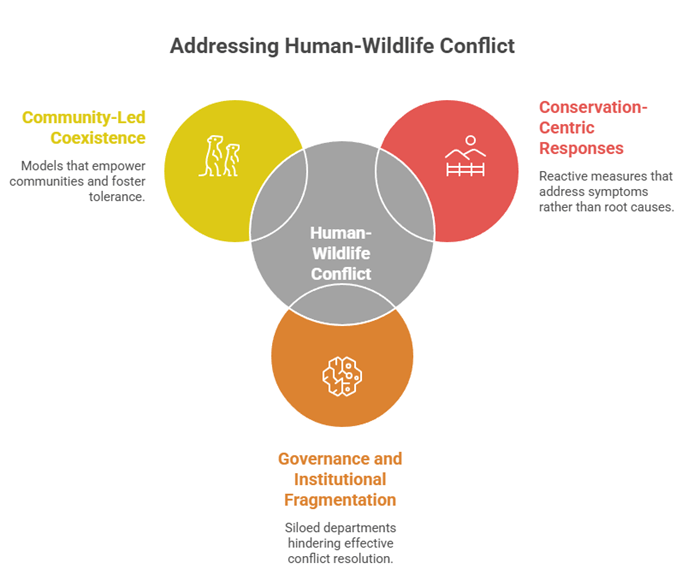
- Example: Nilgiri Elephant Corridor litigation highlighted the necessity of legally protecting movement pathways.
- Case Study: The Supreme Court-backed restoration of Nilgiri corridors reduced bottlenecks in elephant movement.
(b) Rise of edge effects and conflict zones
- Forest edges experience greater human intrusion and become hotspots of crop raiding and livestock predation.
- Expansion of monoculture plantations (tea, rubber, arecanut) creates ecological traps, attracting wildlife but failing to sustain them.
- Fragmentation creates “shared landscapes”, where boundaries between forest and habitation blur.
- Example: Leopard conflicts in Himachal Pradesh and Uttarakhand linked to expanding settlements near forest edges.
(c) Infrastructure-induced mortality and disturbance
- Roads, railways, canals, and power lines create linear intrusions through habitats.
- Wildlife mortality from train collisions, especially elephants in West Bengal and Assam, has increased.
- Noise and light pollution alter animal behaviour and migration patterns.
- Government Initiative: Eco-sensitive zone notifications and Wildlife Passages Guidelines aim to reduce such fragmentation.
- Case Study: Installation of underpasses on NH-44 in Pench landscape improved tiger and ungulate movement.
3. Critical analysis: Why viewing HWC only as a “conservation issue” is inadequate
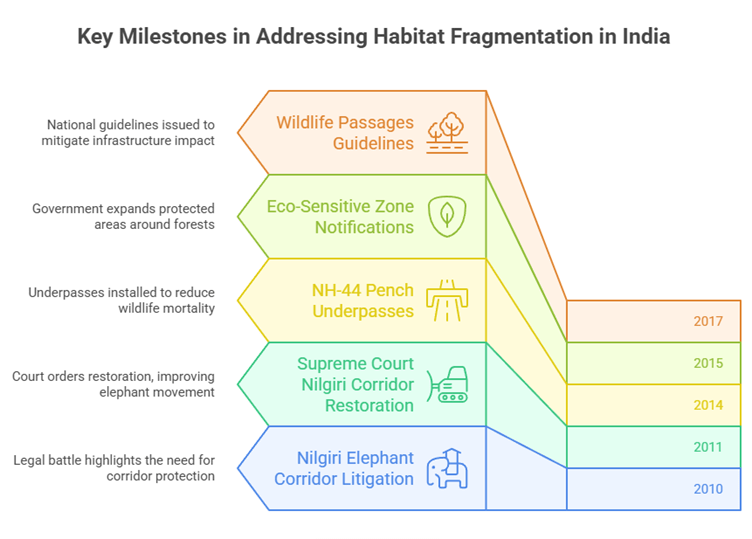
(a) Conservation-centric responses are often reactive
- Measures such as fencing, capture, relocation, or compensation treat symptoms rather than root causes.
- Relocation of “problem animals” often merely transfers conflict spatially.
- Short-term technological fixes fail without landscape planning.
- Example: Solar fencing in several states succeeded only where combined with community vigilance and corridor protection.
(b) Governance and institutional fragmentation
- Wildlife, agriculture, rural development, and infrastructure departments often work in silos.
- Conflict requires integrated landscape governance, not isolated forest department action.
- Delays in compensation reduce trust in institutions.
- Government Initiative: Project Elephant, Project Tiger, and the National Wildlife Action Plan (2017–2031) increasingly emphasize coexistence and corridor management.
- Case Study: Kerala’s rapid response teams for elephant conflict show how decentralized governance improves outcomes.
(c) Need for community-led coexistence models
- International evidence shows conflict reduces when communities gain economic incentives and decision-making power.
- Local stewardship improves legitimacy and tolerance toward wildlife.
- Indigenous knowledge can complement scientific management.
- Examples:
- Bhutan: community forest governance reduced crop damage.
- Nepal: predator-proof livestock sheds lowered snow leopard conflict.
- India: community-managed buffer zones around Periyar Tiger Reserve reduced retaliatory attitudes.
- Examples:
Government Initiative: Eco-Development Committees (EDCs) and Joint Forest Management (JFM) aim to strengthen such participation
Conclusion:
- Human-wildlife conflict in India is not an ecological anomaly; it is a predictable consequence of fragmented landscapes, unsustainable land-use decisions, and unequal development pathways. With nearly one-third of India’s districts experiencing regular wildlife conflict, the challenge demands a shift from species-centric protection to landscape-level coexistence planning.